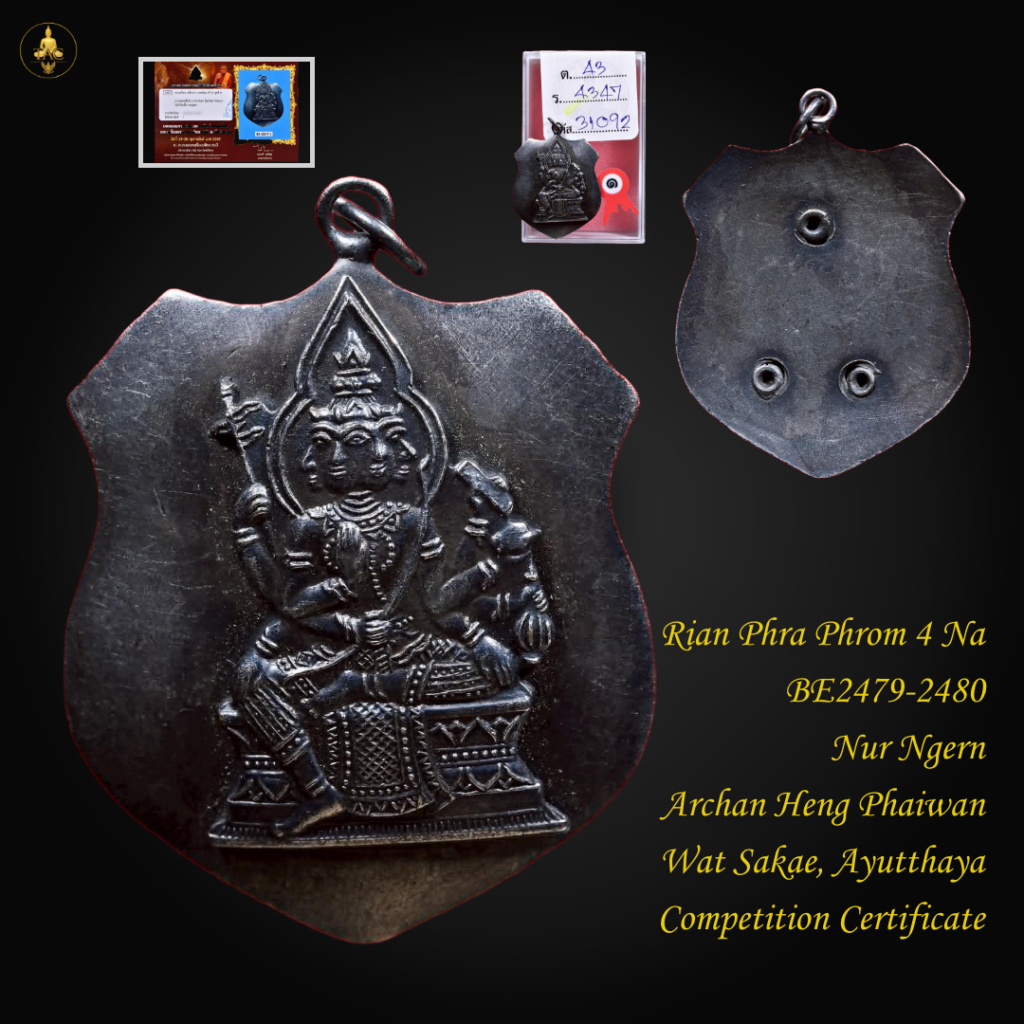

Rian Phra Phrom 4 Na BE2479-2480 Nur Ngern Archan Heng Phaiwan Wat Sakae, Ayutthaya Competition
| Type | Rian Phra Phrom 4 Na (4 Face Budhha) Pim Yai |
| Monk | Archan Heng Phaiwan |
| Temple | Ayutthaya |
| B.E. Year | 2479-2480 |
| Material | Nur Ngern |
| Condition | Good |
| Certificate | Competition |
| Competition | Won 1ST placing |
| SKU | TAC-RianPhraPhrom4Na(4FaceBudhha)PimYai-AcHengPhaiwan-001 |
Adds this amulet and the offer at the bundle price — ready at checkout. Or mention it when you enquire on WhatsApp.
Authentic Rian Phra Phrom 4 Na (4 Face Budhha) Pim Yai by Archan Heng Phaiwan, Wat Sakae Ayutthaya BE2479-2480. Nur Ngern, Competition certified.
What is the Rian Phra Phrom 4 Na (4 Face Budhha) Pim Yai by Archan Heng Phaiwan?
The Rian Phra Phrom 4 Na (4 Face Budhha) Pim Yai Archan Heng Phaiwan is a rare shield-shaped four-faced Brahma coin amulet produced at Wat Sakae, Ayutthaya in BE 2479–2480, cast entirely in Nur Ngern (silver). It carries Competition certification and is widely regarded as the most significant amulet from Archan Heng Phaiwan’s body of work.
Who is Archan Heng Phaiwan and why does this piece matter to collectors?
Archan Heng Phaiwan — also written Ajarn Heng Praiwan — is broadly recognised as the foremost lay practitioner in Thailand. He was ordained twice, with Luang Phor Klan serving as his preceptor, and his circle of disciples included individuals who later rose to considerable prominence across many fields.
Among everything he produced, the four-faced Brahma coin is the piece his name is most closely tied to. The reverse of the Rian Phra Phrom 4 Na (4 Face Budhha) Pim Yai Archan Heng Phaiwan carries his full handwritten inscription, rendered with intricate detail. That inscription is not a printed facsimile — it is his personal mark on every piece, which is exactly why authentication panels treat it as a primary reference point.
The consecration combined Buddhist and Brahmanical rituals, a dual-tradition ceremony that sets this piece apart from standard Buddhist coin amulets. Luang Pu Si of Wat Sakae presided over the Buddhist ceremonial component, lending the temple’s authority directly to the production. That combination of a senior abbot’s involvement and Archan Heng Phaiwan’s own Brahmanical practice gives this amulet an unusually layered consecration history.
Nur Ngern, the Pim Yai form, and what to look for when authenticating
Nur ngern (silver) is the material here — front and reverse both cast in silver, with no mixed-metal composition. This example is described as mint and unused, which for a piece produced in BE 2479–2480 is genuinely uncommon. Most circulated examples from this era show at least some wear from decades of use.
The pim yai (large mould) designation refers specifically to the shield or arm shape of this coin. Within the Phra Phrom series associated with Archan Heng Phaiwan, the pim yai is considered the rarer of the mould types. The obverse depicts Phra Phrom with four faces — the four-na (4 Na) form — following Brahmanical iconography of Brahma simultaneously facing all directions.
For collectors working through authentication, the key reference points are:
- Pim shape: The shield profile of the pim yai is distinct and should match documented reference pieces from BE 2479–2480.
- Reverse inscription: Archan Heng Phaiwan’s full handwritten inscription must be present and consistent with verified examples — line spacing, character form, and stroke depth all matter here.
- Nuea: Silver composition throughout; surface patina on genuine pieces from this era is consistent and not artificially induced.
- Competition certificate: This piece carries Competition certification, the level of authentication that requires review by an expert panel. A certificate should accompany any serious transaction.
For broader context on how Thai amulet authentication developed alongside devotional practice, the Thai Buddhist amulet tradition traces its roots through both Theravāda Buddhism and ancient Brahmanical influence — the dual consecration of this piece sits squarely within that framework.
What collectors traditionally carry this piece for
The four-faced Brahma form carries specific associations in Thai and regional Buddhist-Brahmanical tradition. Collectors and devotees associate the four-na iconography with metta (compassion) and maha niyom (universal goodwill) — the idea being that Phra Phrom’s simultaneous gaze in all directions draws goodwill from every quarter.
Beyond metta, this amulet is traditionally carried for prosperity, business success, and what the tradition describes as comprehensive protection — including invincibility and invulnerability from harm. The dual Buddhist-Brahmanical consecration is what practitioners point to when explaining that last association. These are the beliefs held within the tradition; they are not claims TAC makes about outcomes.
Created in BE 2479–2480, this silver Rian Phra Phrom 4 Na is widely regarded as Archan Heng Phaiwan's most important and representative work — a distinction that places it firmly among the upper tier of mid-era Ayutthaya amulets sought by serious collectors. What elevates this particular example beyond its historical age is the dual Buddhist-Brahmanical consecration and, critically, Archan Heng Phaiwan's own handwritten inscription on the reverse, which functions simultaneously as authentication marker and direct personal artefact of the master. We at TAC consider Competition-certified pieces of this type genuinely difficult to source, and would recommend it to collectors building a focused study of prominent lay-practitioner masters or pre-war Ayutthaya silver coin amulets.
Attributes reflect Thai Buddhist devotional tradition and are not measurable claims.