Miracles of Luang Pu Samret Lun
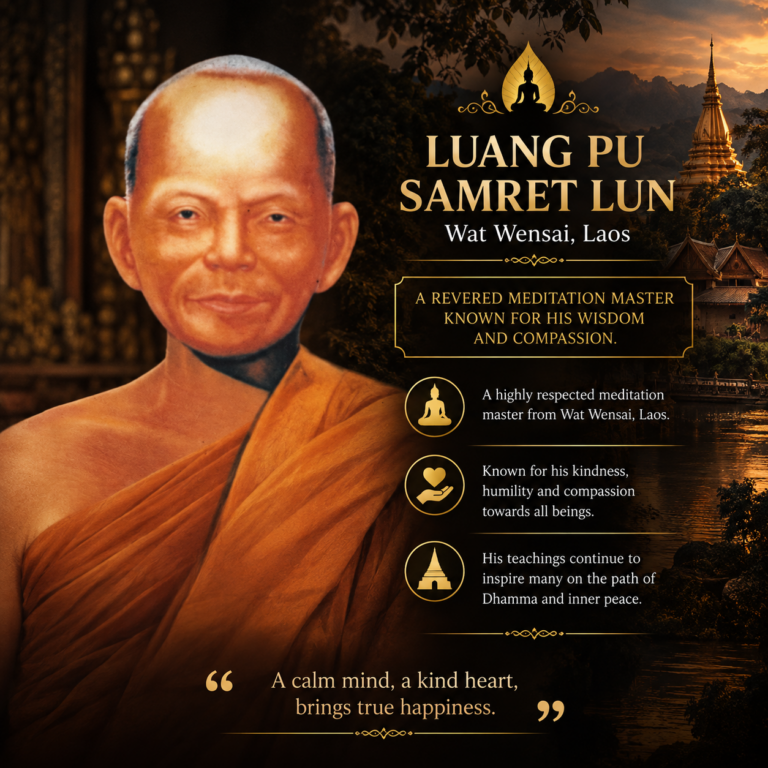
Luang Pu Samret Lun (หลวงปู่สำเร็จลุน) was a supremely venerated Lao Buddhist monk of Wat Ban Wensai (วัดบ้านเวินไซ), Phon Thong District, Champasak Province, Laos, whose birth year is not widely documented in English sources. Revered across Champasak and neighbouring regions, he bore the honorary title Samret Lun — the highest monastic rank bestowed by villagers upon one they believed had attained enlightenment — a distinction held by no other monk in Laos. Read more ↓
Biography
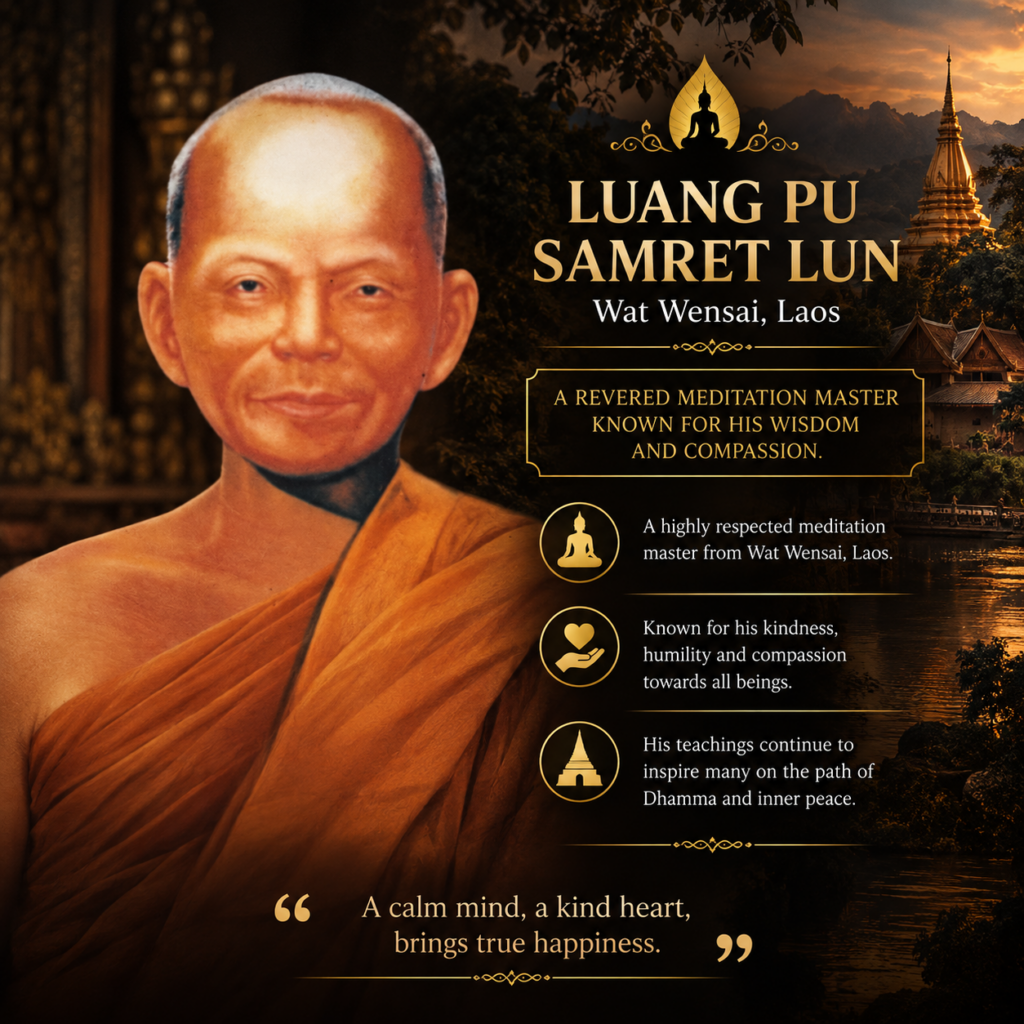
Who Was Luang Pu Samret Lun?
Luang Pu Samret Lun (หลวงปู่สำเร็จลุน) was a supremely venerated Lao Buddhist monk of Wat Ban Wensai (วัดบ้านเวินไซ), Phon Thong District, Champasak Province, Laos, whose birth year is not widely documented in English sources. Revered across Champasak and neighbouring regions, he bore the honorary title Samret Lun — the highest monastic rank bestowed by villagers upon one they believed had attained enlightenment — a distinction held by no other monk in Laos.
Early Life and Ordination
The precise birth year of Luang Pu Samret Lun (หลวงปู่สำเร็จลุน) is not widely documented in English sources, and the records that do survive are largely preserved in Lao and Thai oral tradition rather than formal temple registries. What is consistently recalled across accounts is that he was born into the communities of the Champasak region along the Mekong River corridor, in what was then a territory contested by regional powers and eventually absorbed into the French colonial administration following the treaty of BE 2436 (AD 1893).
His family background remains partially obscured by time, though the influence of his mother is notable: she played a decisive role in compelling him to assume the abbotship of Wat Ban Wensai against his express wishes, coordinating with the village of Wensai to hold the elevation ceremony before he could refuse. This detail alone speaks to the deep esteem in which his family and community held him from an early age.
Luang Pu Samret Lun entered the monastic life and progressed through the traditional Lao ecclesiastical ranks — Yakhu, Yasa, Yathan — before being recognised at the level of Samret, the pinnacle of the village-conferred hierarchy. His ordination year is not widely documented in English sources, but oral accounts confirm that by the time colonial-era events unfolded in the late nineteenth century BE 2430s–2440s (AD 1890s), he was already a monk of considerable standing and reputation.
Spiritual Development and Practice
Luang Pu Samret Lun (หลวงปู่สำเร็จลุน) is remembered above all as a monk of extraordinary inner attainment — one whose spiritual accomplishments manifested in ways that left deep impressions on all who encountered him. His practice appears to have drawn on the forest-monk tradition prevalent along the Mekong basin, placing great emphasis on individual discipline, seclusion, and direct meditative experience rather than administrative or ceremonial prominence. Indeed, his own testimony and behaviour consistently reflected a preference for solitary wandering and personal Dharma practice over institutional life — a disposition so strong that he had to be manoeuvred into the abbotship by his mother and the Wensai community.
Among the most frequently recounted aspects of his practice is a ritual engagement with water. Accounts describe him spending extended periods washing his hands with three large buckets of water at a time, all the while muttering incantations — and bathing in the Mekong River for half the day, chanting throughout. Those close to him observed that these were among the moments when he appeared most content and most fully absorbed in his inner work. Such practices align with the broader tradition of wicha (วิชา), the sacred knowledge lineages of mainland Southeast Asia, in which water, breath, and recitation serve as vehicles for accumulating and transmitting spiritual merit.
Luang Pu Samret Lun was also credited with a profound understanding of the natural world, including the ability to comprehend the language of birds and animals — a quality traditionally associated with monks who have attained elevated states of awareness through sustained meditation. His compassion extended widely, and his teachings drew large congregations across Champasak and surrounding areas, with disciples numbering in the many hundreds throughout the province.
Major Amulet Consecrations and Ceremonies
Detailed batch records — including specific BE year of consecration, formal batch names, materials composition, and ceremony particulars — for amulets associated with Luang Pu Samret Lun are not widely documented in English sources. Collectors and researchers seeking precise production records are advised to consult Thai- and Lao-language temple sources at Wat Ban Wensai, Phon Thong District, Champasak, directly.
Within the broader collector community, amulets attributed to Luang Pu Samret Lun are most commonly encountered as roop muean (รูปเหมือน, likeness effigies) and small votive tablets, reflecting his status as a revered abbot and spiritual master rather than a prolific amulet-production institution. Given that his monastic career unfolded in late nineteenth- and early twentieth-century Laos — during and after the French colonial reorganisation of the region — any surviving pieces from his era would be considered antique amulets of significant historical and spiritual weight. Thai Amulets Collection will update this section as verified records are added to the database.
Legacy and Temple Significance
The legacy of Luang Pu Samret Lun (หลวงปู่สำเร็จลุน) rests on several interlocking foundations: his miraculous reputation, his extraordinary title, his compassionate teaching, and the living memory preserved by the communities of Champasak and the surrounding Mekong region.
The title Samret Lun (สำเร็จลุน) itself is his most enduring monument. Unlike formal ecclesiastical appointments conferred by the Sangha hierarchy, this designation emerged organically from the conviction of the people — villagers and townspeople of Champasak who witnessed his conduct, his miracles, and his attainment, and who collectively determined that no existing rank adequately described him. Oral tradition holds that no other monk in Laos has ever held this specific distinction, making Luang Pu Samret Lun a singular figure in the religious history of the country.
Wat Ban Wensai (วัดบ้านเวินไซ) in Phon Thong District remains the centre of his veneration. The white building associated with his younger brother — where Luang Pu Samret Lun frequently rested when travelling from Champasak, and where multiple witnesses reported bilocation phenomena, seeing him present both at distant ceremonies and resting at home simultaneously — continues to hold significance for devotees. Teacher Wan Komanee, who encountered Luang Pu Samret Lun as a child of nine or ten years old, recalled him as a tall, thin man who once personally gave him an amulet, a memory that encapsulates the intimate, community-embedded nature of his spiritual presence. Annual merit-making ceremonies and ongoing veneration at the temple sustain his memory for new generations of devotees across Laos, Thailand, and the wider collector community.