Luang Phor Chaem – Indochin War Monk
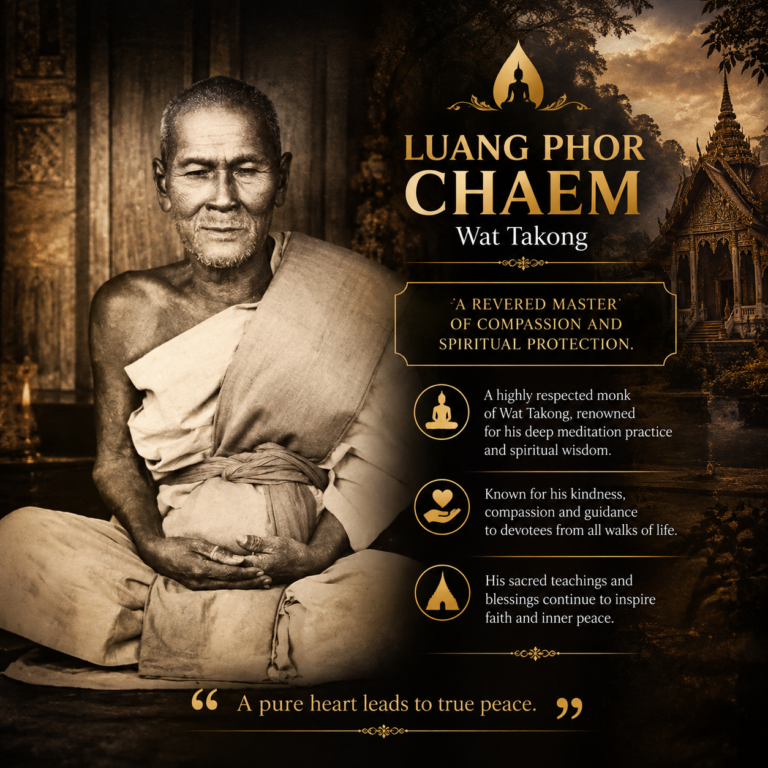
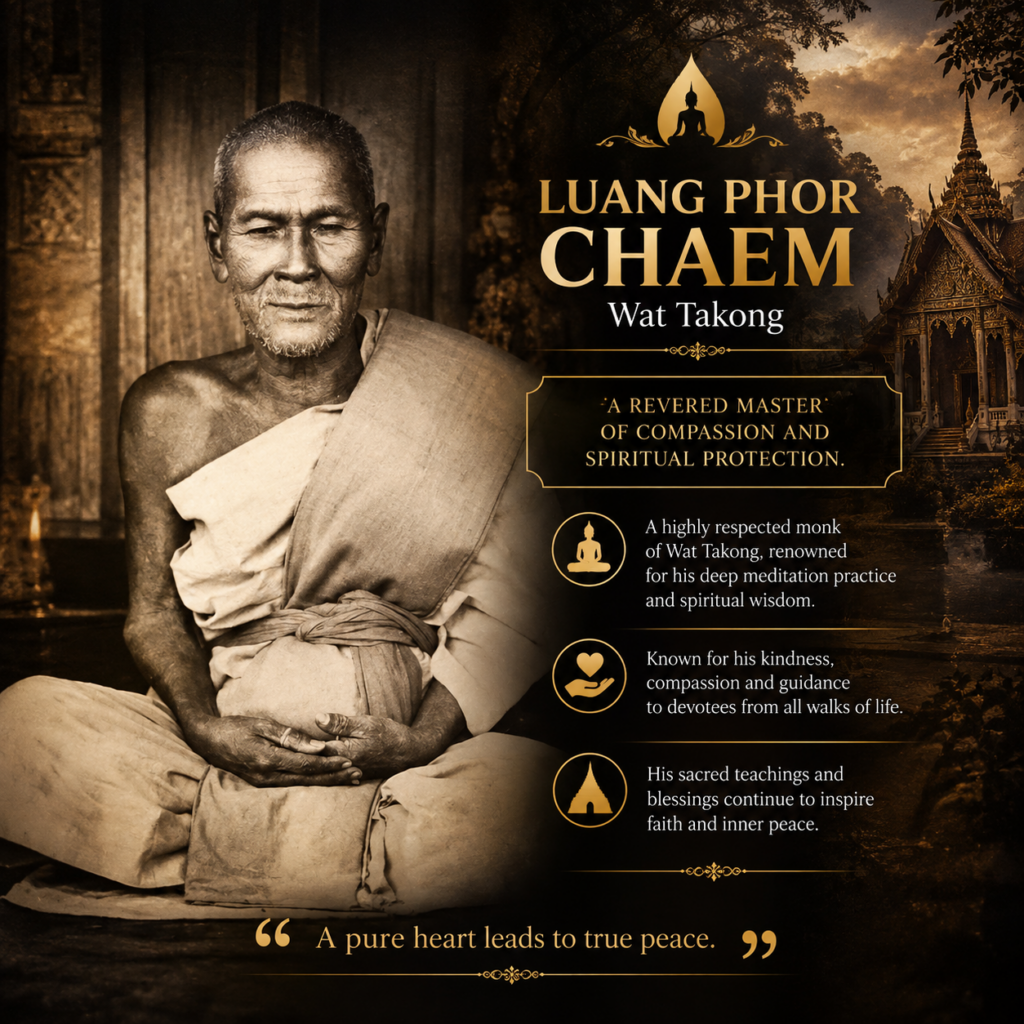
Luang Phor Chaem (หลวงพ่อแฉ่ม), full monastic name Luang Phor Chaem Inthochoto (หลวงพ่อแฉ่ม อินทโชโต), was born in BE 2405 (AD 1862) in Takong Subdistrict, Nakhon Pathom Province, and served as abbot of Wat Takong (วัดตากอง), Nakhon Pathom. He is celebrated as the originator of the iconic crossed-guns amulet and is revered for his extraordinary knowledge of occult and Buddhist sacred sciences. Read more ↓
Amulets by Luang Phor Chaem – Indochin War Monk 1 total · 1 available
Biography
Who Was Luang Phor Chaem?
Luang Phor Chaem (หลวงพ่อแฉ่ม), full monastic name Luang Phor Chaem Inthochoto (หลวงพ่อแฉ่ม อินทโชโต), was born in BE 2405 (AD 1862) in Takong Subdistrict, Nakhon Pathom Province, and served as abbot of Wat Takong (วัดตากอง), Nakhon Pathom. He is celebrated as the originator of the iconic crossed-guns amulet and is revered for his extraordinary knowledge of occult and Buddhist sacred sciences.
Early Life and Ordination
Luang Phor Chaem Inthochoto (หลวงพ่อแฉ่ม อินทโชโต) was born in BE 2405 (AD 1862) in Takong Subdistrict, Mueang District, Nakhon Pathom Province — a district that was then officially recorded as Phra Pathom Chedi District. He grew up along the celebrated Nakhon Chai Si river basin, a region that has historically produced some of Thailand’s most revered Buddhist masters.
In his youth, Luang Phor Chaem pursued both Thai and Khmer languages under the tutelage of Phra Ajarn Joi of Wat Don Chedi (วัดดอนเจดีย์), a distinguished master of occult sciences who imparted a wide range of esoteric knowledge and secrets to the young student until he had mastered them fully.
Upon reaching the age of ordination, he returned to his birthplace to receive the robe at Wat Takong (วัดตากอง), with Luang Pho Tha (หลวงพ่อท้า), the revered abbot of Wat Phaneng Taek (วัดพเนียงแตก), serving as his preceptor. He received the monastic name Inthochoto (อินทโชโต) and subsequently followed his preceptor to reside at Wat Phaneng Taek, where he would begin the long and rigorous spiritual formation that would define his entire monastic career.
Spiritual Development and Practice
Under Luang Pho Tha (หลวงพ่อท้า) of Wat Phaneng Taek (วัดพเนียงแตก), Luang Phor Chaem demonstrated an unwavering dedication and eagerness to learn that enabled him to master every subject his preceptor taught. Luang Pho Tha was himself a renowned and highly respected monk throughout Nakhon Pathom Province, celebrated for his skill in Vipassanā (วิปัสสนา) meditation and his formidable spiritual power — qualities that passed directly to his devoted student.
Seeking to deepen his knowledge further, Luang Phor Chaem became a disciple of Luang Pu Boon (หลวงปู่บุญ), the esteemed abbot of Wat Klang Bang Kaeo (วัดกลางบางแก้ว) in Nakhon Pathom Province, studying additional disciplines under his guidance.
With the blessing of his preceptor, he then undertook a demanding dhutanga-style pilgrimage entirely on foot — refusing any vehicle, boat, ox cart, elephant, or horse — travelling all the way to Burma, where he studied various esoteric disciplines under Burmese masters, before returning through Kanchanaburi and Suphanburi provinces back to Nakhon Pathom. When he returned to Wat Phaneng Taek, Luang Pho Tha received him warmly and said: “It is difficult to be born as a human, difficult to become a monk, and even difficult to go on a pilgrimage after ordination. You have not been born in vain. Our Buddhist religion will not decline with a monk like you.” This period of cross-border spiritual training gave Luang Phor Chaem a rare synthesis of Thai, Khmer, and Burmese sacred sciences — a breadth of knowledge that would later manifest in the extraordinary diversity of his consecrated objects. He was also a contemporary of luminaries such as Luang Phor Kong of Wat Bangkaphom (หลวงพ่อคง วัดบางกะพ้อม), Luang Phor Jad of Wat Bangkabeo (หลวงพ่อจาด วัดบางกะเบา), Luang Phor Jong of Wat Na Tang Nok (หลวงพ่อจง วัดหน้าต่างนอก), Luang Phor Ee of Wat Sattahip (หลวงพ่ออี๋ วัดสัตหีบ), and Kruba Sriwichai (ครูบาศรีวิชัย).
Major Amulet Consecrations and Ceremonies
Luang Phor Chaem’s sacred objects span several decades and cover a remarkable variety of forms, all united by his reputation for granting kong krapan (คงกระพัน) — invulnerability to weapons and protection from harm. The following are the principal amulet batches known to collectors, drawn from Thai-language sources and devotee records.
BE 2484 (AD 1941) — First Edition Rian Luang Phor Chaem (เหรียญรุ่นแรกหลวงพ่อแฉ่ม)
This is unquestionably the most celebrated creation in Luang Phor Chaem’s entire legacy. Produced in BE 2484 (AD 1941) during the Great East Asian War — the period when Japanese forces invaded Thailand — this coin amulet was consecrated with the explicit purpose of protecting Thai soldiers and civilians from the violence of armed conflict. Devotees and collectors attribute its fame precisely to this wartime context, believing that its protective spiritual force is exceptional.
- Material: Copper, available in both blackened (dam) and unblackened (thong daeng) versions, with an integrated hanging loop.
- Shape: Distinctively serrated edge featuring 16 sharp notches corresponding to the Sixteen Auspicious Signs of the Buddha (Sipsong Buddhakhun — สิบหกพระพุทธคุณ). This unusual form sets it apart from the predominantly oval or shield-shaped coins of contemporary monks. Collectors also call it the “Lotus Fan Coin” (เหรียญพัดโบก) or “Chakra Coin” (เหรียญจักร).
- Obverse (front face): At the centre is a seated image of Luang Phor Chaem, fully draped in monastic robes. His left hand is raised with the Khmer character “Na” (นะ) inscribed on his palm. Notably, he sits not on a throne or pedestal but directly above a pair of crossed guns — a powerful occult symbol representing the subduing of weapons, also known as “cutting off the name”. A Khmer script character “A” (อะ) appears on his chest. Around the image, Thai lettering reads “Luang Pho Chaem, Wat Takong” (หลวงพ่อแฉ่ม วัดตากอง), and encircling this are the words “Na Mo Phut Tha Ya” (นะ โม พุท ธา ยะ). Within the 16 notches are the abbreviated names of the Sixteen Buddhas: “Na Ma Na A Nok O Na Ka Ko O No A Na A Ka Am.”
- Two sub-types: The first edition is further divided into the single-ear type (หูเดียว) — where only the right ear of Luang Phor Chaem is visible — and the double-ear type (สองหู), where both ears appear as normal. The single-ear variant is considerably rarer and commands a higher price in the collector market.
- Collector significance: Widely regarded as one of the finest wartime protective amulets of the Indochina and Great East Asian War eras. Its invulnerability lore, distinctive 16-notch design, and extreme scarcity make it one of the most prized coins among Nakhon Pathom collector circles.
BE 2485 (AD 1942) — Amulet Coin of BE 2485 (เหรียญปี ๒๔๘๕)
A subsequent coin issue produced in BE 2485 (AD 1942), one year after the celebrated first edition. While less documented in English-language sources, this batch is recognised among Thai collectors as another significant consecration from Luang Phor Chaem’s productive wartime period.
Additional Sacred Objects
Beyond his coin amulets, Luang Phor Chaem created a diverse range of sacred objects whose spiritual power is revered by devotees across central Thailand. These include:
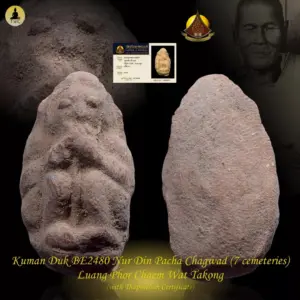
- Clay Buddha image with a drum-like face (phra phim na glawng — พระพิมพ์หน้ากลอง) — a uniquely shaped pressed-clay image bearing Luang Phor Chaem’s characteristic facial mould.
- Phra Khun Phaen amulet with a drum-like face (พระขุนแผนหน้ากลอง) — highly sought after for its blend of Khun Phaen charm and Luang Phor Chaem’s kong krapan specialisation.
- Phra Phlai Phet amulet (พระไพลเพชร) — produced from a mixture of sacred powder and clay incorporating the drum-face mould.
- Mercury-filled amulets (takrut plod nee type with mercury enclosure) — prized for powerful protective properties.
- Talismanic cloths and textiles, including pha yant flags (ผ้ายันต์), amulet shirts (suea yant — เสื้อยันต์), amulet handkerchiefs for popularity (pha chet mue maha niyom), and red protective cloths (pha daeng).
- Amulets made from alms bowl lids (takrut fha bat — ตะกรุดฝาบาตร) — a rare material form that underscores his creative and unconventional approach to sacred object production.
Collectors and devotees note that all categories of Luang Phor Chaem’s sacred objects are now extremely difficult to find or acquire, as their owners cherish them deeply and rarely part with them. Detailed batch records for later or minor editions require consultation of Thai-language temple archives and specialist amulet society publications.
Legacy and Temple Significance
Luang Phor Chaem Inthochoto (หลวงพ่อแฉ่ม อินทโชโต) passed away in BE 2490 (AD 1947) at the age of 85, having been ordained for an extraordinary 65 years. His passing marked the end of an era for the Nakhon Chai Si river basin’s monastic community — a community that had produced some of the most celebrated Buddhist masters in central Thailand’s history during the late 19th and early 20th centuries.
Wat Takong (วัดตากอง) in Nakhon Pathom Province remains the spiritual centre of his legacy. The temple is associated in the collector world primarily with Luang Phor Chaem’s distinctive crossed-guns iconography — a symbol that has since become inseparable from his identity and is instantly recognised among amulet enthusiasts across Thailand, Singapore, Malaysia, Hong Kong, Taiwan, and mainland China.
His story also carries a remarkable human dimension: despite facing formal complaints from fellow monks who accused him of eccentric conduct — including allegations that he refused communal chanting, did not attend Patimokkha recitations, and cooked like a layperson — he successfully refuted every accusation before the Abbot of Nakhon Pathom Province, ultimately emerging with his reputation not diminished but greatly enhanced. This episode is frequently recounted by devotees as evidence of his spiritual confidence and moral integrity.
Today, Luang Phor Chaem is honoured at Wat Takong through the veneration of his image and the preservation of his sacred objects. His amulets are studied and authenticated by specialist collectors and amulet societies as significant historical artefacts from the Indochina War era.
Frequently asked questions
Other monks