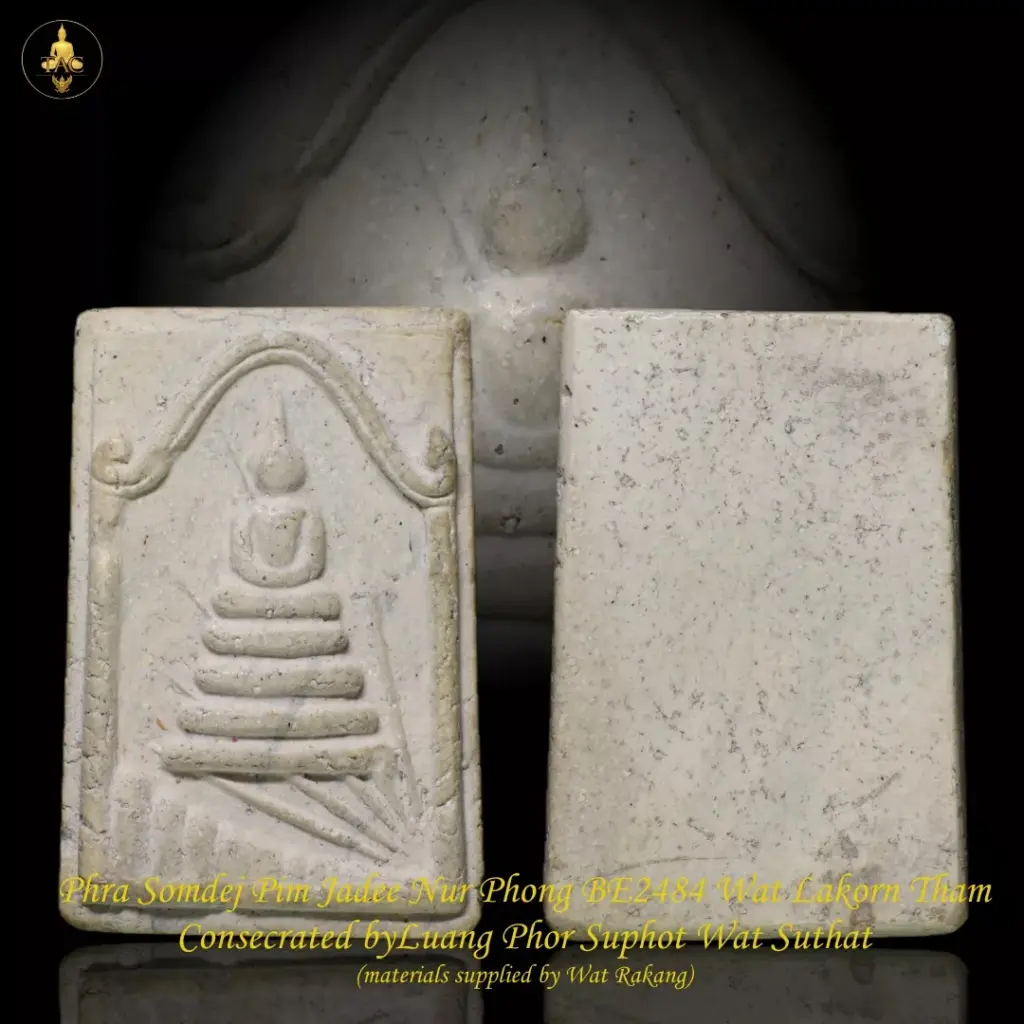
Phra Somdej Pim Jadee Nur Phong BE2484 Wat Lakorn Tham Consecrated by Luang Phor Suphot Wat Suthat
| Type | Phra Somdej |
| Monk | Luang Phor Suphot |
| Temple | Wat Lakorn Tham |
| B.E. Year | 2484 |
| Material | Phong |
| SKU | TAC-0212 |
Authentic Phra Somdej Luang Phor Suphot, Wat Lakorn Tham BE 2484. Pim Jadee nuea phong with Wat Rakhang Somdej material lineage. Consecrated at Wat Suthat.
What is the Phra Somdej Luang Phor Suphot from Wat Lakorn Tham, BE 2484?
The Phra Somdej Luang Phor Suphot dated BE 2484 (1941) is a Pim Jadee (พิมพ์เจดีย์ — pagoda-profile mould) pressed in nuea phong (เนื้อผง — sacred powder blend) and attributed to Wat Lakorn Tham. The consecration was conducted at Wat Suthat under Luang Phor Suphot, with the powder recorded as incorporating fragments of Somdej amulets sourced from Wat Rakhang.
The monk behind the powder — and why the Wat Suthat connection matters
Luang Phor Suphot was based at Wat Suthat during the time of Somdej Phra Sangkharat Pae and Phra Khru Mul. He kept a low profile publicly, but within that circle he was known for his grasp of traditional powder formulation — what collectors call phong wised (ผงวิเศษ — the classical five-powder formula) — and his deep familiarity with old manuscript methods of preparing sacred materials.
His connection to Luang Pu Nak of Wat Rakhang is the lineage point collectors consistently cite. Through that relationship, he is said to have received broken Somdej Wat Rakhang amulets. In the 1930s and 1940s, those fragments held devotional weight, not market value. Devotees returning damaged pieces to temples was normal practice. Luang Phor Suphot reportedly ground these fragments fine and folded them into new presses — following the older principle that sacred material should be respectfully reconstituted rather than discarded.
Permission to include these pieces in broader consecrations is said to have been sought from Somdej Phra Sangkharat Pae. After blessing, many were distributed to soldiers, police officers, and civil servants during the Indochina period. Accounts say he continued giving them out until none remained. His name appears later in connection with several significant ceremonies: the Twenty-Five Buddhist Century blessings, the Wat Prasat ceremony of 1963 — remembered for the unusually wide assembly of masters it gathered — and a Chonburi provincial consecration in 1966.
Reading the nuea and the pim — what the powder carries
Nuea phong pieces from this era are assessed through powder texture, surface ageing tone, press definition, and how the mould character holds after decades. The Pim Jadee profile — the pagoda-shaped impression — is the specific pim (มพิ์ — mould collectors authenticate against) for this piece. Both front impression clarity and the back surface’s settling pattern give collectors their primary reading points.
The recorded material story adds a layer most phong pieces from this period cannot claim. Exact ratios of Wat Rakhang Somdej material in the blend cannot be verified today, but the lineage note — Luang Phor Suphot, Luang Pu Nak of Wat Rakhang, and the Wat Suthat consecration environment — is what drives collector interest in this run. That three-layer framework is how serious collectors frame it:
- Material lineage: Wat Rakhang Somdej fragments (phong gao — old sacred powder admixture) incorporated into the blend, as recorded in collector tradition.
- Ritual environment: Consecration at Wat Suthat under Luang Phor Suphot, with reported sanction from Somdej Phra Sangkharat Pae.
- Historical context: Indochina-period BE 2484, with distribution linked to wartime service groups — a circulation story that limits surviving examples in good condition.
For a broader look at how sacred powder amulets fit into Thai devotional history, the Thai Buddhist amulet tradition article gives useful background on phong-type construction and the role of temple lineage in authentication.
What collectors look for — and the certificate question
Pieces from BE 2484 have had over eighty years to develop their surface character. With nuea phong, collectors watch for consistent powder ageing across the face, no signs of artificial surface treatment, and press definition that matches the known Pim Jadee impression. Some pieces from Luang Phor Suphot’s line show mantra-style stamps on the reverse — described by collectors as Phut Son or Tri Yantra-like markings — while others are left plain. Both are documented within this group.
No certificate issuer is recorded for this piece. For collectors used to certified pieces, the authentication work falls on material reading, lineage documentation, and comparison against known reference examples — the standard approach for Indochina-era phong amulets where formal certification was not yet common practice.
We at TAC acquired this Phra Somdej Luang Phor Suphot as part of our ongoing effort to document Indochina-era phong pieces with traceable lineage records. The Wat Rakhang material note and the Wat Suthat consecration attribution are what make this piece worth a collector's attention — not many BE 2484 powder Somdej pieces come with that specific a provenance story. No certificate is attached, so your material reading notes here will carry significant weight for the buyer.
Attributes reflect Thai Buddhist devotional tradition and are not measurable claims.