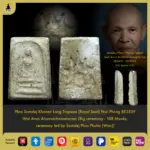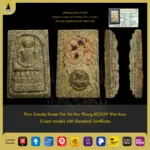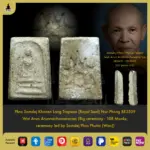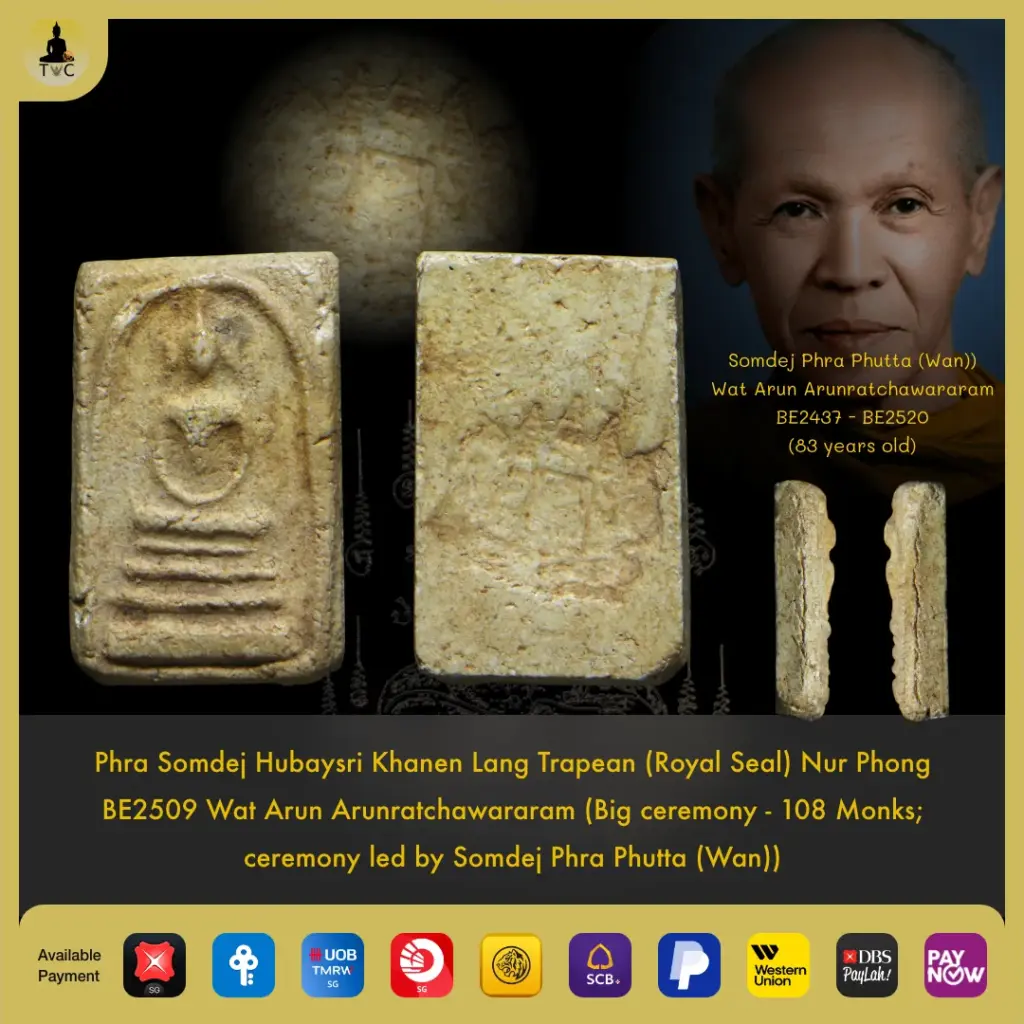
Phra Somdej Khanen Lang Trapean (Royal Seal) Nur Phong BE2509 Wat Arun (Big ceremony – 108 Monks; led by Somdej Phra Phutta (Wan))
| Type | Phra Somdej |
| Monk | Somdej Phra Phutta Wan |
| Temple | Wat Arun |
| B.E. Year | 2509 |
| Material | Phong |
| SKU | TAC-0484 |
Authentic Phra Somdej by Somdej Phra Phutta Wan, Wat Arun BE 2509. Royal Seal edition pressed from phong, consecrated by 108 monks. Singapore dealer TAC.
What is the Phra Somdej Khanen Lang Trapean by Somdej Phra Phutta Wan, Wat Arun BE 2509?
The Phra Somdej Somdej Phra Phutta Wan, Wat Arun BE 2509 — known among collectors as the Khanen Lang Trapean or Royal Seal edition — was consecrated at the Ubosot of Wat Arun Ratchawararam in 1966. Pressed from phong (sacred powder blend) incorporating fragments of three landmark Somdej amulets, it was blessed at a grand pluk sek (consecration ceremony) led by Somdej Phra Phutta Wan with 108 eminent monks in attendance.
The ceremony behind this edition — and why 108 monks matter
The pluk sek for this edition was held inside the Ubosot of Wat Arun, one of Bangkok’s most recognisable riverside temples and a site with deep royal and Buddhist significance. Somdej Phra Phutta Wan, then abbot of Wat Arun, presided over the event. The assembly of 108 monks was drawn from temples across Thailand, each selected for their mastery of Dhamma practice and wicha (esoteric knowledge).
A detail that collectors often cite: Phra Chao Khun Nararat Rachamanit of Wat Thepsirin was unable to attend in person but is said to have directed his meditative concentration toward the ceremony remotely — making him, in spirit, the 109th participant. Whether one takes that literally or not, it speaks to the esteem in which this consecration was held by the senior sangha of the era.
Among the monks who physically attended were Luang Pho Ngern (Wat Don Yai Hom, Nakhon Pathom), Luang Pu Nak (Wat Rakhang, Bangkok), Luang Pho Thong (Wat Chakkrawat), Luang Pu Thian (Wat Bot, Pathum Thani), Luang Pho Nuea (Chulamani Temple), Luang Pho Tae Kongthong (Sam Ngam Temple), Luang Pho Tan (Tham Sen Temple), and Luang Pu Thiam (Kasatrathirat Temple). That is a serious cross-section of the most respected monks active in Thailand at the time.
What went into the phong — and what the Royal Seal tells you
The muan sarn (sacred powder blend) for this edition is unusually well-documented. The base material incorporates ground fragments from three of the most historically significant Phra Somdej amulets in the Thai Buddhist amulet tradition: Phra Somdej Wat Rakhang, Phra Somdej Wat Bang Khun Phrom, and Phra Somdej Wat Ket Chaiyo. To understand why that matters, see the broader context of the Thai Buddhist amulet tradition.
Beyond those foundational fragments, the phong also draws on sacred powders from Wat Plab, Wat Tai Talat, and Wat Amphawa, incense powder from worship rituals, soil from four Buddhist pilgrimage sites, and a formulation said to include over 400 types of herbs and 108 types of flower pollen. The entire batch was prepared to commemorate the 100th anniversary of Somdej Phra Buddhacarya (To) Phromrangsi — the monk most associated with the original Phra Somdej lineage.
Every piece in this run carries a small royal seal (trapean) impressed on the reverse face. That seal is the primary pim (mould/authentication marker) collectors check first. The edition was also consecrated alongside a set of sacred coins from the same period: a small round coin bearing the Buddha image with Wat Arun’s prang on the reverse (created 1965), and a coin depicting King Taksin the Great distinguished by a Thai numeral “1” beneath the base.
What collectors look for when authenticating this piece
Because the muan sarn is powder-based, surface texture and aged patina on genuine pieces differ noticeably from later reproductions. The phong on an original BE 2509 piece will show natural settling and micro-surface variation consistent with nearly six decades of age. Fakes tend to present with overly uniform texture or artificially applied discolouration.
- Royal seal impression: Check sharpness and depth — the trapean on genuine pieces is cleanly struck, not smeared or shallow.
- Phong surface: Look for natural aged texture; the powder should appear consolidated, not chalky or artificially dried.
- Pim consistency: Cross-reference the front face mould against documented reference pieces from the Wat Arun BE 2509 edition.
- Associated coins: Pieces acquired with the original consecration-period coins (particularly the Taksin coin with Thai numeral “1”) provide useful provenance context.
No certificate is noted for this listing. Buyers should factor that into their own authentication process and, where possible, cross-reference against established niyom (collector-standard reference) examples.
We at TAC consider the Wat Arun BE 2509 Royal Seal edition one of the more historically well-documented mid-century Phra Somdej runs — the pluk sek record naming 108 attending monks, led by Somdej Phra Phutta Wan as abbot, is a level of documentation you rarely see for this period. The muan sarn lineage — incorporating fragments of Wat Rakhang, Wat Bang Khun Phrom, and Wat Ket Chaiyo Somdej pieces — gives this edition genuine weight in the collector market beyond its age alone. No certificate accompanies this piece, so do flag that clearly for the buyer and recommend they cross-reference against niyom reference examples before committing.
Attributes reflect Thai Buddhist devotional tradition and are not measurable claims.