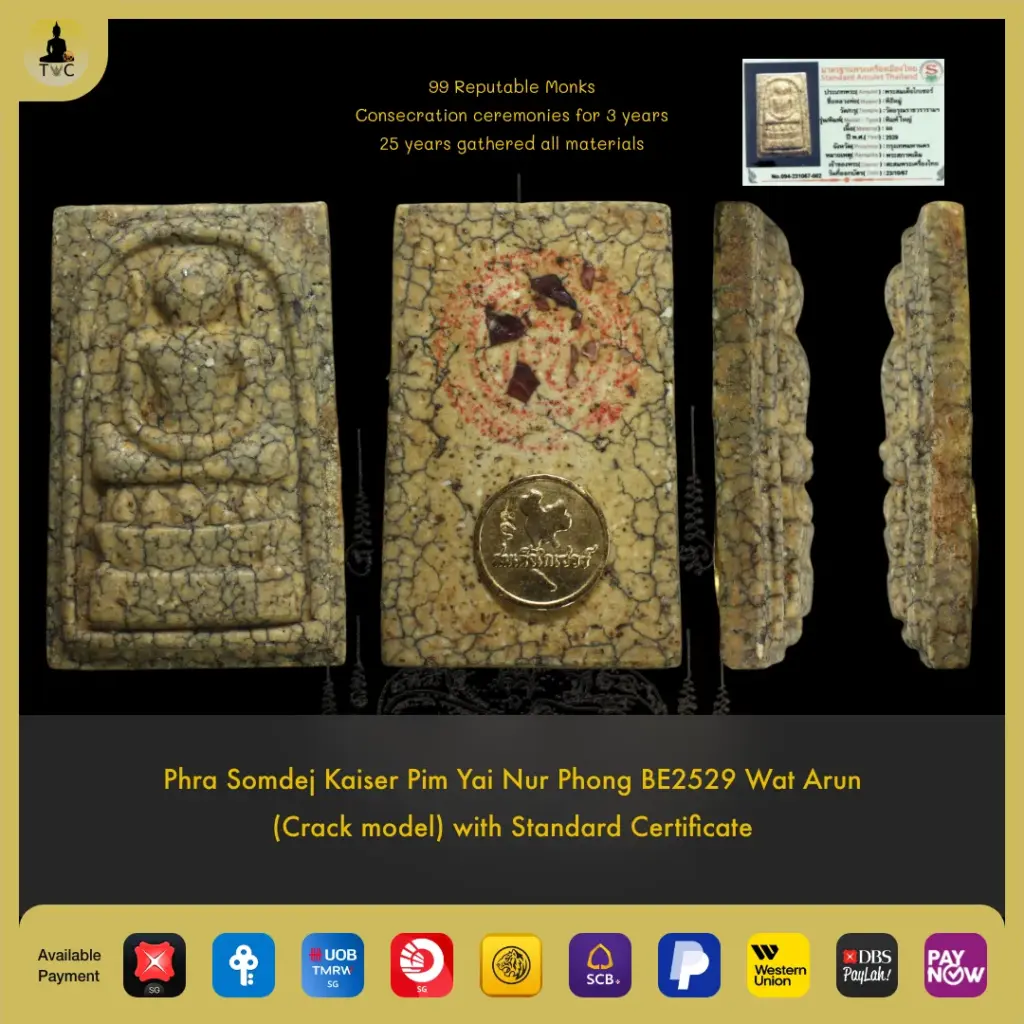
Phra Somdej Kaiser Pim Yai Nur Phong BE2529 Wat Arun Ratchawararam “Crack Model”
| Temple | Wat Arun |
| B.E. Year | 2529 |
| Material | Phong |
| SKU | TAC-0485 |
Authentic Phra Somdej Kaiser Pim Yai Nur Phong BE2529 Wat Arun Ratchawararam "Crack Model" from Wat Arun, Bangkok. Aged phong, natural fissures, Pim Yai form.
What is the Phra Somdej Kaiser Pim Yai Nur Phong BE2529 Wat Arun Ratchawararam “Crack Model”?
The Phra Somdej Kaiser Pim Yai Nur Phong BE2529 Wat Arun Ratchawararam “Crack Model” is a classical Somdej-form amulet pressed in phong (sacred powder blend) and issued by Wat Arun Ratchawararam, Bangkok, in Buddhist Era 2529. Collectors recognise it by its large pim (mould), settled ivory powder surface, and the natural stress fissures that give the piece its “Crack Model” name.
Why Wat Arun and why this pim matters
Wat Arun sits on the west bank of the Chao Phraya in Bangkok and is one of Thailand’s most historically significant royal temples. Amulets issued under its name carry institutional weight that collectors across the region — Singapore, Malaysia, Taiwan, Hong Kong — treat as a meaningful provenance marker, not just a label.
The pim here is Pim Yai, meaning the large mould format within the Somdej typology. The Buddha figure sits upright on a tiered throne, shoulders square, base broad. Collectors reading the pim look at shoulder slope, the spacing between throne tiers, and the symmetry of the arch above the figure. A well-struck Pim Yai from a temple-controlled release holds its geometry cleanly, and that geometry is the first thing an experienced eye checks. For broader context on how mould analysis fits into authentication, the Thai Buddhist amulet tradition article on Wikipedia gives a useful starting point.
BE2529 falls in the mid-1980s, placing this piece at roughly four decades of age. That matters for phong pieces specifically, because time is what separates genuine aged powder behaviour from modern imitation.
Reading the nuea — what forty years does to Nur Phong
Nuea (material/substance) is how collectors shorthand the powder composition of a piece, and this one is Nur Phong — phong pressed from chalk-based sacred powders, temple residue, and binding agents blessed during consecration. Over decades, genuine Nur Phong settles into a matte, off-white to ivory tone. It does not develop a resin gloss. The surface softens slightly, and internal compression produces stress lines that run with the grain of the material rather than across it.
Those stress lines are the “Crack Model” detail. In collector circles, naturally formed fissures on aged phong are a positive sign, not damage. They read differently from artificially induced cracking — the lines are shallower, more organic in direction, and consistent with long-term drying under normal storage conditions.
- Surface finish: matte, no shine, no applied coating
- Colour: muted off-white to ivory, consistent with aged Somdej powder
- Fissures: natural stress lines from compression and drying over decades, not surface damage
- Density: solid feel in hand, not chalky or crumbling at edges
These are the material cues a collector cross-references against reference books and committee specimens when assessing a piece like this.
What to know before buying — authenticity and certification
This piece is attributed to Wat Arun Ratchawararam based on temple release records and established collector references within the Somdej tradition. Authentication rests on pim geometry, nuea character, and age-consistent surface behaviour — the three pillars any serious collector applies to a phong Somdej from this period.
No certificate accompanies this piece. For collectors who require a graded slab or committee card, that absence is worth factoring into the decision. For collectors comfortable reading the piece directly — and many experienced collectors prefer to — the material evidence is what stands on its own.
If you have questions about this piece, TAC can be reached via WhatsApp.
We at TAC sourced this Phra Somdej Kaiser Pim Yai Nur Phong BE2529 Wat Arun Ratchawararam "Crack Model" as a straightforward collector-grade piece from a named royal temple — Wat Arun's institutional standing is a meaningful part of the story here. The natural fissure pattern on the phong surface is what collectors call the "Crack Model" signature, and . At SGD 508, this sits at an accessible entry point for a forty-year-old Somdej phong piece from a royal Bangkok temple, and that combination of age, pim clarity, and provenance is the honest case for it.
Attributes reflect Thai Buddhist devotional tradition and are not measurable claims.