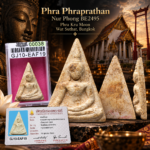
Phra Kru Pim Soom Thong Nur DIn Wat Klang Thung, Ayutthaya, Est. 400-500 years
| Temple | Wat Klang Thung |
| Material | DIn |
| SKU | TAC-0675 |
Authentic Phra Kru Pim Soom Thong Nur DIn Wat Klang Thung, Ayutthaya, Est. 400-500 years. Sacred clay kru amulet, DD-Pra certified.
What is the Phra Kru Pim Soom Thong Nur DIn Wat Klang Thung, Ayutthaya, Est. 400-500 years?
The Phra Kru Pim Soom Thong Nur DIn Wat Klang Thung, Ayutthaya, Est. 400-500 years is a sacred clay kru (temple-crypt) amulet recovered from Wat Klang Thung in Ayutthaya province. Pressed from nuea din (sacred clay), the piece carries the Pim Soom Thong mould profile and comes with DD-Pra authentication as shown in the provided photo set.
A kru piece from Ayutthaya — what the burial context means for collectors
Kru amulets are those recovered from sealed chedi chambers or buried caches, often only surfacing during temple restoration work. That interment history is what separates them from standard commissioned batches — the clay ages in situ, developing the dry warmth, micro-pitting, and soil-tone variation that experienced eyes recognise at a glance.
Two timelines circulate among collectors for this piece. One frames it as Ayutthaya-period, placing the clay at roughly 400–500 years old — the estimate reflected in this listing’s title. The other, drawn from Thai-language collector articles, points to a creation around BE 2450 with a major redistribution during temple renovations around BE 2503, following burial inside a chedi. Both narratives agree on the core fact: this is a kru-associated sacred clay amulet from Wat Klang Thung. Which timeline a collector accepts may affect how they read the surface character, but the clay behaviour itself is consistent with long-term preservation regardless of source.
Wat Klang Thung sits within the broader Thai Buddhist amulet tradition of central Thailand, a region where kru caches tied to old chedi structures have produced some of the most studied pieces in the collector circuit. Ayutthaya as a province carries obvious weight in that context.
The clay, the pim, and what you are actually looking at
The nuea here is din — sacred clay, sometimes described as din phong when ritual powders are blended into the base. Traditional preparation involves temple earth combined with ritual ingredients, then pressed into mould and dried. On older kru pieces the surface reads differently from freshly pressed clay: granularity is coarser, micro-cracks follow the natural shrinkage of the material, and the colour shifts unevenly across the face depending on how moisture moved through it during burial.
The pim is Soom Thong — a compact, grounded Buddha form that collectors in the central Thailand kru circuit recognise as a distinct mould family. Authentication against the pim means checking proportions, the rendering of the robe lines, and how the base sits. Natural age signs — patina, soil-tone variation, surface granularity — are expected and considered honest kru character, not flaws.
Key points collectors check on this piece:
- Pim Soom Thong mould proportions and robe-line rendering consistent with the recognised family
- Natural micro-pitting and surface granularity from long-term clay compression and burial
- Uneven soil-tone patina across the face — not uniform, which is the honest kru reading
- DD-Pra certificate as shown in the photo set, including database or QR verification via the DD-Pra system
Collector value and what drives the price on a piece like this
Kru caches produce uneven condition spreads — some pieces emerge relatively intact, others show heavier surface wear. Condition within the kru line matters to price, and so does how cleanly a piece reads against the pim. DD-Pra verification, shown here, adds a layer of confidence that makes the piece more transferable in secondary market transactions.
Collector belief around Pim Soom Thong generally centres on three themes: protection from harm and misfortune, maha lap (prosperity and smoother opportunities), and metta mahaniyom — the drawing of goodwill and benefactor support. The “Soom Thong” name in particular is often discussed in collector circles in connection with patron and nobleman-backing themes. These are collector traditions, not guarantees.
We acquired this Phra Kru Pim Soom Thong Nur DIn Wat Klang Thung as part of our central Thailand kru holdings — it comes with DD-Pra authentication as shown, which gives collectors a reliable reference point for this pim family. For collectors building a Ayutthaya kru section, the Soom Thong pim with third-party verification at this price point is a practical entry into a line that is genuinely difficult to find in verified condition.
Attributes reflect Thai Buddhist devotional tradition and are not measurable claims.