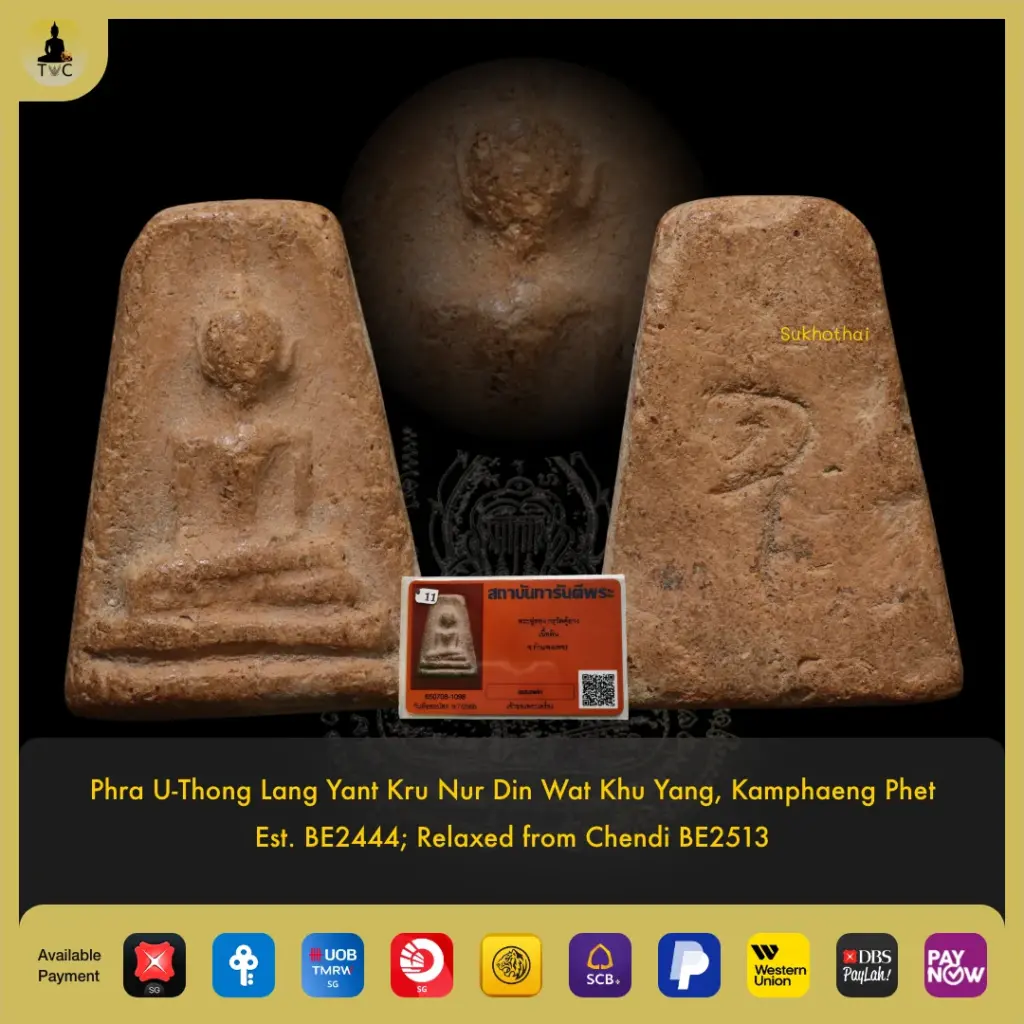
Phra U-Thong Lang Yant Kru Wat Khu Yang, Kamphaeng Phet Est. BE2444; released from Chendi BE2513
| Temple | Wat Kru Yang |
| B.E. Year | 2444 |
| SKU | TAC-0618 |
Authentic Phra U-Thong Lang Yant Kru Wat Khu Yang, Kamphaeng Phet Est. BE2444; released from Chendi BE2513 by Phra Khru Thammathimutmuni (Klung).
What is the Phra U-Thong Lang Yant Kru Wat Khu Yang, Kamphaeng Phet Est. BE2444; released from Chendi BE2513 by Phra Khru Thammathimutmuni (Klung)?
The Phra U-Thong Lang Yant Kru Wat Khu Yang, Kamphaeng Phet Est. BE2444; released from Chendi BE2513 by Phra Khru Thammathimutmuni (Klung) is a kru (temple crypt) amulet pressed in nuea din (sacred clay) and enshrined at Wat Kru Yang, Kamphaeng Phet, around BE2444 (1901 CE). The pieces were formally recovered from the chedi in BE2513 (1970 CE) and are distinguished by their U-Thong-style obverse and yant (sacred inscription) reverse.
Who made it and what went into the nuea
Phra Khru Thammathimutmuni (Klung) was the abbot of Wat Kru Yang at the time these amulets were created. His stated purpose was to sanctify the chedi and enshrine sacred materials within it — both as a religious act and as a way of transmitting merit forward to future generations. That intent shaped everything about how the pieces were assembled.
The nuea (material/substance) is local clay blended with a muan sarn (sacred powder blend) that draws on several distinct sources. Phong Itijay powder from Somdej Phra Phutthachan Toh of Wat Rakhang was included, along with Pilan relic powders and burnt palm-leaf powder from scriptures. Beeswax was used as a binding agent, following the Phra Pilan style tradition. Holy relics and herbs were pressed into the clay body to complete the blend. The Thai Buddhist amulet tradition of layering relic powders from multiple venerated sources into a single nuea is precisely what gives pieces like this their standing among serious collectors.
The reverse carries a yant — the sacred geometric inscription that gives this pim (mould/type) its full name. That detail matters when comparing pieces in hand, because it is the feature that distinguishes this type from other U-Thong-style amulets recovered from the same province.
Why kru pieces from BE2444 read differently to collectors
Amulets that spent roughly seven decades sealed inside a chedi before recovery in BE2513 age in ways that cannot be replicated. The clay surface develops a patina and surface character from the crypt environment — what collectors refer to simply as kru ageing. Pieces from this recovery are also finite: only what survived intact from the excavation exists. No further production was possible after the recovery.
The Kamphaeng Phet region has its own collector following, partly because the province sits on older Central Thai artistic and religious lineages. The inclusion of Phong Itijay from Wat Rakhang in the muan sarn connects this piece to one of the most respected powder traditions in Thai amulet history, which lifts its standing beyond a purely provincial piece.
Collectors typically look for the following when assessing authenticity:
- Natural kru ageing consistent with clay sealed in a chedi over several decades — surface patina, not artificial staining
- The U-Thong-style obverse profile, correctly proportioned for this pim
- The yant inscription on the reverse, legible and consistent with documented examples
- Clay texture and colour typical of Kamphaeng Phet nuea din pieces from this period
- Overall condition consistent with excavation recovery, not later reworking
No certificate issuer is documented for this piece at time of listing. Buyers are encouraged to compare against niyom (collector-standard reference pieces) when assessing any example.
We at TAC are offering this Phra U-Thong Lang Yant Kru Wat Khu Yang — a nuea din kru piece enshrined under Phra Khru Thammathimutmuni (Klung) circa BE2444 and formally recovered from the chedi in BE2513, with muan sarn that includes Phong Itijay powder from Wat Rakhang. For collectors focused on documented Kamphaeng Phet kru material with a credible ingredient lineage, this is a piece worth examining closely.
Attributes reflect Thai Buddhist devotional tradition and are not measurable claims.