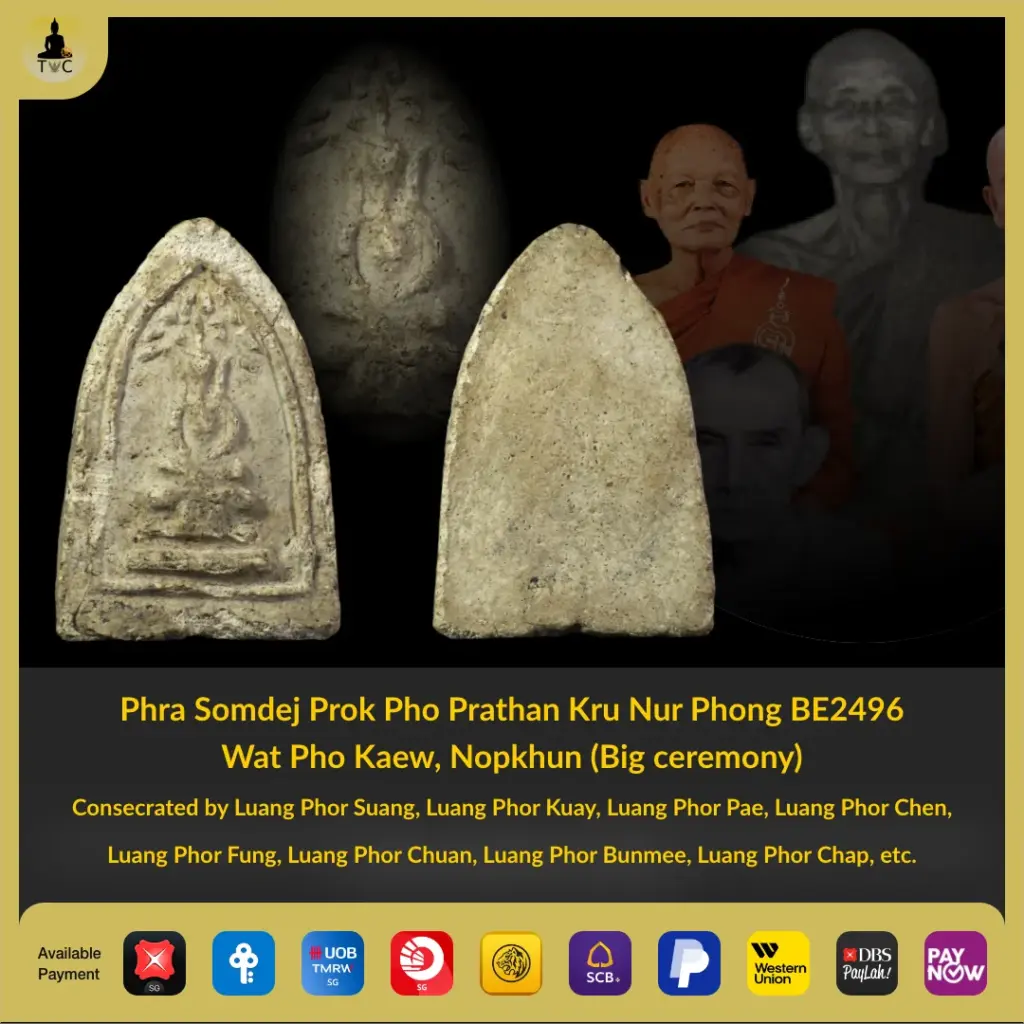
Phra Somdej Prok Pho Prathan Kru Nur Phong BE2496 Wat Pho Kaew, Nopkhun (Big ceremony) Consecrated by LP Suang, LP Kuay, LP Pae, LP Chen, LP Fung, LP Chuan, LP Bunmee, LP Chap
| Temple | Wat Pho |
| B.E. Year | 2496 |
| Material | Phong |
| SKU | TAC-0555 |
Authentic Phra Somdej Prok Pho Prathan Kru Nur Phong BE2496 Wat Pho Kaew Nopkhun, consecrated by LP Suang, LP Kuay, LP Pae and five masters. Phong.
What is the Phra Somdej Prok Pho Prathan Kru Nur Phong BE2496 Wat Pho Kaew, Nopkhun (Big ceremony) Consecrated by LP Suang, LP Kuay, LP Pae, LP Chen, LP Fung, LP Chuan, LP Bunmee, LP Chap?
The Phra Somdej Prok Pho Prathan Kru Nur Phong BE2496 Wat Pho Kaew, Nopkhun (Big ceremony) Consecrated by LP Suang, LP Kuay, LP Pae, LP Chen, LP Fung, LP Chuan, LP Bunmee, LP Chap is a sacred phong (sacred powder) amulet pressed at Wat Pho Kaew, Nopkhun in BE 2496 (1953). The front depicts the Buddha seated beneath the Bodhi tree — the Prok Pho image — and the piece was empowered during a major phutthaphisek (consecration ceremony) attended by eight named master monks from across central Thailand.
A big ceremony, a specific purpose — why this piece from Wat Pho Kaew matters
Wat Pho Kaew in Nopkhun organised this batch with a clear intent: to fund temple restorations and religious activities, and to honour traditional amulet-making practice. That dual purpose — practical fundraising and doctrinal preservation — is recorded in the designation “Prathan Kru,” marking it as a special edition tied to temple stewardship rather than a routine production run.
The Prok Pho image has a specific meaning within the broader Thai Buddhist amulet tradition. The Buddha sheltered by the Bodhi tree references the moment of enlightenment and the protection said to flow from that event. Collectors who focus on Phra Somdej forms often regard the Prok Pho posture as one of the more doctrinally grounded designs — it is not purely decorative.
The reverse may carry sacred inscriptions or temple markings. Examine this surface carefully against reference pieces when authenticating.
Eight monks, one ceremony — the consecration lineup and what it means for collectors
The phutthaphisek in BE 2496 drew a cross-temple assembly that is unusually well-documented for a provincial ceremony of this era. Each monk brought a distinct lineage to the empowerment:
- LP Suang (Wat Praibun)
- LP Kuay (Wat Kositaram)
- LP Pae (Wat Pikulthong) — known for his Phra Somdej work
- LP Chen (Wat Ngiu Rai)
- LP Fung (Wat Nong Muang)
- LP Chuan (Wat Kaosoon)
- LP Bunmee (Wat Ban Khun Sai)
- LP Chap (Wat Ngiu Rai)
The ceremony involved continuous scriptural chanting over an extended period before the final empowerment. For collectors, the presence of LP Pae — whose Phra Somdej amulets from Wat Pikulthong are among the more actively traded pieces in the central Thai collector market — adds particular weight to this lineup.
A single-monk piece has one lineage. This one carries eight, from temples spread across the region. That breadth is a core part of what the market prices in.
Nuea and pim — what went into the press and what to check
The muan sarn (sacred powder blend) here is identified as phong, combining several named powder types from the original temple records. Pong Phutthakun was gathered from ancient temple relics and blessed substances. Pong Itthijay — associated with prosperity — and Pong Trinisinghae — used for protection — were blended in. Floral ash and temple incense from major Buddhist ceremonies completed the mix.
These ingredients were mixed and pressed to form the finished amulet. With phong-based Phra Somdej pieces from BE 2496, age-appropriate surface texture and powder oxidation are among the first things an experienced eye checks. The material should feel dry and settled, not chalky-new or artificially treated.
For authentication, examine these points against established reference material:
- Surface texture consistent with nearly 70 years of natural aging
- Pim (mould) details — sharpness of the Bodhi tree framing and the seated figure’s proportions
- Reverse markings, if present, matching documented examples from Wat Pho Kaew
- Powder composition — colour and grain consistent with the named phong blend
No certificate accompanies this piece. Authentication therefore rests on physical examination by a knowledgeable specialist and comparison with documented reference examples from this batch.
We acquired this piece as part of our focus on documented multi-monk consecration batches from the BE 2490s. The Nopkhun big ceremony lineup — eight named masters including LP Pae of Wat Pikulthong — is the main draw here, and the "Prathan Kru" designation confirms this was a purposeful temple edition rather than a general release. For a collector building a BE 2496 central Thailand reference set, this is a hard batch to find in presentable condition.
Attributes reflect Thai Buddhist devotional tradition and are not measurable claims.
