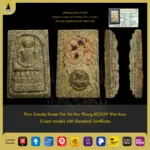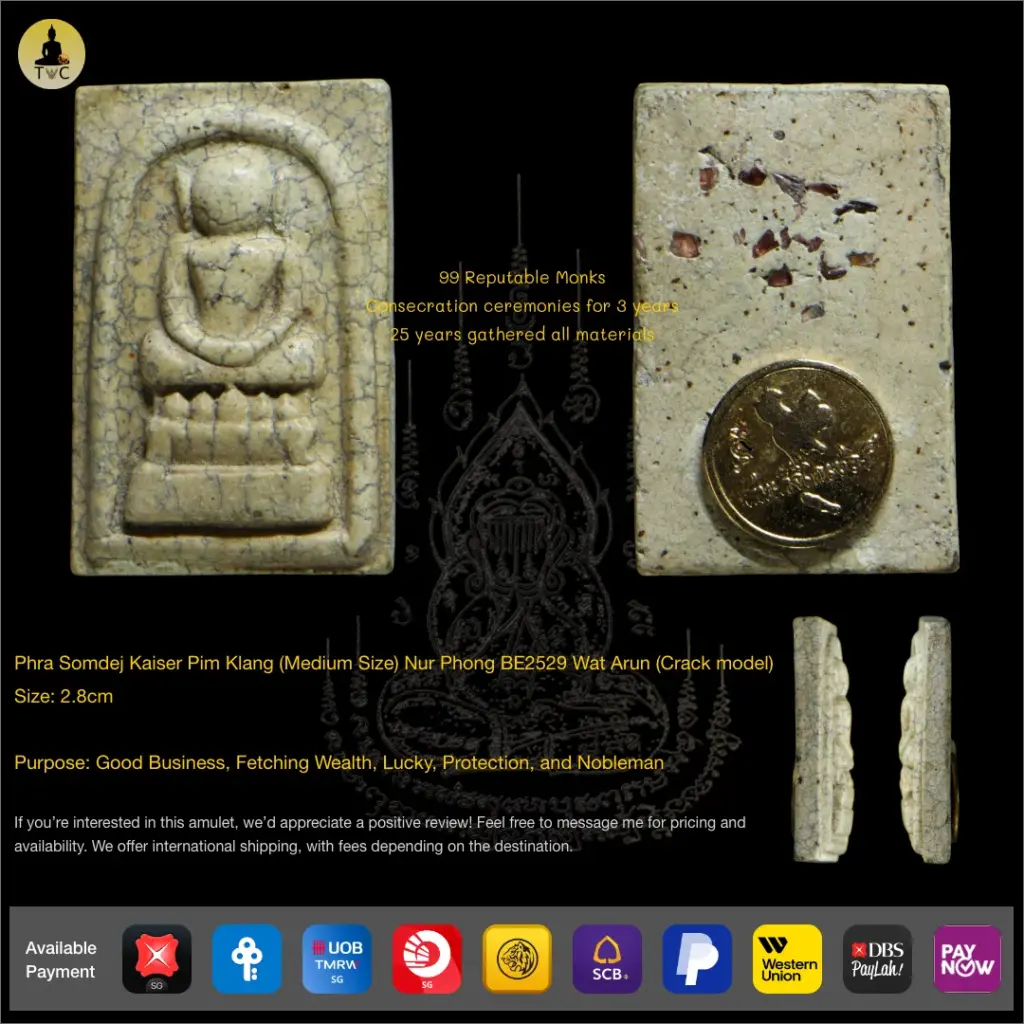
Phra Somdej Kaiser Pim Klang (Medium) Nur Phong BE2529 Wat Arun (Crack model)
| Temple | Wat Arun |
| B.E. Year | 2529 |
| Material | Phong |
| SKU | TAC-0196 |
Authentic Phra Somdej Kaiser Pim Klang (Medium) Nur Phong BE2529 Wat Arun (Crack model) by Mass Chanting.
What is the Phra Somdej Kaiser Pim Klang (Medium) Nur Phong BE2529 Wat Arun (Crack model) by Mass Chanting?
The Phra Somdej Kaiser Pim Klang (Medium) Nur Phong BE2529 Wat Arun (Crack model) by Mass Chanting is a sacred powder amulet produced at Wat Arun Ratchawararam, Bangkok, in BE2529 (1986 CE). Pressed from phong (sacred powder) blended from over 200 sanctified materials, it measures approximately 2.8 cm and carries the characteristic natural crack-model curing signature prized by collectors of modern Somdej.
The Kaiser Series and What Wat Arun Was Doing in BE2529
The Kaiser edition was produced to support temple fundraising at Wat Arun and to revive Bangkok’s Somdej tradition through a formal multi-monk consecration. It was not a quick temple run. The muan sarn (the blended sacred-powder substance) had been gathered across roughly 25 years, and the consecration cycle itself ran for three years before the amulets were released.
The phutthaphisek (consecration ceremony) was led by Somdej Phra Yanasangwon, the Supreme Patriarch, together with 99 senior monks. Nine separate candle-lighting rites completed the cycle. A selection of the attending elders reads like a who’s-who of mid-century Thai Buddhism: Luang Phor Koon of Wat Banrai, Luang Phor Jarun of Wat Amphawan, Luang Phor Pae of Wat Pikulthong, Luang Phor Put of Wat Klang Bang Phra, and several others of comparable standing.
For context on where this sits within the broader Thai Buddhist amulet tradition, the Kaiser series belongs to the collector category sometimes called gammakan (committee edition) — pieces where the consecration roster and material provenance are documented well enough to authenticate against.
The Phong, the Pim, and the Crack Model
The nuea (material/substance) here is Nur Phong — a sacred powder blend drawing from legacy Somdej powders sourced from Wat Rakhang, Wat Intharaviharn, and Wat Mai Amataros, combined with pong bailan (scripture ash), herb and soil admixtures, and trace metals from offerings. Over 200 sanctified materials were incorporated in total. These include the four Mahasathan soils from India — Lumbini, Bodh Gaya, Sarnath, and Kushinagar — along with multi-era powders from Wat Paknam, and special inclusions such as gold pollen, 108 floral pollens, and mineral components including Phet Tap Pet, Phet Na Tham, and Khao Dok Phra Ruang.
The pim (mould collectors authenticate against) is the Kaiser geometry — a rounded chest arc with clear tiered base, in Pim Klang (medium) format at approximately 2.8 cm. This size sits between Pim Lek and Pim Jumbo, making it central to any size-complete Kaiser set.
The crack model is not damage. It refers to shallow, random hairlines that form when the powder binder contracts during slow sun-drying under humid conditions. These are a natural curing phenomenon, and on a genuine period piece they appear superficial, unfilled, and distributed in a way consistent with how the press dried. Collectors value them precisely because they cannot be easily replicated on a fake without also getting the powder tone, press density, and Kaiser chest arc right simultaneously.
What Collectors Look For on This Piece
There is no single certificate listed for this piece. Authentication rests on reading the physical tells correctly. Key points to check:
- Crack-model hairlines that are naturally randomized, superficial, and unfilled — not structural fractures or later impact marks
- Even press density across the tiered base, with no collapse or warping on the pedestal tiers
- Stable powder tone consistent with period-appropriate Nur Phong from the late BE2520s
- Clean edge radius and correct Kaiser chest arc profile when viewed against reference pieces
- Natural micro-voids from compression — present but not excessive
Collectors who focus on modern Somdej treat the crack model as a desirable secondary marker rather than a defect. When the hairlines are genuine, they confirm slow natural curing, which is harder to fake than a smooth surface.
We acquired this Phra Somdej Kaiser Pim Klang (Medium) Nur Phong BE2529 Wat Arun (Crack model) for its well-documented consecration lineage — a Supreme Patriarch-led phutthaphisek with 99 senior monks is not common even for temple fundraising editions of this period. For collectors building a Kaiser size set or looking for a mid-period Wat Arun Somdej with strong ritual provenance, this Pim Klang sits at the centre of the run.
Attributes reflect Thai Buddhist devotional tradition and are not measurable claims.