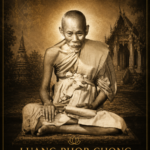
Phataphin (Wealth Fetching Fishes) Ngern Thong BE2490-2499 Luang Phor Chong Wat Natangnok
| Monk | Luang Phor Chong of Wat Natangnok, Ayutthaya |
| Temple | Wat Natangnok |
| B.E. Year | 2490 |
| SKU | TAC-0798 |
Authentic Phataphin (Wealth Fetching Fishes) Ngern Thong BE2490-2499 Luang Phor Chong Wat Natangnok by Luang Phor Chong of Wat Natangnok, Ayutthaya.
What is the Phataphin (Wealth Fetching Fishes) Ngern Thong BE2490-2499 Luang Phor Chong Wat Natangnok by Luang Phor Chong of Wat Natangnok, Ayutthaya?
The Phataphin (Wealth Fetching Fishes) Ngern Thong BE2490-2499 Luang Phor Chong Wat Natangnok is a paired Ta Pian fish charm created by Luang Phor Chong of Wat Natangnok, Ayutthaya during the BE2490–2499 period (1947–1956 CE). Finished in a silver-and-gold tone Ngern–Thong pairing, it carries a Thaprachan certificate and is associated in Thai-Buddhist and Thai-Chinese tradition with prosperity, household continuity, and livelihood protection.
The Ta Pian fish — where Thai folk-Buddhist symbolism and Chinese prosperity belief converge
The Ta Pian (ปลาตะเพียน), or phataphin, draws on two streams of meaning that run deep in communities across Singapore, Malaysia, and Thailand. In Thai Buddhist storytelling, the fish appears in Jataka narratives as an emblem of calm guidance — a creature that brings others safely through uncertain waters by virtue of steadiness and right conduct, not luck alone. That framing is why the Ta Pian is spoken of as a “merchant helper” symbol rather than a simple fortune charm.
For Thai-Chinese devotees, the resonance compounds. The Chinese word for fish, 鱼 (yú), echoes the sound of “surplus,” which is why fish imagery is deployed at shopfronts, wedding tables, and household entryways — places where continuity matters. The old Thai saying “Nai nam mee pla, nai na mee khao” (“In the water, there is fish; in the field, there is rice”) captures the same idea from the Thai side. Luang Phor Chong’s paired Ta Pian sits precisely at that crossover — a form both traditions read without translation. The broader Thai Buddhist amulet tradition is full of livelihood objects, but few carry this kind of dual cultural fluency.
How Luang Phor Chong made the paired form his own
Luang Phor Chong of Wat Natangnok, Ayutthaya — also written LP Chong or LP Jong — is respected for combining monastic discipline with focused blessing work. His Ta Pian pieces are remembered for ritual seriousness: protective chanting and wealth-attracting recitations, with Na Cha Li Ti referenced in oral tradition as part of the livelihood-luck framing common in Thai devotional practice.
He popularised the fish in paired form, with the two pieces understood as a complementary set expressing balance and two-way flow — incoming fortune and guarded keeping. Traditionally the pair is spoken of as a male (Ngern / silver tone) and female (Thong / gold tone) unit. Wat Natangnok in Ayutthaya Province is the source temple, and pieces associated with this temple and this monk carry weight in collector circles precisely because the symbolism is coherent and the documentation trail — where it exists — is traceable.
This example comes with a Thaprachan certificate, which is the primary documentary reference collectors use when assessing pieces from this period.
What collectors look at when handling a piece from this range
The BE2490–2499 window spans roughly a decade of production, and within that range collectors focus on period-consistent workmanship rather than chasing a single batch date. Key points to check:
- Fish silhouette and pim integrity — the outline should be clean and consistent with documented reference pieces from Luang Phor Chong’s production
- Hole placement — position and finish of the suspension hole is a reliable indicator of authentic period workmanship
- Thickness and surface character — the Ngern–Thong tonal distinction should be visible; aging and wear should be consistent with genuine long-term use, not artificially induced
- Thaprachan certificate — this piece carries one; it strengthens the collector story and supports due diligence, particularly for items that have circulated in commerce circles
Collectors traditionally place the pair at a shopfront or cashier area to invite steady trade, near a home entryway for household stability, or carry one as a pocket charm. These are conventional usage points rooted in Thai-Chinese folk practice — not guarantees of outcome.
Phataphin (Ta Pian) amulets of this period are among the more quietly significant folk-Buddhist objects in serious Thai amulet collections — the Ta Pian fish carries deep roots in Thai-Chinese prosperity belief, and a Ngern-Thong (silver-gold) pair from Luang Phor Chong of Wat Natangnok, datable to the BE2490–2499 window, represents a decade of consecration work from a monk whose Ayutthaya lineage is well regarded by specialist collectors. The traditional male-female pairing concept expressed through contrasting silver and gold tones adds a layer of symbolic completeness that single-piece fish amulets simply do not carry. The accompanying Thaprachan certificate provides the authentication reference point that collectors at this level of the market rightly expect, and we at TAC consider documented pieces from this era and temple a sound long-term addition to any collection focused on pre-BE2500 Ayutthaya material.
Attributes reflect Thai Buddhist devotional tradition and are not measurable claims.