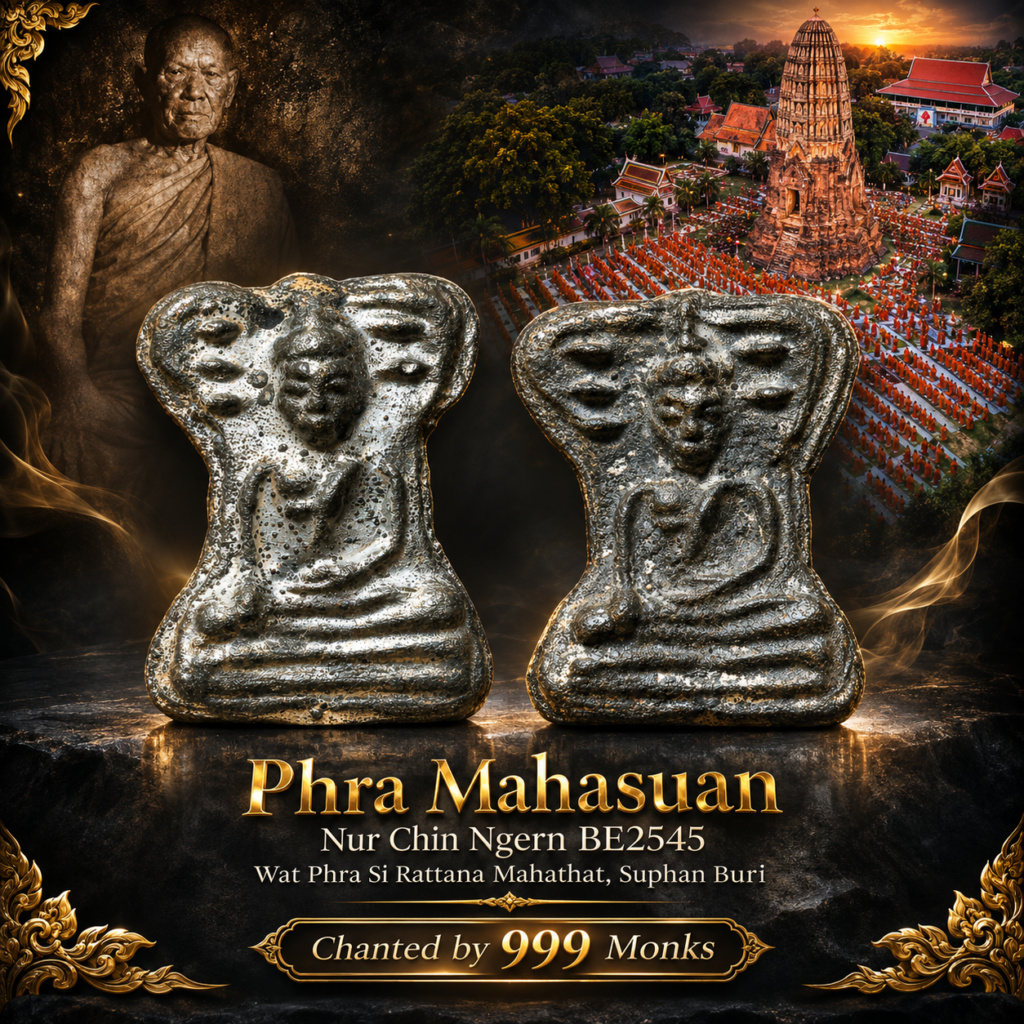
Phra Mahasuan Nur Chin Ngern BE2545 Wat Phra Si Rattana Mahathat, Suphan Buri Chanted by 999 Monks
| Type | Phra Mahasuan |
| Temple | Wat Phra Si Rattana Mahathat |
| B.E. Year | 2545 |
| Material | Nur Chin Ngern |
| Condition | Good |
| SKU | TAC-PhraMahasuan-999Monks-001 |
Phra Mahasuan 999 Monks, Wat Phra Si Rattana Mahathat, BE 2545. Pressed in Nur Chin Ngern — a silver-toned alloy blended with old amulets recovered from the chedi. Singapore dealer TAC.
What is the Phra Mahasuan 999 Monks from BE 2545, and why do collectors rate it?
The Phra Mahasuan 999 Monks from Wat Phra Si Rattana Mahathat, consecrated in BE 2545, is pressed in Nur Chin Ngern — a silverish alloy that incorporates old Phra Mahasuan amulets recovered from the chedi. The phutthaphisek (consecration ceremony) was conducted at Wat Mahathat, Supanburi, and subsequently at Wat Rakang, with 999 monks in attendance.
The name, the legend, and why this pim has staying power
The name itself tells part of the story. Before the amulet was called Phra Mahesuan, it was known simply as Phra Suan — suan meaning inverted. The renaming came from a real person: a chief bandit named Mahesuan, who was high on the Thai police wanted list and was said to carry only one amulet. That amulet was Phra Suan. He was never caught. He is, by all accounts, still alive. You can work out the rest.
The inversion concept is central to how devotees understand this piece. The image of an inverted Buddha at the back is not incidental — it is the whole logic. If luck is running down, the belief is that it inverts upward again. If you are on course to cross paths with an enemy or a bad situation, it inverts that too. The meeting simply does not happen. That is why this amulet has long been associated with klaewkard (avoidance of harm and misfortune), kungkaphan (imperviousness), and mahalap (great luck).
999 Monks is not a single master but a collective — the power here draws from the combined pluk sek of an unusually large assembly. The scale of the phutthaphisek across two temples, Wat Mahathat in Supanburi and then Wat Rakang, gives this run a ceremonial weight that single-monk batches rarely match. For collectors who follow the Phra Mahasuan tradition, the BE 2545 run from the Thai Buddhist amulet tradition sits at a meaningful point — not so old it is inaccessible, not so recent it lacks depth.
What makes the Nur Chin Ngern pim worth paying attention to
Of the pim available in this batch, the ching ngern variant is the one we at TAC particularly favour. The nuea (material substance) is a combination of metals blended with original Phra Mahasuan amulets that were unearthed from the chedi — so you are getting muan sarn that carries both the consecrated weight of the BE 2545 ceremony and the accumulated age of the older pieces folded into it. That is a meaningful combination, not a marketing one.
Visually, the Nur Chin Ngern reads as a clean silver tone. Under close inspection, collectors should look at the surface texture and how the older material integrates into the press — it is not uniform in the way a purely modern pour would be. That layered quality in the nuea is part of what gives this pim its character.
Authenticating this piece — what to check
Because Phra Mahasuan has a long production history and is widely circulated across Thailand, Malaysia, and Singapore, authentication matters. Key points for this specific pim:
- The silverish tone of the Nur Chin Ngern nuea should show the characteristic mix of metals — not a flat, overly uniform finish
- Check the pim (mould impression) against known reference examples for this BE 2545 run — the inverted Buddha at the back should be clear and correctly formed
- The overall weight and density of the piece reflects the inclusion of older recovered amulet material in the muan sarn blend
No certificate details are listed for this piece. Collectors who require paperwork should factor that into their assessment. The piece stands on its nuea and its pim — both of which are verifiable against documented reference examples from this run.
This BE 2545 Phra Mahasuan in Nur Chin Ngern is the pim we would steer a serious collector toward if they are building out a Phra Mahasuan set — the muan sarn blend incorporating old recovered amulets from the chedi is what separates it from a standard modern press, and the phutthaphisek across Wat Mahathat, Supanburi and Wat Rakang with 999 monks is a documented fact, not a sales line. No certificate accompanies this piece, so authenticate against reference examples before purchase and price it accordingly.
Attributes reflect Thai Buddhist devotional tradition and are not measurable claims.
