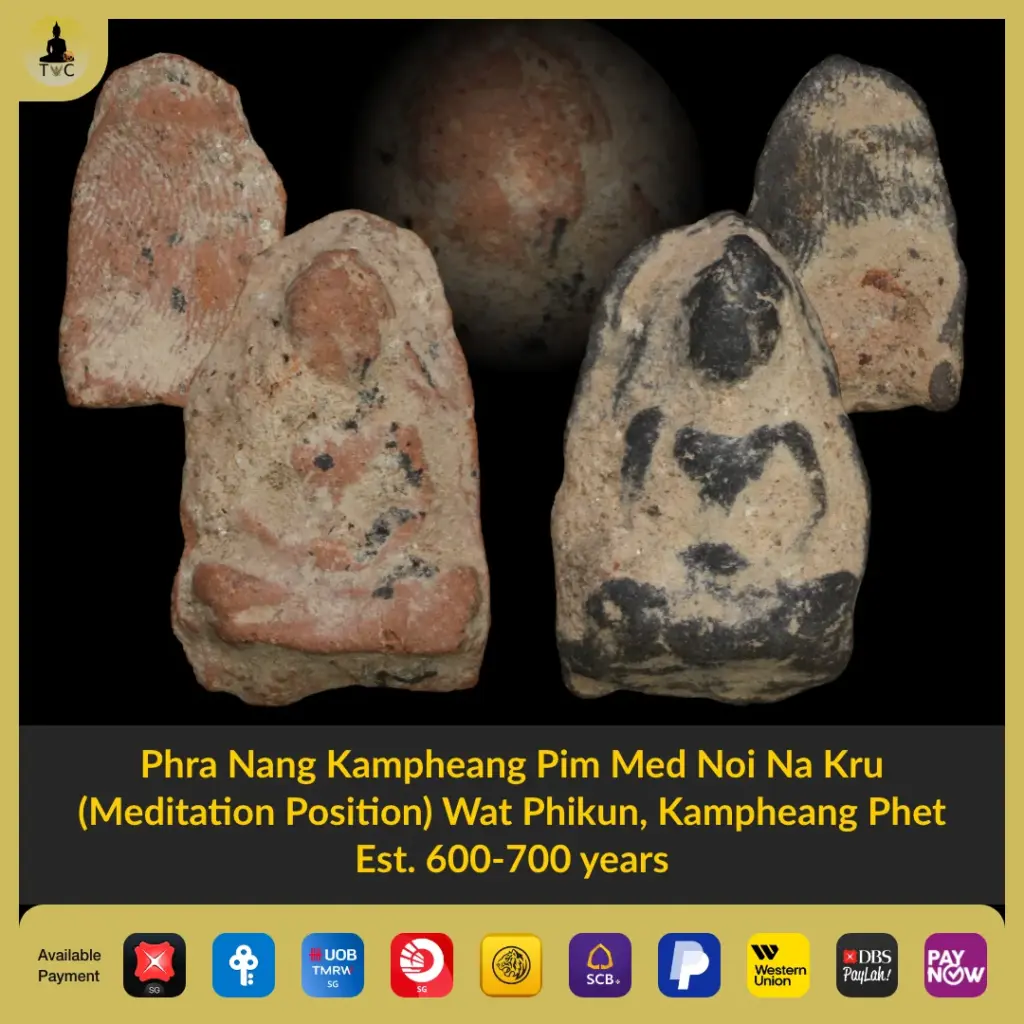
Phra Nang Kampheang Pim Med Noi Na Kru (Meditation Position) Wat Phikun, Kampheang Phet Est. 600-700 years
| SKU | TAC-0321 |
Authentic Phra Nang Kampheang Pim Med Noi Na Kru (Meditation Position) from Wat Phikun, Kampheang Phet. Sacred clay, est.
What is the Phra Nang Kampheang Pim Med Noi Na Kru (Meditation Position) Wat Phikun, Kampheang Phet Est. 600-700 years?
The Phra Nang Kampheang Pim Med Noi Na Kru (Meditation Position) Wat Phikun, Kampheang Phet Est. 600-700 years is an ancient sacred clay amulet from Wat Phikun, Kampheang Phet, dating to the Sukhothai–early Ayutthaya period. Pressed in a small oval pim (mould) depicting the Buddha in meditation posture, it was recovered from Na Kru (hidden crypt chambers) inside temple chedis and is nationally recognised as part of Thailand’s Phra Kru Kampheang Phet heritage.
Six Centuries in a Crypt — What Makes This Piece Significant
Kampheang Phet amulets occupy a distinct place in the Thai Buddhist amulet tradition. The city sat at the northern edge of the Sukhothai kingdom, and its temples were royal merit-making projects — not provincial workshops. Amulets produced here were pressed with purpose and entombed inside chedis as acts of royal dedication, sealed away for centuries before excavation.
This particular piece comes from Wat Phikun, one of the temples whose Na Kru yielded material now recognised by Thailand’s Fine Arts Department. The kru (temple crypt) origin matters to collectors because it establishes provenance in a way that surface finds cannot. Pieces from documented Na Kru sites carry a chain of context that later editions simply do not have.
The pim here is Pim Med Noi — a small, seed-shaped oval pressed with the Buddha seated in full meditation posture. The format is compact, the lines clean even after burial. That the image survives this legibly after 600–700 years underground tells you something about both the nuea (material/substance) quality and the original pressing pressure used.
Sacred Clay, Burial Marks, and What the Nuea Tells You
The nuea is sacred clay — phong phra — mixed with relic powders and herbal essences according to Sukhothai-period practice. There was no standardised recipe across temples, which is part of why authentication requires examining the clay body closely. Colour, density, and the way natural patina has formed across the surface over centuries of burial are all factors collectors learn to read.
Soil marks and burial encrustation are expected on genuine Na Kru pieces and are not flaws. They are evidence. A surface that looks artificially cleaned should raise questions; uneven, naturally accumulated deposits are what six centuries of interment actually produces.
- Nuea: sacred clay (phong phra) mixed with relic powders and herbal essences
- Pim: small oval (Pim Med Noi) — Buddha in meditation posture
- Surface: natural patina and soil marks consistent with Na Kru burial
- Origin: Na Kru crypt chambers at Wat Phikun, Kampheang Phet
- Period: Sukhothai–early Ayutthaya, estimated 600–700 years
Consecration at the time of pressing involved Pali chanting and Kasina meditation practice by the monks of the period. There was no single named master — this is royal-era temple production blessed collectively by the sangha (monastic community) of the Sukhothai kingdom. That collective empowerment model was standard for amulets destined to serve the community and the court rather than carry a single monk’s personal lineage.
Collecting This Piece — Rarity, Recognition, and What to Check
The Fine Arts Department of Thailand recognises Phra Nang Kampheang pieces from documented kru sites, and examples are held in national museum collections. That institutional recognition matters for the secondary market. It also means there is reference material collectors can compare against when evaluating a piece.
Genuine examples are scarce. They pass between collectors through inheritance as often as through open sale, and when they do surface, condition and legibility of the meditation image drive value considerably. The Pim Med Noi format is among the more compact in the Kampheang Phet family, which makes clean surface survival rarer still.
Collectors in Singapore, Malaysia, and Taiwan have shown sustained interest in Sukhothai-period kru pieces over the past decade, partly because supply is genuinely finite — no further production is possible, and the original Na Kru sites are either exhausted or protected.
This is a genuinely old piece — Sukhothai–early Ayutthaya period sacred clay from a documented Na Kru site at Wat Phikun, Kampheang Phet, with Fine Arts Department recognition behind the broader Phra Kru Kampheang Phet category it belongs to. We at TAC consider pieces like this worth holding precisely because supply is permanently closed — no further examples will come from these kru sites — and documented Kampheang Phet material at this age tier continues to find buyers across Singapore, Malaysia, and Taiwan.
Attributes reflect Thai Buddhist devotional tradition and are not measurable claims.