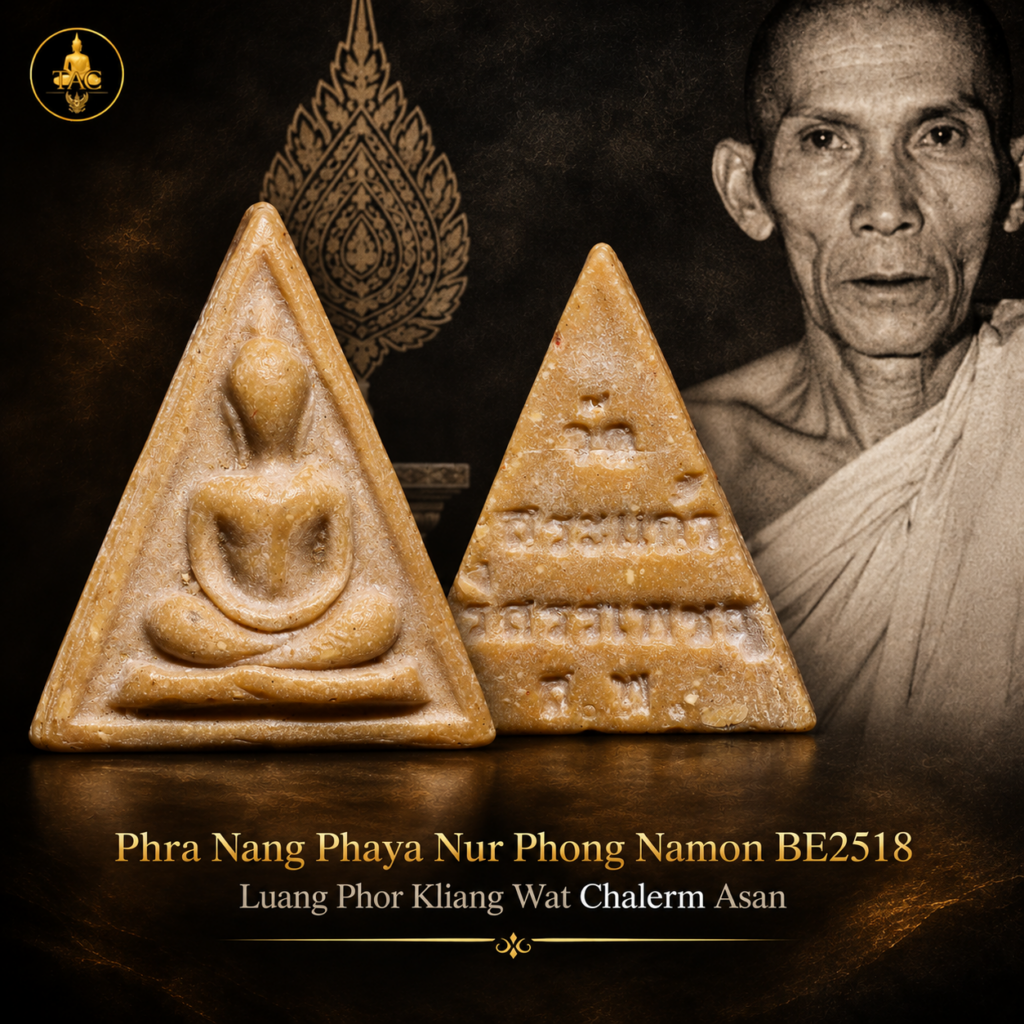
Phra Nang Phaya Nur Phong Namon BE2518 Luang Phor Kliang Wat Chalerm Asan
| Type | Phra Nang Phaya |
| Monk | Luang Phor Kliang |
| Temple | Wat Chalerm Asan |
| B.E. Year | 2518 |
| Material | Nur Phong Namon |
| Condition | Very Good |
| SKU | TAC-PhraNangPhaya-LpKliang-001 |
Phra Nang Phaya Luang Phor Kliang, Wat Chalerm Asan, BE 2518. Pressed in Nur Phong Namon. A mid-era powder piece from a lesser-documented but genuine lineage. Singapore dealer TAC.
What is the Phra Nang Phaya Luang Phor Kliang from Wat Chalerm Asan, BE 2518?
The Phra Nang Phaya Luang Phor Kliang from Wat Chalerm Asan, consecrated in BE 2518, is a powder-based amulet pressed in Nur Phong Namon — a milk-white sacred powder blend. This is a mid-era piece from a monk whose work sits outside the mainstream spotlight, which is exactly why serious collectors take a second look.
Luang Phor Kliang and why this piece is worth your attention
Luang Phor Kliang of Wat Chalerm Asan is not a name you see plastered across every amulet fair. That relative quietness is part of what makes his work interesting. Monks who built their practice away from the big-city circuits often produced pieces with a tighter, more focused muan sarn — not scaled for mass distribution, but made for the people around them.
BE 2518 sits in a productive window for Thai amulet making. The decade running from the late 2510s saw a number of provincial temples producing powder pieces that now surface rarely. What you get from that era is a natural aged patina in the phong that you simply cannot replicate today. When you hold a genuine piece from this period, the surface tells you something a fresh pressing never could.
For context on how the Nang Phaya form has travelled across different monks and eras, you can browse TAC’s Phra Nang Phaya Nur Din BE 2496–2497 by Phra Ajarn Thanom Khemjaro — one of the benchmark early pieces that shows what the classic pim looks like before later variations came in. For a closer material comparison, the Phra Nang Phaya Nur Phong Namon BE 2515–2521 by Luang Phor Kuay Wat Kositaram is pressed in the same nuea and shows what well-preserved Phong Namon looks like across this era.
The nuea — what Nur Phong Namon means for this piece
Nur Phong Namon — literally “milk powder” — is a white or off-white powder base. The muan sarn (the blend of sacred powders pressed into the amulet) in a good Phong Namon piece is fine-grained and compact. Over decades, genuine examples develop a soft, slightly matte surface that feels consistent across the face. Fresh fakes tend to look chalky or too uniform.
What to check on this piece:
- Surface texture — genuine aged Phong Namon settles evenly; look for consistent compression, no crumbling edges
- The pim (mould impression) — the Nang Phaya form has specific proportions in the seated figure; the lines should be clear and unrushed
- Colour depth — older Phong Namon pieces often show a slight warm cast from decades of handling and ambient contact, not a bright white
- Reverse face — check for any yant impression or maker’s mark consistent with Wat Chalerm Asan’s production style from this period
No third-party certificate is noted for this piece. That is not unusual for smaller temple runs from the provinces. What matters is reading the piece itself. The Thai Buddhist amulet tradition has always relied on the collector’s eye as much as any paper — experienced sien know the difference between documentation and substance.
What is this Phra Nang Phaya traditionally carried for?
The Nang Phaya form is one of the most closely associated pim with metta and social harmony. Collectors and devotees who carry this piece typically look to it for the following:
- Metta — loving-kindness that smooths dealings with people; traditionally carried by those who need goodwill from strangers and colleagues alike
- Maha Saneh — a natural likeability and personal warmth; associated with drawing people closer rather than pushing them away
- Kaa Khaay — support for trade and sales; devotees in business often carry Nang Phaya pieces when dealing with clients or entering negotiations
- Baramee — composure and a quiet authority that earns trust over time, without needing to assert it
How collectors wear this today
This is a piece that suits daily wear. The qualities collectors associate with the Nang Phaya form — Metta, Maha Saneh, Kaa Khaay — translate well for people whose work depends on relationships: those in sales, service, management, or any role where being read as trustworthy and warm matters from the first impression. Business owners carrying into client meetings, professionals who deal across different personalities, anyone who finds social friction a consistent obstacle — these are the people who gravitate toward this form.
For those who sit with a meditation practice, the Nang Phaya is also carried as a focus for metta meditation — the seated figure itself is a natural anchor. Worn at the neck in a casing, or kept near the workspace, the tradition is simply to treat it with respect and keep it above the waist.
This is a Phra Nang Phaya in Nur Phong Namon from Luang Phor Kliang of Wat Chalerm Asan, BE 2518 — a genuine mid-era powder piece from outside the usual big-name circuit. No third-party certificate accompanies this piece, so we present it on the strength of the piece itself; collectors who know their Phong Namon will want to look closely at the surface ageing.
Attributes reflect Thai Buddhist devotional tradition and are not measurable claims.