Phra Somdej 6 Chan Ketchaiyo Nur Phong BE2490 Wat Pho Kriap, Ang Thong
| Type | Phra Somdej |
| Temple | Wat Pho Kriap |
| B.E. Year | 2490 |
| Material | Phong |
| Condition | Very Good |
| Certificate | Competition |
| Competition | Won 1ST placing |
| SKU | TAC-0310 |
Phra Somdej 6 Chan Ketchaiyo in nuea phong, Wat Pho Kriap, Ang Thong, BE 2490. Competition-certified 1st placing. Available from TAC Singapore.
What is the Phra Somdej 6 Chan Ketchaiyo from Wat Pho Kriap, BE 2490?
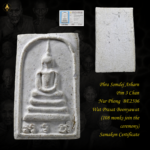
The Phra Somdej 6 Chan Ketchaiyo is a phong (sacred powder) amulet pressed at Wat Pho Kriap in Ang Thong province during BE 2490. It follows the Ketchaiyo-inspired silhouette — a tall seated Buddha beneath a clean arch, set over six evenly stacked tiers. This example comes with its original competition box and certificate, recording a 1st placing result.
The Somdej design language and what the Ketchaiyo silhouette means for collectors
Somdej is a design tradition, not a single temple line. It spread through regional crafting networks and devotional practice across central Thailand, and each issuing temple left its own proportional fingerprint on the mould. Understanding the Thai Buddhist amulet tradition helps place why the Ketchaiyo-style geometry carries weight among serious collectors.
The Ketchaiyo reference (แนวเกศไชโย) points to a specific silhouette: tall, composed, architectural rather than decorative. The arch frames the figure cleanly, the tiers beneath stack with an even rhythm, and the base anchors the image without crowding it. For the pim (mould) to read correctly, the centerline must sit naturally — nothing too wide, nothing too cramped. Collectors often make that judgment in seconds.
The six-tier count (๖ ชั้น, 6 chan) is part of the structural identity of this piece. Each tier should be distinct and proportionate. When the spacing collapses or the tiers merge at the edges, that is usually the first sign a cast is not right.
Nuea phong at over 70 years — what the powder surface tells you
Nuea phong (เนื้อผง) — the powder-based muan sarn used here — is valued precisely because it records the maker’s process honestly. Mixing density, compression pressure, drying conditions, and decades of natural aging all leave marks you cannot fake convincingly at scale. A piece from BE 2490 has had more than seven decades to develop those characteristics.
On a genuine piece of this age, the surface settles into a calm matte finish. Micro-porosity is visible under magnification. Fine grain variation shows across the face — not the uniform smoothness you see in modern re-casts. Edges round gradually with time but stay readable; the arch line, tier separations, and base profile do not dissolve.
- Natural pores and grain variation across the surface — inconsistency here is a positive sign
- Edge softening that looks gradual and even, not melted or sanded back
- Relief that remains legible: arch, tiers, and base all hold their form
- Back surface often shows age character more openly than the face — worth examining closely
- Thickness and edge condition visible from the side — check for uneven reworking
Keep nuea phong dry. Avoid chemical cleaners and soaking. Handle with clean, dry fingers — skin oils can darken powder surfaces unevenly over long periods. If cased, manage humidity with silica gel and avoid heat trapping.
What the competition certificate adds — and what it does not replace
This piece was presented for formal competition assessment and received a 1st placing result. The competition box and certificate come with the amulet and should be kept together to preserve provenance continuity. In the collector market, competition documentation signals that the piece has passed structured visual review — typically covering structural integrity, print consistency, material behaviour, and overall age coherence.
That documentation strengthens the chain for collectors who value provenance discipline. It is not a substitute for expert verification on a high-value acquisition, but it is a meaningful data point, especially for a BE 2490 piece where original documentation at this level is not common.
We acquired this BE 2490 Phra Somdej 6 Chan Ketchaiyo from Wat Pho Kriap complete with its original competition box and 1st placing certificate — the kind of documented set that rarely stays together over seven decades. For collectors who prioritise provenance discipline alongside structural correctness, the combination of Ketchaiyo geometry, BE 2490 nuea phong aging, and intact competition documentation makes this a piece worth considering seriously.
Attributes reflect Thai Buddhist devotional tradition and are not measurable claims.