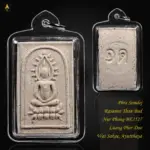
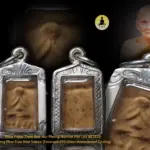
Phra Somdej Pim Yai Nur Din BE2500 Luang Pu Doo Wat Sakae, Ayutthaya
| Type | Phra Somdej |
| Monk | Luang Phor Doo (Lp Du) |
| Temple | Wat Sakae |
| B.E. Year | 2500 |
| Material | Din |
| SKU | TAC-0063 |
Phra Somdej Luang Phor Doo (Lp Du), Wat Sakae BE 2500. Pim Yai, nuea din, back stamp. Accompanied by Thaprachan Certificate. Available from TAC Singapore.
What is the Phra Somdej Pim Yai Nur Din BE 2500 by Luang Phor Doo (Lp Du)?
The Phra Somdej Luang Phor Doo (Lp Du) in Pim Yai (พิมพ์ใหญ่) format is a sacred clay amulet pressed in BE 2500 and attributed to Luang Phor Doo (Lp Du) of Wat Sakae, Phra Nakhon Si Ayutthaya. Nuea din (sacred earth/clay) construction, back stamp noted, accompanied by Thaprachan Certificate.
Luang Phor Doo (Lp Du) and the BE 2500 Issue
Luang Phor Doo (Lp Du) (1904–1990) spent most of his monastic life at Wat Sakae in Ayutthaya, building a reputation on rigorous meditation practice and direct, unadorned teachings. He consistently reminded devotees that real protection comes from a trained mind, not ritual objects alone — a stance that gave his amulets an unusually grounded character among collectors.
The BE 2500 issue sits squarely in the post-war period that many serious collectors value for its old-school devotional straightforwardness. Somdej lines connected to Luang Phor Doo from this era are actively discussed across Thai amulet communities, and early-period pieces are assessed against era cues: block character, surface density, and the handling traditions specific to Wat Sakae. That context matters when you are trying to place a piece in the right window.
Nuea Din — What the Clay Tells You
Nuea din (เนื้อดิน — sacred earth/clay base) sits at the heart of this piece. Clay-based Somdej are pressed and allowed to cure under prolonged chanting, absorbing muan sarn (sacred powder blend) energy differently from powder-heavy formulations. The result is a denser, quieter surface — fine pores, a soft matte finish, and an aging character that becomes more legible over decades of careful keeping. Collectors who handle enough of them can read the compression marks and surface grain almost like a fingerprint.
For this pim (the mould collectors authenticate against), Pim Yai means the larger format: composed seated Buddha posture, clear layered base lines, and proportions that read immediately whether the piece is in hand or under a loupe. The back stamp (ตรายาง / chop mark) is treated as a meaningful identity marker in Wat Sakae-related circulation — not decorative, but a reference point that supports the Thaprachan Certificate accompanying this piece.
What Collectors Check and How This One Is Documented
The Thai Buddhist amulet tradition places Phra Somdej at the top of the classification hierarchy — sometimes called the “king of amulets” — which also means the market has no shortage of later reproductions. Careful documentation is not optional here; it is the baseline.
For a piece like this, authentication comes down to a short list of reference points:
- Pim Yai structure: front definition, proportion of the Buddha image against the base tiers, and edge angle — these three together establish which mould generation the piece belongs to.
- Surface character: consistent nuea din aging across front, back, and edges, with no signs of artificial patination or re-pressing.
- Back stamp placement and texture: the chop and the clay surface surrounding it should share the same aging signature.
- Thaprachan Certificate: strong collector advantage for any Somdej line — especially where imitations circulate freely. This piece is accompanied by one.
Keep the piece dry. Avoid chemical cleaners and soaking. Handle with clean hands — nuea din surfaces record contact over time, and preserving that original texture is part of preserving the documentation trail.
This Phra Somdej Pim Yai attributed to Luang Phor Doo (Lp Du) of Wat Sakae is a BE 2500 nuea din piece accompanied by a Thaprachan Certificate — a combination that makes it straightforward to present to a serious collector without hesitation. We at TAC see consistent interest in well-documented Wat Sakae Somdej from this period, particularly among collectors in Thailand and the broader Chinese-speaking market who prioritise certification alongside physical character.
Attributes reflect Thai Buddhist devotional tradition and are not measurable claims.