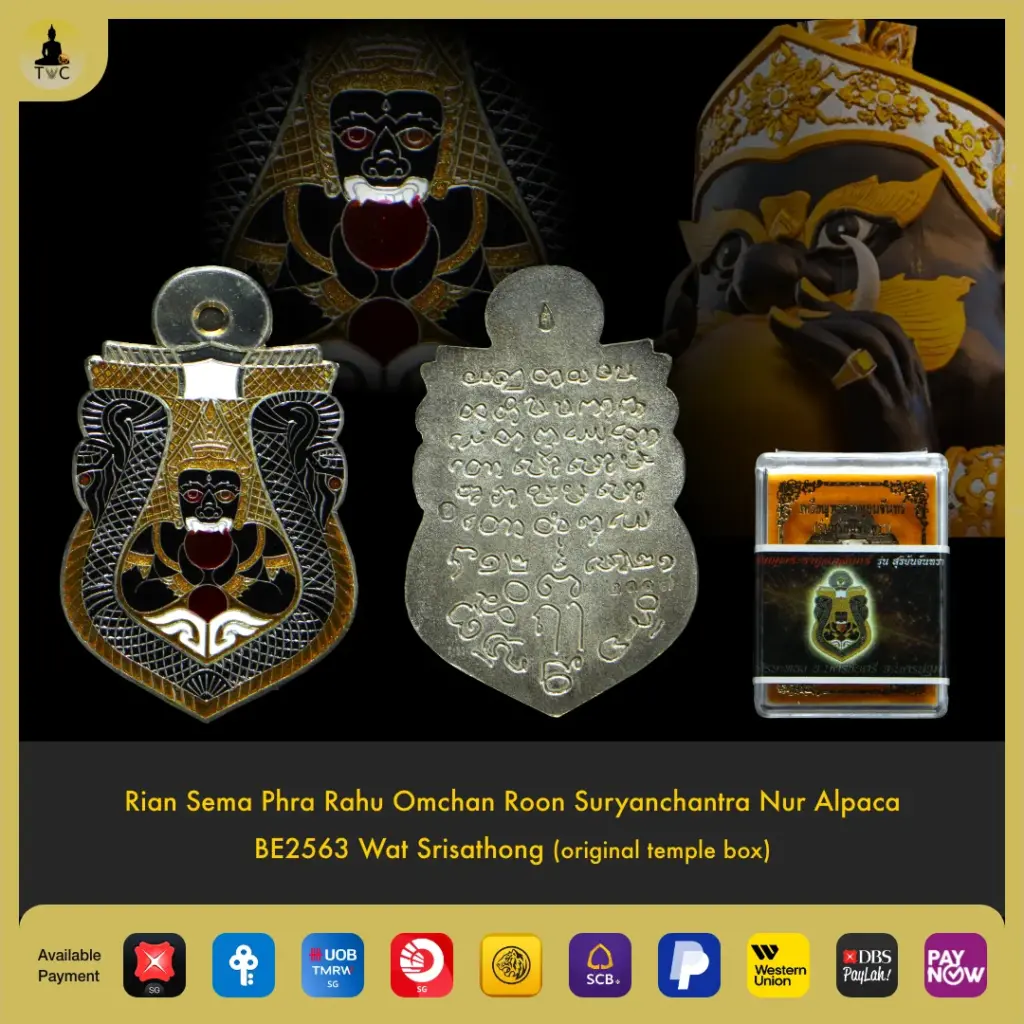
[SOLD] Rian Sema Phra Rahu Omchan Roon Suryanchantra Nur Alpaca BE2563 Wat Srisathong (original temple box)
| Type | Rian |
| Temple | Wat Srisathong |
| B.E. Year | 2563 |
| Material | Alpaca |
| SKU | TAC-0149 |
The Rian Phra Rahu Omchan Roon Suryanchantra is one of the most distinctive celestial protection medallions available to collectors in Singapore and acr…
The Rian Phra Rahu Omchan Roon Suryanchantra is one of the most distinctive celestial protection medallions available to collectors in Singapore and across Southeast Asia, consecrated in Buddhist Era 2563 at Wat Srisathong in Nakhon Pathom province. Cast in Nur Alpaca alloy and blessed through a rigorous multi-day Phutthaphisek ceremony, this rian is specifically revered for its capacity to neutralise malevolent planetary influences and provide comprehensive celestial protection. Its dual solar-lunar designation — Suryanchantra — reflects a sophisticated theological approach to harmonising opposing cosmic forces.
The Rian Phra Rahu Omchan was consecrated during a period of notable astrological transition in early BE 2563 (2020 CE). The monastic committee of Wat Srisathong commissioned this edition as a deliberate spiritual response to the turbulent celestial conditions perceived to characterise that juncture.
The edition name Suryanchantra — a Sanskrit compound of Surya (sun) and Chandra (moon) — encapsulates the medallion’s dual protective mandate. This theological innovation distinguishes it from conventional Phra Rahu amulets that focus solely on lunar symbolism.
The sema medallion form references the Bai Sema boundary stones that demarcate consecrated temple grounds in Thai Buddhist architecture. This structural choice positions the wearer within a portable sacred space, symbolically extending the protection of consecrated ground into daily life.
Rian Phra Rahu Omchan and Wat Srisathong Heritage
Wat Srisathong, located in Nakhon Pathom province, is recognised as Thailand’s preeminent institutional centre for Phra Rahu veneration, maintaining an unbroken lineage of specialised ritual practices spanning more than a century. Its singular focus on this celestial deity distinguishes it from the broader landscape of Thai Buddhist temples and attracts devotees seeking remediation from adverse astrological conditions.
The monastic community preserves rigorous adherence to traditional Rahu propitiation ceremonies, transmitting specialist knowledge across successive generations of monks. These practices include the recitation of Rahu Katha protective incantations, eclipse-related ceremonial observances, and the preparation of prescribed ritual offerings — black sesame seeds, coconut, and sugar cane juice — presented beneath the temple’s principal Rahu statue.
Phra Rahu occupies a distinctive position within Thai Buddhist cosmology, derived from Hindu astronomical mythology and integrated into Theravada practice through centuries of syncretic development. As part of the broader Thai Buddhist amulet tradition, Rahu amulets from authoritative institutions such as Wat Srisathong are regarded as among the most potent instruments for planetary remediation available to contemporary practitioners and collectors.
Alpaca Rian — Composition and Craftsmanship
Nur Alpaca refers to a copper-zinc-nickel alloy — typically composed of copper (50–70%), zinc (15–25%), and nickel (8–20%) — selected for this edition for both its material and metaphysical qualities. The alloy produces a bright silver-white surface with exceptional luster retention and corrosion resistance, valued within Thai amulet metallurgy for its perceived conductivity of consecrated energies.
The silvery luminosity of Alpaca alloy carries direct iconographic relevance to this edition: it evokes the radiance of the moon, the celestial body most closely associated with Rahu’s mythological role as the moon-devourer. Its structural durability further reinforces the medallion’s symbolic function as an instrument of enduring protection.
The obverse presents Phra Rahu in canonical iconographic form — a disembodied head devouring the lunar orb — surrounded by solar rays and lunar crescents embodying the Suryanchantra principle. The reverse features intricate sacred yantra, planetary symbols corresponding to Rahu’s position within the Navagraha, and inscriptions in traditional Lanna-Rattanakosin script encoding invocations for protection, karmic reversal, and celestial balance. Dimensions measure approximately 3.5–4.0 cm in height.
Spiritual Benefits of Rian Phra Rahu Omchan
According to traditional Thai Buddhist belief and the accumulated devotional testimony of Rahu practitioners, the Rian Phra Rahu Omchan Roon Suryanchantra is attributed with a comprehensive range of protective and fortuitous functions. These reflect Rahu’s paradoxical nature as both a disruptive cosmic force and a deity capable of absorbing and neutralising malevolent energies.
- Gae Duang (Planetary Remediation): Neutralisation of adverse astrological influences associated with Rahu periods in individual horoscopes, including career obstacles, relationship difficulties, and financial setbacks attributed to unfavourable planetary positions.
- Kong Krapan Chatri and Klaew Khlad (Invulnerability and Danger Evasion): Protection from physical harm, accidents, and violent encounters, combined with enhanced intuitive awareness that facilitates circumstantial redirection away from perilous situations.
- Pokhrong and Paed Thit (Comprehensive Spiritual Protection): Shielding from black magic, malevolent spirits, defamation, and psychic attack through the absorption of negative energies, with coverage extending across all eight directional approaches.
Rian BE 2563 — Authentication and Collector Value
The Rian Phra Rahu Omchan Roon Suryanchantra BE 2563 was distributed in original temple-issued boxes bearing Wat Srisathong’s official emblem, accompanied by certificate cards and serial numbering. This institutional provenance documentation — issued directly by Wat Srisathong — constitutes the primary authentication framework for this edition and distinguishes it from unauthorised reproductions.
The Nur Alpaca variant represented a restricted portion of the overall Suryanchantra production run. While the edition included multiple material types — bronze, brass, and gold-plated variants — the Alpaca alloy examples were produced in comparatively limited quantities, creating natural scarcity that supports collector interest and market appreciation over time.
Specimens retaining complete original temple packaging in pristine condition command premium valuations within specialised collector markets. The convergence of authenticated institutional provenance from Thailand’s foremost Rahu temple, limited Nur Alpaca production numbers, superior die-striking quality with sharp iconographic detail and crisp edge definition, and the historical significance of the BE 2563 consecration period collectively position this rian as a documentable artifact of contemporary Thai Buddhist material culture.
Attributes reflect Thai Buddhist devotional tradition and are not measurable claims.