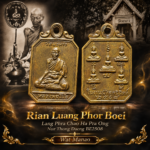
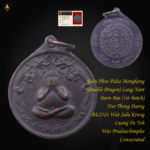
Rian Luang Phor Charm (Lp Cheam) Nur Ngern Longya BE2536 Wat Chalong
| Type | Rian |
| Monk | Luang Phor Cheam |
| Temple | Wat Chalong |
| B.E. Year | 2536 |
| Material | Ngern Longya |
| SKU | TAC-0407 |
Authentic Rian Luang Phor Cheam, Wat Chalong BE 2536 in ngern longya. Complete with original temple box. Southern lineage piece from Singapore dealer TAC.
What is the Rian Luang Phor Cheam from Wat Chalong BE 2536?
The Rian Luang Phor Cheam is a portrait coin (roop muean rian) issued by Wat Chalong in BE 2536, cast in ngern longya — silver-toned metal with enamel colour accents. It honours Luang Phor Cheam, the monk widely remembered as the Protector of Phuket, and comes with its original temple box intact.
The monk behind the coin — and why Wat Chalong collectors take note
Luang Phor Cheam was born in BE 2370 (1827 CE) and ordained young into monastic life at Wat Chalong, formally known as Wat Chaiyathararam. He spent decades building a reputation grounded in vinaya discipline, meditation practice, and a deep, unshowy compassion — metta (เมตตา) — that drew ordinary people to him long before any amulet tradition formed around his image.
The moment that fixed his place in Southern Thai memory was the Angyee Rebellion of 1876 (BE 2419), a violent secret-society uprising tied to Phuket’s tin-mining era. Historical accounts describe him steadying the community — encouraging unity, and blessing protective cloths and talismans for villagers. That episode is the root of his khlaew khlaad (แคล้วคลาด — avoidance of danger) reputation, which stayed with his lineage long after he passed in BE 2451 (1908 CE).
Portrait coins bearing his likeness are therefore read by collectors through a specific lens: not just as amulets, but as wearable references to a historical figure whose authority came from conduct, not ceremony. That framing matters for the BE 2536 issue — it was produced by the same temple that preserves his image and his story.
Nuea ngern longya — what the material tells a collector
The nuea (นื้อเงิน / material) here is ngern longya — a silver-toned metal base finished with longya (ลงยา) enamel work. In the context of the broader Thai Buddhist amulet tradition, longya finish on a rian is a deliberate choice: the colour accents frame the portrait and make it readable at a distance, while still holding detail for close inspection.
On a well-kept piece, the silver tone brings out facial contours, robe lines, and rim lettering cleanly. The longya itself should show stable, even colour with crisp boundaries — that is what collectors mean when they say the enamel work “reads well.” Poor longya shows lifting edges, uneven tone, or bleed past the boundary lines.
- Portrait clarity: sharpness of facial features and robe detail against the silver-toned surface.
- Rim and legend: cleanliness of the lettering around the coin’s edge — a quick gauge of strike quality.
- Longya condition: stable tone, clean colour boundaries, no lifting or crazing.
- Temple box: original Wat Chalong box — not mere packaging, but a preservation record that elevates the set.
Original temple boxes are lost more often than they are kept. A BE 2536 set with the box intact is a complete preservation piece, not a loose coin that has been separated from its context. That completeness is a genuine factor in how Southern-lineage collectors and Phuket devotees assess the piece.
What collectors look for and how this piece stands
No certificate is listed with this piece. For a BE 2536 Wat Chalong rian, authentication leans on physical reading: portrait sharpness, rim detail, and the quality of the longya execution. Collectors familiar with Wat Chalong issues will cross-reference against known reference coins from the same period.
Demand for Luang Phor Cheam portrait coins sits primarily with Southern Thai lineage collectors, Phuket devotees, and collectors focused on Wat Chalong’s output. The combination of recognisable temple identity, intact longya, and a complete original box is what keeps this category steadily regarded rather than volatile.
We at TAC sourced this BE 2536 Rian Luang Phor Cheam as a complete set — coin and original Wat Chalong temple box together. For collectors focused on Southern Thai lineage or Wat Chalong issues specifically, the intact box is the detail that lifts this from a standard loose rian.
Attributes reflect Thai Buddhist devotional tradition and are not measurable claims.