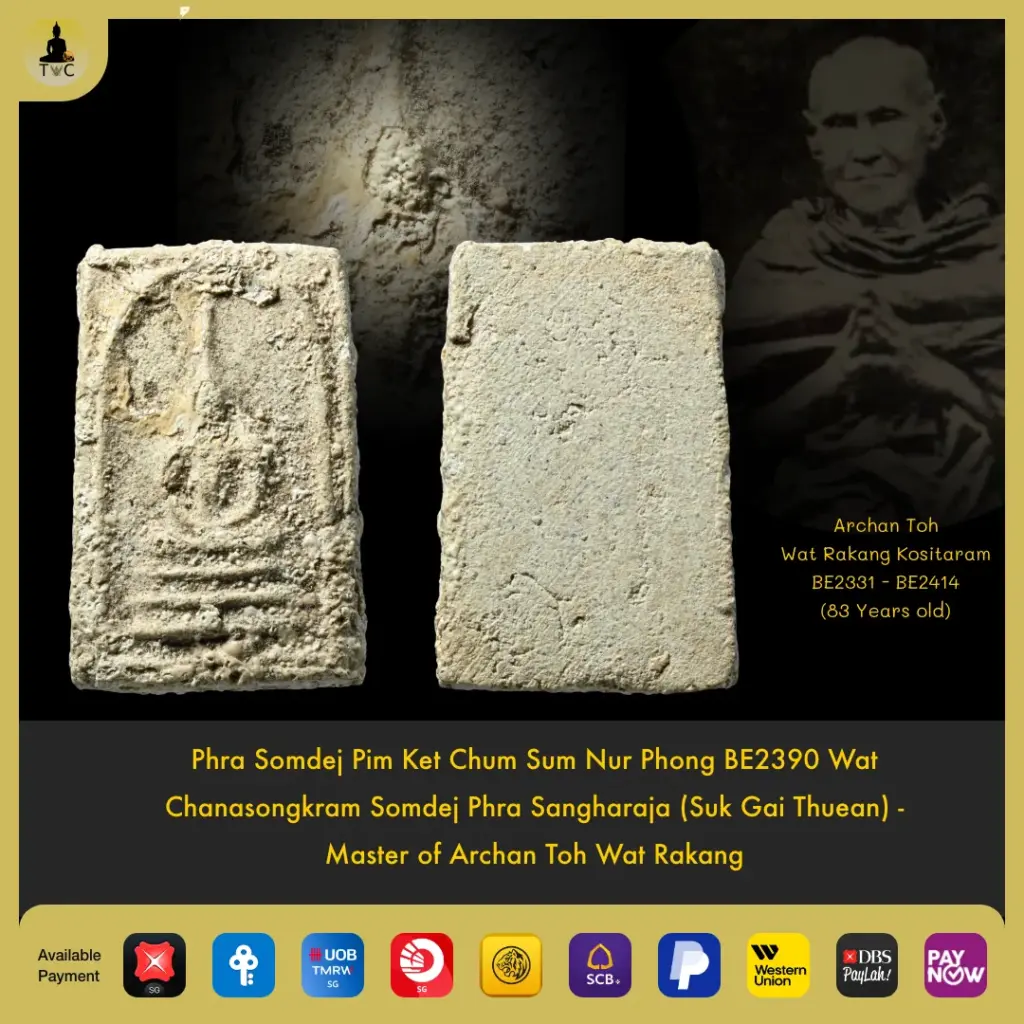
[SOLD] Phra Somdej Pim Ket Chum Sum Nur Phong BE2390 Wat Chanasongkram Somdej Phra Sangharaja (Suk Gai Thuean) – Master of Archan Toh Wat Rakang (Rare)
| Type | Phra Somdej |
| Monk | Archan Toh |
| Temple | Wat Chanasongkram |
| B.E. Year | 2390 |
| Material | Phong |
| SKU | TAC-0112 |
**SOLD**Phra Somdej Pim Ket Chum Sum Nur Phong BE2390 Wat Chanasongkram Somdej Phra Sangharaja (Suk Gai Thuean) - Master of Archan Toh Wat Rakang (Rare)Biography Phra Somdej Arahant Pim Ket Chon Sum, Wat Chanasongkram Estimated
Phra Somdej Arahant Pim Ket Chon Sum, Wat Chanasongkram
Estimated Creation: circa B.E. 2360
Material: Sacred powder (Nuea Pong)
Mold Type: Ork Rong (Indented Chest)
Estimate Size: 2.8m – 3.3cm
Origin: Discovered in the crypt beneath the principal Buddha image of Wat Chanasongkram, Bangkok
Historical Context of Wat Chanasongkram and the Amulet’s Creation
According to historical records, this amulet was likely created during the early Rattanakosin period, around B.E. 2360 (1817 CE). It is believed to have been crafted under the guidance of Somdej Phra Sangharaja (Suk Gai Thuean), who was also the teacher of Somdej Phra Buddhacharn (Toh Promrangsri).
Wat Chanasongkram, formerly known as Wat Klang Na, is located near the silk canal on Chakrabongse Road in the Phra Nakhon district of Bangkok. The temple was originally built during the Ayutthaya period (founder unknown). Later, Prince Maha Sura Singhanat, brother of King Rama I, restored the temple and commissioned construction in the Ayutthaya architectural style
King Rama I later renamed it “Wat Chanasongkram” (“Temple of Victory”) in honor of Prince Sura Singhanat’s military victories over the Burmese army during the Nine Armies War around B.E. 2330.
Discovery of the Somdej Crypt (B.E. 2515)
In B.E. 2511, the temple initiated renovation of its main Buddha image and surrounding sacred statues. During this period, workers reconstructed the base structure of the Buddha platform. Because the temple was actively used for religious activities, renovation progressed slowly.
On Tuesday, 29 August B.E. 2515, while novice monks were having lunch, a worker reported finding a small Phra Somdej amulet while digging beneath the base of the principal Buddha image. Further excavation revealed:
-
Over 10,000 Phra Somdej amulets, many found fused together in clusters of 50–60 pieces each
-
A Sukhothai-era ceramic urn containing 35 special gold-leafed amulets
Due to the fragile condition of many amulets, only approximately 5,250 were considered intact and suitable for distribution.
Classification of Discovered Phra Somdej Types
The amulets were sorted and categorized into eight main mold types:
-
Phra Somdej Pim Yai (Large mold), three-tiered base
-
Phra Somdej Pim Lek (Small mold), three-tiered base
-
Phra Somdej Arahant Pim Ket Chon Sum (arch-touching crest), with two subtypes:
-
Pim Ork Rong (Indented chest)
-
Pim Ork Ton (Flat chest)
-
-
Phra Somdej Pim Than Saem (Split base)
-
Phra Somdej Pim Khanaen (Miniature mold), three-tiered base
-
Phra Somdej Pim Khanaen, five-tiered base
-
Phra Somdej Pim Jiw (Tiny mold), five-tiered base
-
Phra Somdej Pim Nang Phaya, modeled after the famous Sukhothai-era Phra Nang Phaya
The first four types together numbered approximately 4,000 pieces. The special miniature types totaled about 1,000 pieces. Around 200 pieces were of the tiny Pim Jiw type. An additional 35 gold-leafed miniature amulets were found inside the ceramic urn. The Pim Nang Phaya type was found in very limited quantity, with only a few pieces discovered.
Altogether, the total number of intact Phra Somdej amulets recovered was approximately 5,250.
Distribution and Blessing Event
Once sorted, the remaining amulets were distributed under the direction of Phra Maha Prachum (Pali 8), then-secretary to the abbot. The amulets were given to attendees during the annual Maha Chat sermon at Wat Chanasongkram on 1–2 September B.E. 2515, one per person. After the event, the temple made the remaining amulets available for donation and worship, with official receipts issued.
Estimated Age and Attribution
There is no direct evidence identifying the creator or exact date of the amulets found under the main Buddha image. However, experts widely agree—based on material composition, mold characteristics, and natural aging—that the amulets predate those from Wat Rakang and Wat Bang Khun Phrom. It is strongly believed they were created around B.E. 2360, during the era of Somdej Phra Sangharaja (Suk Gai Thuean).
About Somdej Phra Sangharaja Suk (Gai Thuean)
A revered figure in Thai Buddhist history:
-
Teacher of Somdej Phra Buddhacharn Toh
-
Renowned for both scriptural knowledge and deep meditation mastery
-
Known for his ability to radiate loving-kindness, earning the nickname “the Wild Chicken Monk” for taming wild chickens
-
Served as Upajjhaya (preceptor) for King Rama III and King Rama IV during their ordination
-
Considered one of the most spiritually powerful monks of the Rattanakosin era
He resided at Wat Tha Hoi in Ayutthaya before being invited by King Rama I to Bangkok to teach Vipassana meditation. His teachings influenced both the meditation and sacred arts traditions of early Rattanakosin Buddhism.
Artistic and Spiritual Value
The Somdej amulets discovered at Wat Chanasongkram are regarded as authentic early Bangkok-period sacred objects. The artistry and craftsmanship closely resemble Somdej Arahant amulets from Wat Mahathat. Notably, these amulets were enshrined beneath the main Buddha image that Prince Maha Sura Singhanat deeply revered after the Nine Armies War.
He is said to have draped his personal yantra cloth over the image as an offering, after which the statue was enlarged and enshrined with sacred plaster. The discovery of these amulets under that same statue affirms their authenticity and sacred lineage.
These Phra Somdej are recognized in the amulet community as rare, highly venerable, and not modern replicas or planted relics.
Attributes reflect Thai Buddhist devotional tradition and are not measurable claims.


