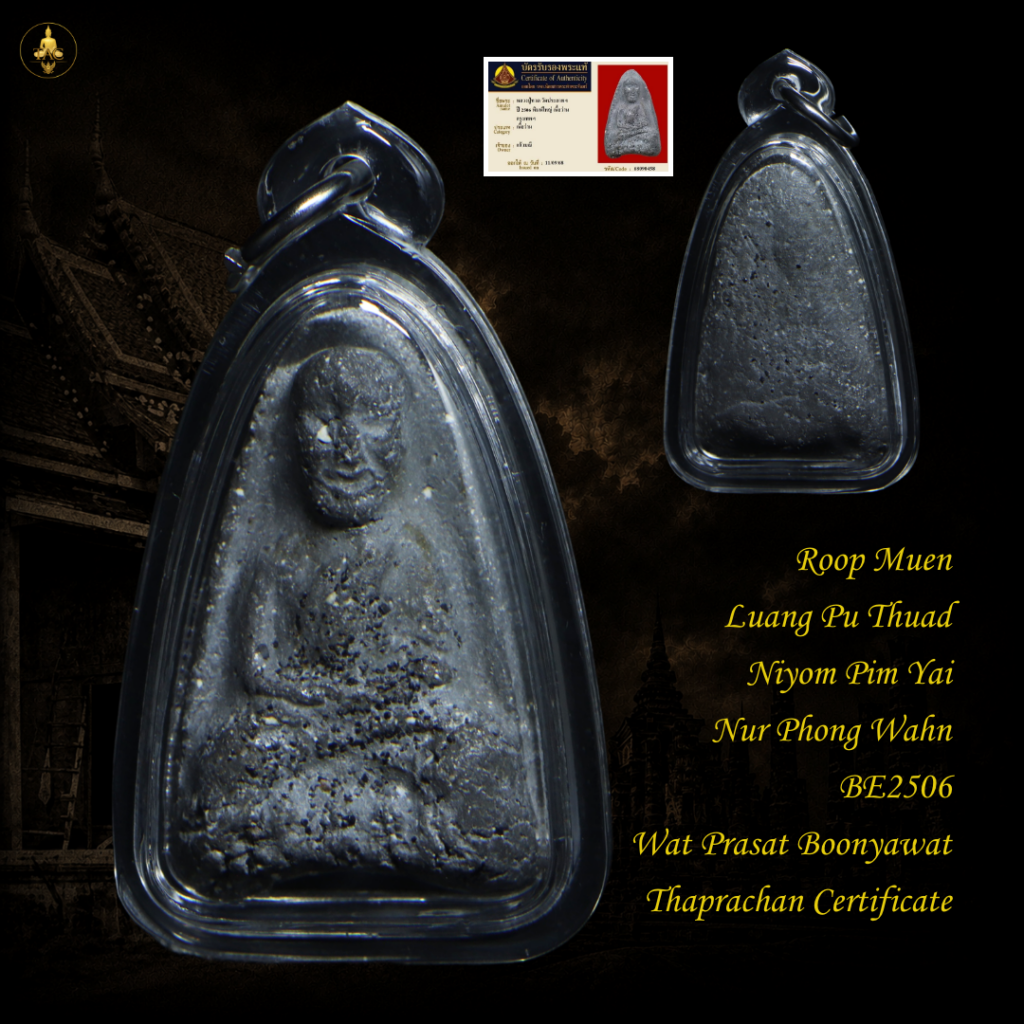
Phra Luang Pu Thuad (Lp Thuad) Pim Yai Nur Wahn BE2506 Wat Prasat Boonyawat
| Type | Luang Pu Thuad |
| Monk | Luang Pu Thuad |
| Temple | Wat Prasat |
| B.E. Year | 2506 |
| Material | Nur Phong Wahn |
| Condition | Good |
| Certificate | Thaprachan |
| SKU | TAC-0129 |
The Luang Pu Thuad Luang Pu Thuad Pim Yai Nur Phong Wahn edition of B.E. 2506, consecrated at Wat Prasat, is among the most historically significant amu…
The Luang Pu Thuad Luang Pu Thuad Pim Yai Nur Phong Wahn edition of B.E. 2506, consecrated at Wat Prasat, is among the most historically significant amulets available to collectors in Singapore and across Southeast Asia, distinguished by its extraordinary consecration assembly and rare sacred composition. This edition was created in direct response to a devastating fire that destroyed much of Wat Prasat in B.E. 2506, with the resulting mass chanting ceremony serving both to raise rebuilding funds and to empower a series of protective amulets for devotees.
The legend of Luang Pu Thuad centres on his miraculous ability to protect devotees from danger, most famously attributed to his power over the sea and his role as a guardian of travellers. His amulets have been venerated across Thailand, Malaysia, Singapore, and the broader Chinese diaspora for generations. The B.E. 2506 Wat Prasat edition stands as a mid-century milestone within his broader amulet lineage.
The mixture used in this batch incorporated fragments of ancient amulets including Somdej Wat Rakhang, Somdej Wat Bangkhunphrom, and Luang Phor Thuad B.E. 2497, grounding this edition in a deep continuum of Thai Buddhist sacred material tradition.
Luang Pu Thuad and Wat Prasat Heritage
In B.E. 2506, Wat Prasat suffered catastrophic fire damage that left the temple nearly entirely destroyed. To support the rebuilding effort, the temple organised a mass chanting ceremony at which a broad range of amulet types were consecrated and blessed in two separate rounds during that same year.
The first chanting session was held continuously for three days and three nights, from the 6th to the 9th of March B.E. 2506. The second session followed later that year, lasting four days and four nights, from the 13th to the 15th of November B.E. 2506. Both rounds were conducted under the guidance of an exceptional assembly of senior monks from across Thailand.
This dual consecration structure is considered a defining characteristic of the B.E. 2506 Wat Prasat edition and contributes directly to its standing within the broader Thai Buddhist amulet tradition. The ceremony’s scale and the temple’s historical circumstance give this batch a documentary and spiritual weight that later editions cannot replicate.
Nur Phong Wahn Luang Pu Thuad — Composition and Craftsmanship
Nur Phong Wahn refers to a sacred herbal powder base incorporating botanicals chosen for their auspicious and spiritually activating properties. In this edition, the Phong Wahn mixture included Wahn Jampasak, associated with power, authority, and prestige, alongside Phong Itije (prosperity), Phong Maharaj, and Phong Puttamang. These powders were combined with Nur Din (sacred soil), See Pheung (lip wax), and Raw Leklai, a rare metal charm widely believed to melt at candle temperature.
The composition also incorporated soil from four holy places associated with the Buddha’s time, broken fragments of Somdej Wat Bangkhunphrom, mineral ore, and holy metal plates inscribed with Yantras. These ingredients were drawn from sources of established sacred authority, and their inclusion is documented as part of this edition’s provenance.
Each amulet was hand-pressed and bears natural surface characteristics consistent with mid-20th-century Nur Phong Wahn craftsmanship, including tonal variation ranging from pale herbal brown to deeper, aged shades. These physical markers are among the primary reference points used by specialists when examining the Luang Pu Thuad Luang Pu Thuad Wat Prasat B.E. 2506 piece.
Spiritual Benefits of Luang Pu Thuad by Luang Pu Thuad
The Luang Pu Thuad Luang Pu Thuad Wat Prasat B.E. 2506 edition is regarded as a multi-faceted protective and fortune-drawing amulet. Devotees across Thailand, Singapore, Malaysia, and the Chinese-speaking world have venerated this batch specifically for Luang Pu Thuad’s renowned power over danger and adversity.
- Klaew Klaad — protection from physical danger, accidents, and harm, particularly valued by those who travel frequently by road or sea.
- Metta Mahaniyom — the cultivation of compassion and social goodwill, supporting harmonious relationships in professional and personal spheres.
- Maha Lap — the attraction of fortune, material prosperity, and fortunate circumstance across business and daily life.
Luang Pu Thuad BE 2506 — Authentication and Collector Value
This edition carries a Thaprachan certificate, issued by one of Thailand’s most respected amulet authentication bodies. Thaprachan certification provides collectors with documented verification of the amulet’s origin, material composition, and period, and is considered a strong marker of authenticity within the serious collector community across Singapore, Malaysia, Thailand, and Greater China.
The Luang Pu Thuad Luang Pu Thuad B.E. 2506 Wat Prasat edition is further distinguished by the breadth of its consecrating assembly. Over sixty senior monks participated, including LP Nak and LP Hin of Wat Rakhang, Pra Ajahn Tim of Wat Chang Hai, LP Toh of Wat Praduchimplee, LP Pae of Wat Pikultong, LP Klai of Wat Suan Kun, and many others drawn from temples throughout Central Thailand and beyond. The scale of this assembly is exceptional even by the standards of mid-century mass consecration ceremonies.
Pieces from this batch have become increasingly scarce in the secondary market, and certified examples with clear provenance command sustained collector interest. The combination of historical circumstance — the temple fire and rebuilding campaign — sacred material depth, and the strength of the consecrating assembly places this edition among the more collectible Luang Pu Thuad releases of the B.E. 2500s decade.
Attributes reflect Thai Buddhist devotional tradition and are not measurable claims.