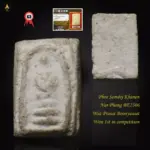
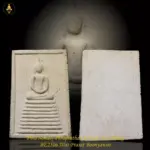
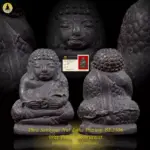
Phra Kring Prathan Porn (Phra Kring Deed Nam Mon) Nur Thong Phasom BE2506 Wat Prasat Boonyawat
| Type | Phra Kring |
| Temple | Wat Prasat |
| B.E. Year | 2506 |
| Material | Thong Phasom |
| SKU | TAC-0449 |
Authentic Phra Kring Prathan Porn (Deed Nam Mon), Wat Prasat Boonyawat BE 2506. Cast in Thong Phasom. Major phutthaphisek ceremony release.
What is the Phra Kring Prathan Porn (Deed Nam Mon) from Wat Prasat BE 2506?
The Phra Kring Prathan Porn, also named Deed Nam Mon, is a small-cast seated Buddha amulet issued at Wat Prasat Boonyawat in Bangkok during BE 2506. Cast in nuea Thong Phasom — a mixed-metal alloy — it was released as part of a major phutthaphisek (consecration ceremony) period that collectors still reference by the shorthand “Wat Prasat 2506.”
The BE 2506 Consecration at Wat Prasat and Why Collectors Still Track It
Wat Prasat Boonyawat is an old Bangkok temple in the Dusit area with a clear collector footprint built on its mid-era releases. The BE 2506 event was not a quiet, single-day affair. Collector accounts describe a multi-day phutthaphisek atmosphere — sustained chanting, collective monk participation, and blessing-water rites — that gave the entire release a strong ceremonial identity.
That context is why “Wat Prasat 2506” functions as a recognised category in Thai collecting circles rather than just a date. Pieces from this period carry a shared anchor: the temple, the ceremony, and the consecration memory attached to that run. Within the broader Thai Buddhist amulet tradition, Phra Kring pieces tied to a documented temple event tend to hold collector attention more reliably than generic castings without that background.
The name “Deed Nam Mon” (เดือดน้ำมนต์) is a ritual-idiom label. Collectors read it as a reference to energised blessing-water rites — a pointer to the intensity of the ceremony’s ritual focus, not a literal description of outcome. “Prathan Porn” (ประทานพร), the other name this piece carries, translates broadly as “bestowing blessings” — a naming convention consistent with Kring pieces intended for daily protective and auspicious wear.
Nuea Thong Phasom — Reading the Metal on a Piece This Age
Thong Phasom (ทองผสม) is a mixed-metal alloy family. On pieces cast in BE 2506, the surface typically presents warm gold-brass tones that have had decades to develop a natural patina. That ageing process is part of how collectors study authenticity — it is not just aesthetic.
- Natural darkening tends to settle in recesses, while raised contours — robe lines, facial features, base edges — stay comparatively brighter from decades of handling.
- Authentic older castings often show fine casting pores or subtle flow lines. These are absent or inconsistent on modern re-casts and polished replicas.
- For Kring types specifically, collectors also check sound and weight. Internal casting density matters, and a genuine piece from this era will feel and sound different from a later copy.
The pim (mould) details collectors focus on here are facial proportion, robe-line consistency, and base geometry. On genuine Wat Prasat 2506 Kring pieces, those elements stay coherent within the mould family. Any significant deviation in proportion or finishing is worth flagging before a purchase decision.
What Collectors Carry This For and How Value Is Set
Phra Kring is traditionally associated with steadiness rather than dramatic protection symbolism. Collectors and devotees describe wearing it as a reminder of calm discipline — keeping precepts, staying grounded, reducing friction in daily life. Three frames come up repeatedly in Thai amulet culture around Kring pieces:
- Khum-khrong (คุ้มครอง) — protective framing covering travel safety and daily steadiness.
- Metta (เมตตา) — softer social harmony, easier communication, calmer interactions especially in work settings.
- Serm siri-mongkol (เสริมสิริมงคล) — auspicious reinforcement, a devotional anchor for confidence and positive direction.
These are traditional beliefs — how collectors and devotees frame wearing this piece, not claims about outcome. For many long-term collectors, that “quiet” function is exactly the point. A Kring is more about grounding the mind than chasing spectacle.
We at TAC are offering this Phra Kring Prathan Porn (Deed Nam Mon) in nuea Thong Phasom from the well-documented Wat Prasat Boonyawat BE 2506 consecration period — a release that collectors across multiple circles still reference by temple and year as a category of its own. For a collector tracking mid-era Bangkok temple pieces, the combination of the Deed Nam Mon ceremony context and the Thong Phasom casting makes this a grounded, historically anchored addition rather than a generic Kring.
Attributes reflect Thai Buddhist devotional tradition and are not measurable claims.