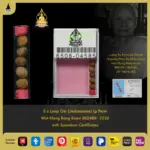
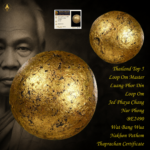
[SOLD] Loop Om Maha Jindamanee BE2400-2415 Phra Palad Pan, Wat Tukata Nakhon Pathom
| Type | Loop Om Maha Jindamanee |
| Monk | Phra Palad Pan |
| Temple | Wat Tukata |
| B.E. Year | 2400 |
| Material | Nur Jindamanee |
| Condition | Very Good |
| Certificate | Competition |
| Competition | Won 2ND placing |
| SKU | Wat Tukata Nakhon Pathom |
Authentic Loop Om Maha Jindamanee by Phra Palad Pan, Wat Tukata BE 2400. Nur Jindamanee nuea, Competition certified.
What is the Loop Om Maha Jindamanee by Phra Palad Pan, Wat Tukata?
The Loop Om Maha Jindamanee Phra Palad Pan is an early Rattanakosin period amulet created at Wat Tukata in BE 2400. Pressed from Nur Jindamanee — a dense sacred mineral and herbal composition — and shaped in the loop-om form, it holds Competition certification and ranks among the more significant pieces to come out of that temple’s classical output.
Phra Palad Pan and what made his output matter
Phra Palad Pan was active in the early Rattanakosin era, when the standards for sacred amulet production in central Thailand were being set by a small number of monks with deep command of Wicha — the esoteric sacred sciences. His reputation rested on two things: his knowledge of sacred mineral and herbal compositions, and the rigour of his consecration practice. Those two factors together are what collectors still point to when they discuss his pieces.
The term “Maha Jindamanee” carries specific weight in that context. Jindamanee refers to a jewel-like sacred substance; Maha elevates that to the highest order. Monks did not apply that designation loosely, and Phra Palad Pan’s use of it on this run reflects the seriousness of the material and the ceremony behind it.
The nuea, the form, and what Wat Tukata contributed
Nur Jindamanee as a nuea (material/substance) is built from sacred earths, mineral powders, and consecrated herbal ingredients blended according to Wicha formulas of the period. The result is physically distinctive — collectors who handle enough examples learn to recognise its density and surface character. It is not a generic powder paste; the composition was specific to this lineage.
The loop-om form was a deliberate choice. A fully enclosed loop encapsulates the sacred content on all sides, making it a compact wearable vessel — practical for daily carry without sacrificing the integrity of the muan sarn (sacred powder blend) inside. Phra Palad Pan favoured this form for that reason.
Wat Tukata provided the environment for consecration. Sacred chanting, prolonged meditation, and phutthaphisek (formal Buddhist consecration ceremony) were all conducted within the temple grounds. The temple has contributed to the broader Thai Buddhist amulet tradition across this period, and its association with Phra Palad Pan’s output gives these pieces a clear and traceable origin.
What collectors look for and how this one is certified
With any piece from BE 2400, the first question is always authenticity — age alone makes verification non-trivial. This Loop Om Maha Jindamanee carries Competition certification, which means it has passed examination by an expert panel under competition conditions. That is the standard collectors in Singapore, Malaysia, and Greater China treat as credible third-party verification.
When assessing a piece like this, experienced collectors focus on a few specific points:
- Nuea consistency — the density, colour, and surface texture of the Nur Jindamanee material against known reference pieces
- Loop-om form integrity — the shape and proportion of the enclosed loop, which should match the pim (mould) characteristics documented for Phra Palad Pan’s output from Wat Tukata
- Age indicators — natural wear patterns and patina consistent with a piece of this period, not artificially induced
- Certification paperwork — the Competition certificate itself, checked against the issuing body’s records
Certified examples from BE 2400 with this lineage are not common on the open market. When they do appear, collector interest from across the region tends to be immediate.
This Loop Om Maha Jindamanee from Phra Palad Pan of Wat Tukata, dated BE 2400, represents one of the earliest and most historically significant amulets from the Rattanakosin period that we at TAC have had the privilege of handling — pieces of this era in Nur Jindamanee material are exceptionally scarce in the open market, and this example carries a competition certificate that confirms its authentication within the collector community. Phra Palad Pan's reputation for mastery of sacred mineral and herbal compositions is well-documented among serious collectors in the Thai amulet circuit, and the Maha Jindamanee designation places this firmly among his most prized consecrated works. For collectors focused on early Rattanakosin-period pieces, particularly those with verifiable provenance and third-party authentication, this is the calibre of amulet that rarely surfaces — and when it does, it seldom remains available.
Attributes reflect Thai Buddhist devotional tradition and are not measurable claims.