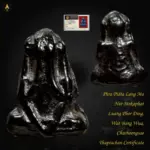
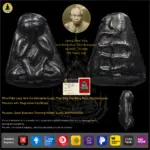
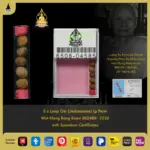
Loop Om Jed Phaya Chang BE2490 Luang Phor Ding (Lp Ding) Wat Bang Wua, Nakhon Pathom
| Type | Loop Om |
| Monk | Luang Phor Ding Wat Bang Wua, Chachoengsao |
| Temple | Wat Bang Wua |
| B.E. Year | 2490 |
| Material | Nur Phong |
| Condition | Very Good |
| Certificate | Thaprachan |
| SKU | TAC-0810 |
Authentic Loop Om by Luang Phor Ding Wat Bang Wua, Chachoengsao. BE 2490 Nur Phong, Pong Ya Jed Phaya Chang Sarn. Thaprachan certified.
What is the Loop Om by Luang Phor Ding Wat Bang Wua, Chachoengsao?
The Loop Om Luang Phor Ding Wat Bang Wua, Chachoengsao is a spherical sacred powder amulet produced in BE 2490 at Wat Bang Wua in Chachoengsao Province. Pressed from Nur Phong (sacred powder blend) and certified by Thaprachan, it ranks among the most documented mid-century amulets from the Eastern region of Thailand.
Luang Phor Ding and the story behind the BE 2490 production
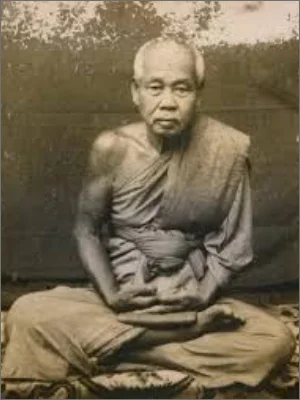
Luang Phor Ding Wat Bang Wua, Chachoengsao — formally styled Phra Khru Wimol Khannarak — was the presiding master at Wat Bang Wua. His standing in collector circles rests on deep meditative practice and an unrivalled command of ancient Wicha (sacred sciences), particularly those governing protection and invulnerability.
The Loop Om of BE 2490 was produced on two distinct occasions. The primary batch was blessed by Luang Phor Ding himself and distributed at temple festivals and his birthday celebrations. A second, closely related batch came about at the request of his nephew, Luang Phor Khrim, when Luang Phor Khrim was invited to become abbot of Wat Khlong Suan around the 1940s — these were intended for those who helped build that temple.
Luang Phor Ding personally gathered and consecrated the second batch to his own specifications, then passed custody to Luang Phor Khrim. He recorded in writing that this set belonged to Luang Phor Khrim and numbered approximately half a bowl — around 4,000 pieces. Luang Phor Khrim rarely distributed them, and after his passing more than a thousand were found remaining in his kuti (monastic dwelling).
What the phong is made from and how the pieces were consecrated
The nuea (material/substance) at the heart of this amulet is Pong Ya Jed Phaya Chang Sarn — the Sacred Powder of Seven Elephant Kings. Its preparation required moss and fragments gathered from the chedi (stupas) of seven pagodas, boundary stones (sema) from seven temples, and sacred stones from seven uposatha (ordination halls), combined with Pong Ittijae and Pong Maharaj. These components were ground in a mortar under continuous chanting of protective incantations.
The muan sarn (sacred powder blend) was then moulded into spheres approximately 1 cm in diameter. Once dry, each piece was coated with rak — a traditional herbal lacquer resin — producing the characteristic dark, aged surface associated with this series. That finish is one of the first things an experienced collector checks when handling a piece.
Luang Phor Ding retained the finished Loop Om within his kuti for extended periods, performing daily meditative empowerment focused on Kongkraphan (invulnerability) and Maha Ut (the power to stop weapons). He distributed amulets only once fully satisfied with their readiness. That standard of care is a large part of why total output remained so limited.
Where Wat Bang Wua fits and what the Thaprachan certificate means for collectors
Under Luang Phor Ding’s stewardship, Wat Bang Wua became closely associated with pong ya (sacred powder) amulets of documented lineage, drawing devotees from across Thailand. The Loop Om BE 2490 was partly distributed to support the temple’s restoration — a long-standing practice in which amulet runs served both devotional and practical purposes for the monastic community. Pieces traceable to Wat Bang Wua and Wat Khlong Suan provenance are today found mainly among families living near those two temples.
This sits within the broader Thai Buddhist amulet tradition, where consecrated objects function as material expressions of a monk’s accumulated merit and meditative attainment. The documented dual-batch production history and the written record left by Luang Phor Ding himself make this piece unusual even within that tradition.
Authentic examples carry a Thaprachan Certificate — the recognised certifying authority for Thai amulets of this category and period. Certification confirms material composition, consecration lineage, and period of origin. For a piece this old, that document is not optional; it is the foundation of any serious transaction.
Collectors assessing authenticity focus on several specific points:
- The dark rak lacquer surface and aged patina consistent with BE 2490 production
- Spherical form approximately 1 cm in diameter — pim (mould) proportions should match documented reference pieces
- Material composition consistent with Pong Ya Jed Phaya Chang Sarn, visible under close inspection
- A valid Thaprachan Certificate confirming material, lineage, and period
- Provenance traceable to Wat Bang Wua or Wat Khlong Suan distribution
Genuine pieces are scarce. The labour-intensive preparation of the phong, combined with Luang Phor Ding’s exacting consecration standards, kept total output finite. Those who hold verified examples today tend not to let them go easily.
We at TAC consider the Loop Om Luang Phor Ding Wat Bang Wua, Chachoengsao BE 2490 one of the more historically grounded mid-century phong amulets from the Eastern region — the dual-batch production record and Luang Phor Ding's own written documentation of the Wat Khlong Suan set are genuinely unusual for this era. For a collector focused on verifiable lineage rather than speculation, the combination of documented output figures, a named secondary custodian in Luang Phor Khrim, and Thaprachan certification makes this a strong candidate for a serious collection.
Attributes reflect Thai Buddhist devotional tradition and are not measurable claims.