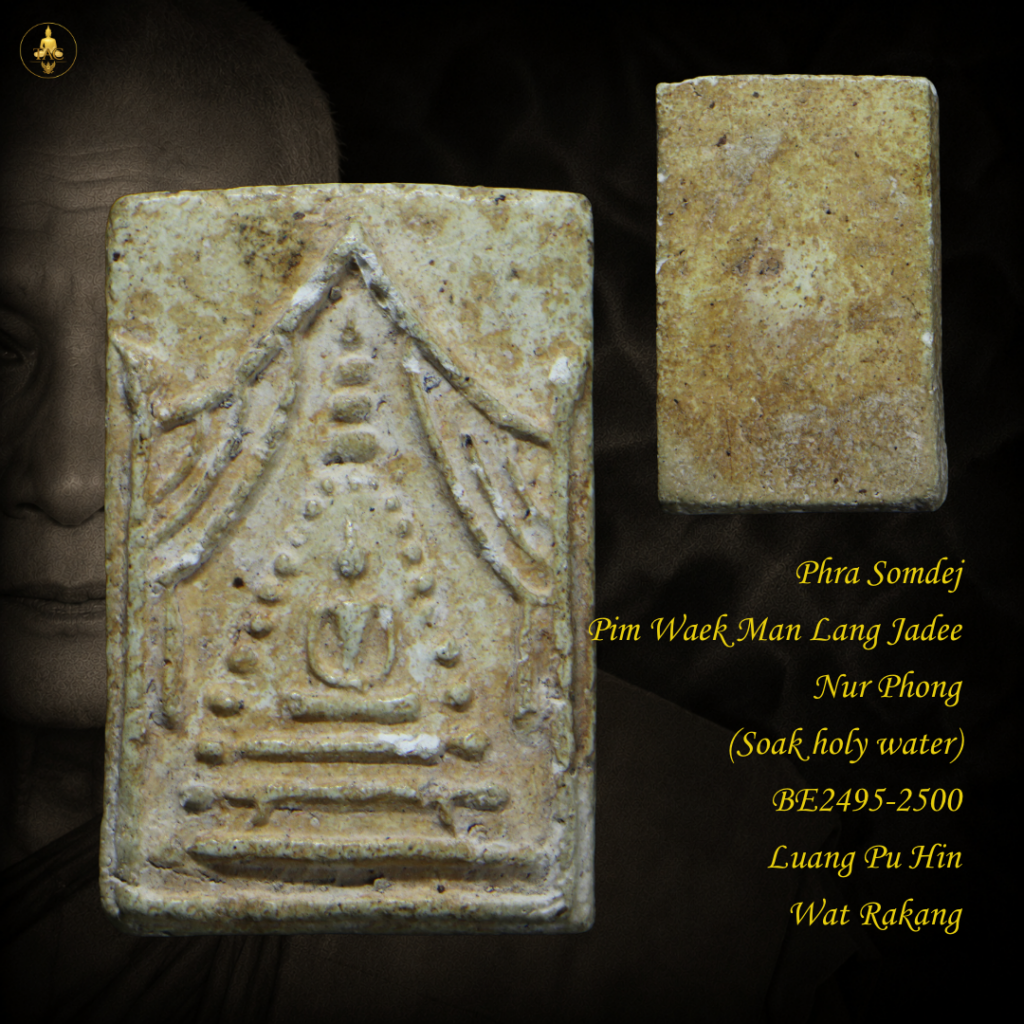
Phra Somdej Pim Waek Man Lang Jadee Nur Phong (Soak holy water) BE2495-2500 Luang Pu Hin Wat Rakang
| Type | Phra Somdej Pim Waek Man Lang Jadee |
| Monk | Luang Pu Hin Wat Rakang Kositaram |
| Temple | Wat Rakang |
| B.E. Year | 2495-2500 |
| Material | Nur Phong (Soak holy water) |
| Size | 40 x 27 mm |
| Condition | Fair |
| SKU | TAC-PhraSomdejPimWaekManLangJadee-LpHin-001 |

Adds this amulet and the offer at the bundle price — ready at checkout. Or mention it when you enquire on WhatsApp.
Authentic Phra Somdej Pim Waek Man Lang Jadee by Luang Pu Hin Wat Rakang Kositaram, BE2495-2500. Nur Phong (Soak holy water). No certificate.
What is the Phra Somdej Pim Waek Man Lang Jadee by Luang Pu Hin Wat Rakang Kositaram?
The Phra Somdej Pim Waek Man Lang Jadee Luang Pu Hin Wat Rakang Kositaram is a classical-era Thai amulet produced at Wat Rakang between BE 2495 and BE 2500. Pressed from Nur Phong (Soak holy water) — a phong (sacred powder blend) incorporating Somdej Toh’s original holy powders, crushed fragments of broken Phra Somdej Wat Rakang from LP Nak’s private collection, and holy water blessed by Somdej Pra Buddhachan Toh — this piece carries no certificate.
The powder behind this amulet and why the muan sarn matters
The nuea (material/substance) here is what collectors call Nur Phong — a muan sarn (sacred powder blend) soaked in sanctified water, which gives the pressed body its distinctive aged surface. Three layers went into it. First, the original holy powder formulations of Somdej Pra Buddhachan Toh. Second, crushed phong from broken original Phra Somdej Wat Rakang amulets, drawn from LP Nak’s private collection. Third, the entire mass was soaked in holy water personally blessed by Somdej Toh himself.
That material chain matters to collectors because it creates a direct, physical lineage to the most celebrated amulets in the Thai Buddhist amulet tradition. You are not simply holding a piece pressed from generic temple powder. Part of what is inside this pim (mould-type) began its sacred life as an earlier Somdej Toh amulet. That is an unusual claim for any piece, and in this case it is borne out by the documented composition.
The pim itself is identified by its “Lang Jadee” pagoda back — the reverse design that collectors use as a primary authentication marker for this type. When examining a candidate piece, the aged surface character of the Nur Phong body should be consistent with natural patination developed over more than six decades. Fresh-looking or mechanically smoothed surfaces are a red flag on any piece claimed to be from this era.
Luang Pu Hin Wat Rakang Kositaram and why his consecration counts
Luang Pu Hin Wat Rakang Kositaram was among the respected masters connected to Wat Rakang during the mid-20th century — a period widely regarded in collector circles as one of the most significant in Thai amulet history. His involvement in the consecration of this series places the Phra Somdej Pim Waek Man Lang Jadee Luang Pu Hin Wat Rakang Kositaram within a clearly documented lineage of sacred oversight at the temple.
Among Thai devotees there is a longstanding belief tied specifically to amulets consecrated by LP Nak, LP Hin, and LP Suphod: that a wearer will not die in suffering or distress. Whether or not a collector holds that belief personally, it tells you something about how the community has valued these masters across generations. That kind of sustained esteem tends to hold a piece’s standing in the market over time.
The name Pim Waek Maan itself carries meaning that devotees translate as: the power of this amulet would help the wearer pass through all difficulties and arrive at great achievement. That framing is specific to this pim type and is part of what distinguishes it within the broader Wat Rakang Phra Somdej family.
What collectors look for, and what to know about certification
This piece carries no certificate. For the BE 2495–2500 Wat Rakang series, that is not unusual — formal gammakan (committee edition) certification as collectors now know it was not standard practice for amulets produced during this era. Authenticity for pieces like this rests on material examination, pim comparison against established niyom (collector-standard reference) examples, and provenance tracing where possible.
Genuinely provenanced examples from this series are scarce. The combination of documented muan sarn lineage — running from Somdej Toh’s powder through LP Nak’s private collection to Luang Pu Hin’s consecration at Wat Rakang — means that when a piece can be traced to a verified source, collectors in Singapore, Malaysia, and across Greater China treat it as a meaningful acquisition.
Collectors traditionally associate this amulet with a wide range of qualities: obstacle clearance and safe passage through difficulty (Pim Waek Maan); protection and danger avoidance (Klawklad Plodpai); invulnerability associations (Kongkraphan and Maha-ut); loving-kindness drawn from those around the wearer (Metta Maha Niyom); lucky wealth (Maha Larp); and business and trade success (KaaKaai Dee). These are the terms you will hear from long-term holders of this piece.
We at TAC are offering this Phra Somdej Pim Waek Man Lang Jadee Luang Pu Hin Wat Rakang Kositaram from the BE 2495–2500 period — a series that holds consistent interest among serious collectors precisely because of its documented muan sarn lineage running through LP Nak's private collection back to Somdej Toh's original powders. There is no certificate with this piece, which is standard for the era, so buyers will want to rely on TAC's sourcing and any comparative reference material we can provide.
Attributes reflect Thai Buddhist devotional tradition and are not measurable claims.


