Who is Phra Sivali?
Phra Sivali the legend, iconography, and devotional traditions behind Thailand's beloved Arahant of Abundance.
What is Phra Sivali?
รู้จักพระสีวลีปางต่าง ๆ บูชาให้ถูกแล้วยิ่งรวย เสริมโชคลาภ เรียกทรัพย์ refers to understanding the different iconographic forms — known as pang — of Phra Sivali (พระสีวลีเถระ), one of the eighty great disciples of the historical Buddha, honoured with the title of Etadagga, meaning “most foremost in receiving offerings.” His story and iconography have shaped Thai Buddhist devotional culture for generations.
Phra Sivali is not simply a figure of religious biography. In Thai Buddhist tradition, he is understood as a living embodiment of abundance — a holy man whose very presence, the stories tell, caused offerings of food, water, and necessities to flow freely even in the most barren of places.
His legend, rooted in the Pali canon and amplified by centuries of Southeast Asian devotion, explains why Thai Buddhists have long sought his image for their shrines, and why understanding his different pang — his ritual postures and their symbolic meanings — remains so meaningful to collectors and devotees alike across Thailand, Singapore, Malaysia, and the broader Chinese-speaking world.
Origins and Historical Background of Phra Sivali
The origins of Phra Sivali’s extraordinary merit stretch across many lifetimes, as told in the Jataka and Pali commentarial literature of Theravada Buddhism.
In one of his most celebrated past lives, during the era of Vipassi Buddha — the twenty-fourth Buddha in the canonical lineage — a great king prepared to host the Buddha and a retinue of five hundred monks. The king invited all townspeople to contribute to the communal offering. The villagers, determined to give something truly rare, something that no one could claim was absent from their gift, identified a single missing item: raw wild honey, which was extraordinarily scarce in that time and place. Unable to find even a drop anywhere in the city, they posted agents at all four city gates, each offering the extraordinary sum of 1,000 kahapanas for a supply of honey — a remarkable figure, given that a single cow could be purchased for just 12 kahapanas.
It was at this moment that the man who would eventually be born as Phra Sivali entered the story. A simple villager from the countryside near the city, he happened to notice a wild honeycomb hanging from a branch along his path into town. Sensing good fortune, he cut the branch and carried the honeycomb into the city. Strangers immediately offered to buy it — first for 1 kahapana, then progressively higher, until the full offer of 1,000 kahapanas was placed before him. Curious at the escalating bids, he asked why honey was valued so dearly that day.
When he learned of Vipassi Buddha and the great offering being prepared, something shifted in his heart. He refused every monetary offer and instead declared, through an intermediary sent to the townspeople, that he would not sell the honeycomb at any price — he would offer it himself, with his own hands, directly to the Buddha. The assembled crowd rejoiced and praised his intention.
The Story of Phra Sivali: Key Figures and Events
The narrative of Phra Sivali weaves together past-life devotion, a miraculous birth, and a lightning-fast attainment of Arahantship — making it one of the most layered biographies in the Theravada hagiographic tradition.
When the villager presented his honey to Vipassi Buddha, he spoke humbly: “This is the humble gift of a poor man — please accept it.” The Buddha accepted, and then set a profound intention: that the honey would not run out until every one of the five hundred monks had received their portion. The legend holds that, through the power of Vipassi Buddha’s spiritual force, this came to pass exactly as wished. After the offering was complete, the young man made his own heartfelt vow — to be reborn, lifetime after lifetime, as one supremely endowed with labha, or material blessings.
That vow bore fruit in his final birth. He was born into the womb of Princess Suppavasa (พระนางสุปปวาสา), daughter of the king of the Koliya kingdom. Even while still unborn, his accumulated merit was said to cause a flow of five hundred cartloads of offerings to arrive at the palace morning and evening. Farmers reportedly brought their seed rice for the princess to touch, believing it would multiply a single grain into hundreds and thousands.
Yet Princess Suppavasa carried the child for seven years, seven months, and seven days — a prolonged and painful gestation understood in Buddhist teaching as the ripening of past-life karma. When her suffering became life-threatening, her husband sought the intervention of the Buddha, who sent his blessing: “May Suppavasa be well, free from sickness, and may she give birth to a healthy child.” The child was born safely and given the name Sivali (สีวลี) — meaning “one who brings happiness and prosperity to his kin.”
What followed was extraordinary even by the standards of Buddhist hagiography. At just seven days old, the infant Sivali was presented to the Elder Sariputta (พระสารีบุตร), one of the Buddha’s two chief disciples. Princess Suppavasa gave her consent for Sariputta to ordain the child. Sariputta taught the boy the Tajapancakakammatthana — a meditation on the five parts of the body — and instructed him to contemplate the suffering his mother had endured for seven years, seven months, and seven days: the fruit of old karma from his own past lives. As Sariputta drew the razor across the child’s head, a series of attainments unfolded in rapid succession:
- At the first stroke of the razor, Sivali attained Sotapatti — Stream-Entry, the first stage of Arahantship.
- When half the head was shaved, he attained Sakadagami — Once-Returner, the second stage.
- At three-quarters shaved, he attained Anagami — Non-Returner, the third stage.
- When the head was completely shaved, Sivali attained full Arahantship — liberation.
The Buddha then bestowed upon Phra Sivali the title of Etadagga in receiving offerings — the foremost among all disciples in the accumulation of labha (โลภ, material blessings and provisions). Wherever Sivali walked thereafter, the four requisites of monastic life — robes, food, shelter, and medicine — were said to appear in abundance, blessing not only him but all those who travelled in his company.
Cultural and Spiritual Significance of Learning about the different forms of Phra Siwali and worship him correctly to become even wealthier, enhance your fortune, and attract wealth.
The iconography of Phra Sivali translates his biography directly into visual form, giving Thai Buddhist devotional art a richly layered symbolic language.
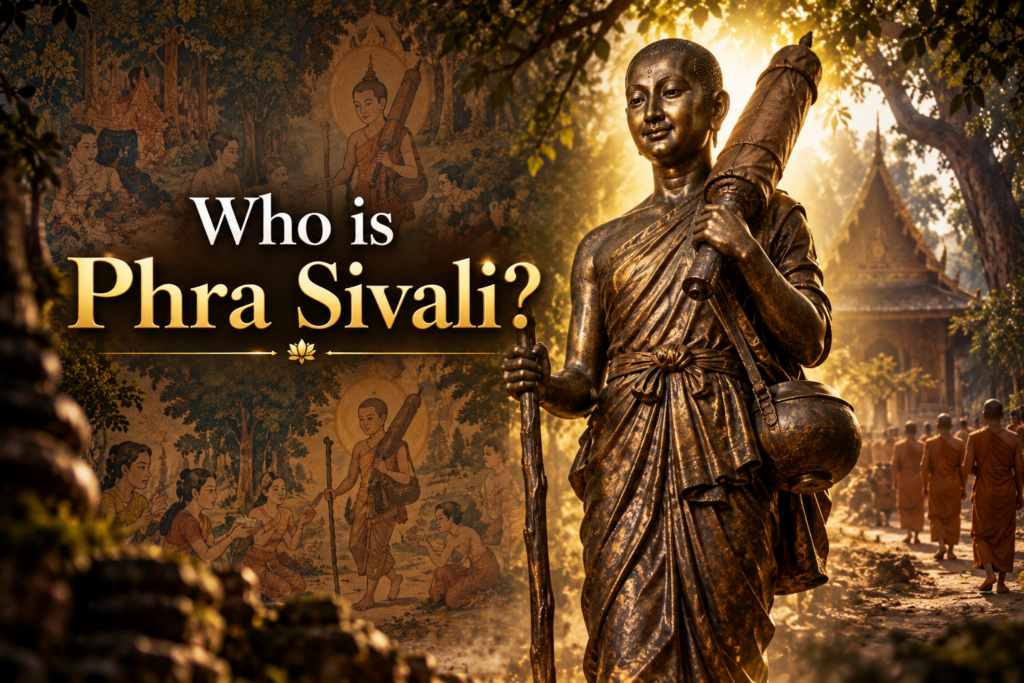
Two principal pang (ปาง) — ritual postures — are most familiar to Thai devotees. The first is Phra Sivali Pang Thudong (พระสีวลีปางธุดงค์), depicting the Arahant mid-stride in the posture of a wandering monk on ascetic practice. He carries a staff in his right hand, balances an umbrella-parasol (klot) over his left shoulder, and is equipped with an alms bowl, a shoulder bag, and a water vessel. Each object carries symbolic weight: the bowl and vessel represent perpetual abundance; the bag suggests the patient accumulation of provisions, never running short; the staff symbolises support and assistance coming from others; and the klot parasol represents shelter, protection, and peaceful wellbeing.
The second is Phra Sivali Pang Um Bat (พระสีวลีปางอุ้มบาตร or ปางจกบาตร), in which the figure sits in cross-legged meditation, the left hand cradling the base of an alms bowl while the right hand reaches into it. This posture conveys an image of inexhaustible blessing — the bowl is always full, always being drawn from, yet never empty. This seated form drew inspiration from the tradition of venerating Phra Sivali in Sri Lanka, where cross-legged devotional images became popular.
Devotees hold that worshipping Phra Sivali with sincere intention — and above all with generous, sustained effort, mirroring his own lifetimes of giving — draws prosperity and wellbeing. The traditional offering associated with him is raw honey (nam phueng dip), reflecting his decisive past-life gift. Where daily honey offerings are not possible, tradition suggests offering honey every Thursday, accompanied by fragrant flowers (lotus blossoms are particularly auspicious), fruit with auspicious names, three sticks of incense, and a single candle. The number of flowers is ideally five or nine — both considered fortunate numbers in Thai Buddhist custom.
Legacy of Phra Sivali in Thai Buddhist Tradition
The enduring resonance of รู้จักพระสีวลีปางต่าง ๆ บูชาให้ถูกแล้วยิ่งรวย เสริมโชคลาภ เรียกทรัพย์ in Thai religious culture reflects a deeply Buddhist understanding of how merit works: that what we give with genuine intention becomes the seed of what we receive.
Images of Phra Sivali began to be produced in Thailand in the period shortly before BE 2500 (AD 1957), with early Thai sculptors drawing on the iconographic tradition already well-established in Burma (Myanmar), where Phra Sivali has long been one of the most beloved figures in popular devotion. The Sri Lankan tradition of the seated alms-bowl posture added a second iconographic lineage that enriched Thai artistic output further.
Today, Phra Sivali images appear in homes, businesses, and temples across Thailand and throughout Southeast Asia. His story is taught as a lesson in the power of dana — generosity — and in the importance of giving what is truly needed rather than what is merely convenient. The tale of the honeycomb, the village man who refused a fortune in order to make a personal act of faith, remains one of the most vivid illustrations in Thai Buddhist folklore of how a single moment of sincere devotion can ripple across countless lifetimes.
For collectors and devotees in Singapore, Malaysia, Hong Kong, and Greater China, Phra Sivali occupies a meaningful place at the intersection of Thai Buddhist history and living spiritual practice. His different pang are not merely artistic variations — they are a visual vocabulary telling the full arc of his story, from the wandering monk of abundant blessings to the meditating master of inexhaustible grace. To learn more about Phra Sivali’s place among the great disciples of the Buddha, the Wikipedia entry on Sivali provides a useful introduction to his canonical biography across Theravada traditions.
Frequently asked questions
Phra Sivali (พระสีวลีเถระ) was one of the eighty great disciples (Asiti Mahasavaka) of the historical Buddha, who bestowed upon him the title of Etadagga — foremost among all disciples in receiving offerings and material blessings (labha). This distinction was earned through accumulated merit across many lifetimes, most famously through his past-life act of offering rare wild honey to Vipassi Buddha and five hundred monks, refusing payment of 1,000 kahapanas to do so personally. After his ordination in his final life, provisions of food, shelter, and necessities were said to arise wherever he travelled, benefiting those around him as well. The Buddha's recognition of this quality made Phra Sivali a central figure in Thai Buddhist devotional tradition focused on prosperity and abundance.
Phra Sivali was born to Princess Suppavasa (พระนางสุปปวาสา), daughter of the king of the Koliya kingdom, after a gestation lasting seven years, seven months, and seven days — understood in Buddhist teaching as the result of past-life karma. His safe birth followed the Buddha's spoken blessing to the suffering princess. At only seven days old, he was presented to the Elder Sariputta (พระสารีบุตร), who ordained and taught him the Tajapancakakammatthana meditation. As Sariputta shaved the boy's head, Sivali attained each of the four stages of awakening in succession — Stream-Entry at the first stroke, Once-Returner at the halfway point, Non-Returner at three-quarters, and full Arahantship when the shaving was complete.
Each pang — iconographic posture — of Phra Sivali encodes a specific dimension of his legendary qualities in visual form, making the image itself a teaching. The Pang Thudong (wandering monk) form, with its staff, parasol, bag, and vessel, expresses protection, support, and perpetual provision. The Pang Um Bat (alms-bowl) form, inspired by Sri Lankan tradition, conveys meditative stillness and inexhaustible abundance. Knowing which posture one is venerating — and the story behind it — is considered important in Thai Buddhist practice, as it aligns the devotee's intention with the specific qualities