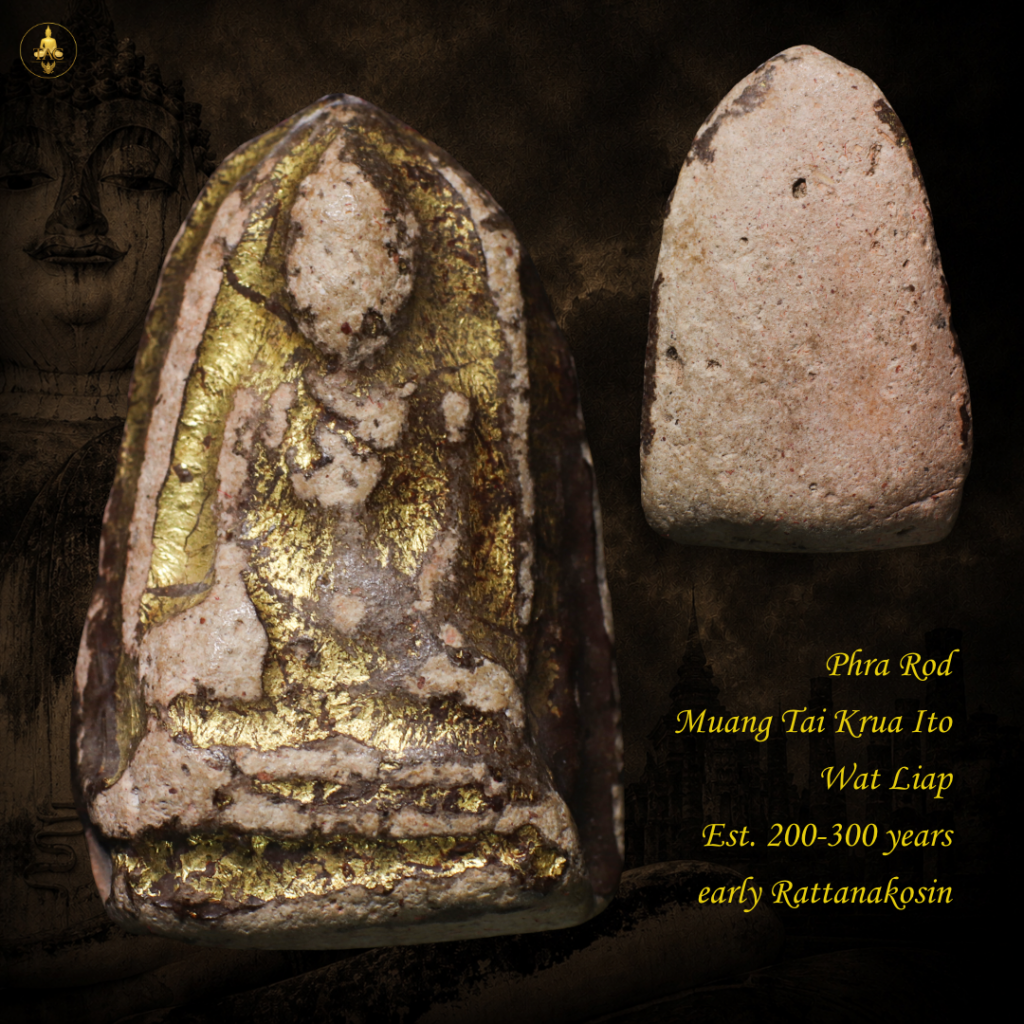
Phra Rod Muang Tai Krua Ito Nur Phong Wat Liap Est. 200-300 years early Rattanakosin
| Type | Phra Rod Muang Tai Krua Ito |
| Temple | Wat Liap |
| B.E. Year | 2200 |
| Material | Nur Phong |
| Condition | Fair |
| SKU | TAC-PhraRodMuangTaiKruaIto--001 |
Phra Rod Muang Tai Krua Ito from Wat Liap, Bangkok, BE 2200–2300. Nur Phong powder amulet created by Somdej Phra Sri Somphot. Singapore dealer TAC.
What is the Phra Rod Muang Tai Krua Ito from Wat Liap, and why do collectors care about it?
The Phra Rod Muang Tai Krua Ito is a small nur phong (sacred powder) amulet produced at Wat Liap (Wat Rat Burana), Bangkok, dated to BE 2200–2300. Created by Somdej Phra Sri Somphot and his close attendant Nai Thong Duang, it is sized and styled close enough to the Phra Rod of Wat Mahawan, Lamphun, that collectors in the South long nicknamed it “Phra Rod of the South.”
The monk behind the name — and why the story of the floating machete still matters
Somdej Phra Sri Somphot was not a figure who left much of a paper trail beyond what his amulets and temple records tell us. What survives is vivid enough. During the second fall of Ayutthaya to the Burmese in 1767, he was taken captive and held in Burma for years. When King Taksin the Great restored independence, Somdej Phra Sri Somphot escaped and made his way back to Thonburi with a female relative, eventually settling at Wat Liap.
The rumours that followed him were predictable. Monks and villagers whispered that travelling alone with a woman — even a relative — violated his vow of celibacy (parajika). His response became the founding legend of the amulet. He invited his accusers to the temple pond, recounted the journey with the machete he had kept between them as witness, and when no one believed him, he made a vow to the Mother Goddess of the Ganges. He threw the iron machete into the water. It floated.
That is where his popular name comes from: Phra Khrua E-to Loy Nam — “the monk whose knife floats.” The name was eventually shortened to Phra Khrua E-to, and his amulets took the same name. The floating-knife story is not decorative. For collectors, it anchors the sanctity of the pluk sek (consecration) to a monk whose moral integrity was publicly tested and publicly confirmed.
What went into the making — and how 84,000 pieces ended up buried in a pagoda
The amulets were pressed from nur phong — powdered clay material — by Somdej Phra Sri Somphot and Nai Thong Duang. According to the tradition recorded at Wat Rat Burana, the number produced was 84,000, mirroring the 84,000 teachings of the Buddhist canon. That figure is a canonical aspiration rather than a modern inventory count, but it underlines the intent: these were created to propagate the Dhamma, not to circulate commercially.
The amulets were enshrined inside the pagoda of Wat Rat Burana. Over the following decades villagers dug them out and took them, until the pagoda was formally opened in 1930 when the government expanded the area to build the Phra Phutthayodfa Chulalok Bridge. That 1930 opening is the documented moment when broader circulation began in earnest — meaning most pieces on the market today passed through hands for nearly a century before reaching collectors. Condition and pim (mould form) integrity vary accordingly.
The pim itself closely mirrors the Phra Rod of Wat Mahawan, Lamphun — that’s the comparison any sien (experienced collector) will make first. A copper inscription in Khmer script on original examples records the names of the creators. Where that inscription is legible and consistent with known examples, it is one of the stronger authentication anchors for this piece. For background on how powder amulets fit into the broader Thai Buddhist amulet tradition, the Wikipedia overview is a reasonable starting point.
What to look for when you have one in hand
At the age range of BE 2200–2300, the nuea (material body) should show natural compression settling — not crumbling, not suspiciously pristine. The key authentication points collectors cross-reference:
- Overall pim profile matches Phra Rod proportions — compact, slightly rounded base
- Khmer script copper inscription, where present, should correspond to known reference examples for Somdej Phra Sri Somphot and Nai Thong Duang
- Surface texture consistent with aged phong (sacred powder blend) — look for natural patina rather than applied colouring
- Provenance tracing to post-1930 pagoda opening, where documentation exists
No certificate details are listed for this piece. TAC, as a Singapore-based dealer, recommends that buyers handling a piece at this age range seek comparison against established reference books or committee-graded examples before making a significant purchase decision.
This is a classical-era nur phong piece from Wat Liap — the "Phra Rod of the South" — dating to BE 2200–2300 and attributed to Somdej Phra Sri Somphot and Nai Thong Duang. We handle it because the founding story and the pim's connection to the Phra Rod tradition make it genuinely interesting to collectors who know their Lamphun benchmark. No certificate is listed; buyers should factor that into their assessment and, for significant purchases, seek committee comparison.
Attributes reflect Thai Buddhist devotional tradition and are not measurable claims.


