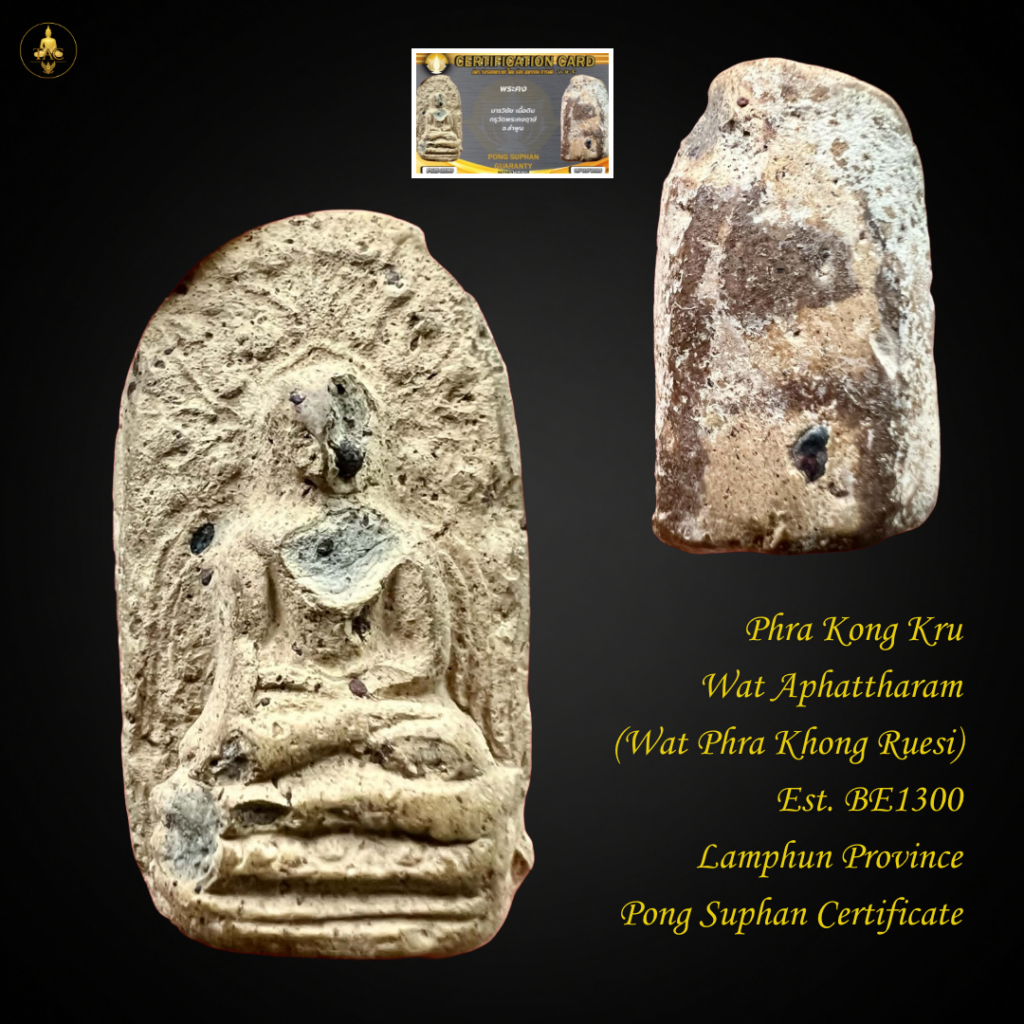
Phra Kong Kru Wat Aphattharam (Wat Phra Khong Ruesi) Est. BE1300 Lamphun Province
| Type | Phra Kong Kru |
| Temple | Wat Phra Kong |
| B.E. Year | 1300 |
| Material | Nur Din |
| Condition | Fair |
| Certificate | Others |
| SKU | TAC-PhraKongKru--001 |
Authentic Phra Kong Kru from Wat Phra Kong, BE 1300. Ancient nuea din, Hariphunchai lineage, independently certified.
What is the Phra Kong Kru from Wat Phra Kong, BE 1300?
The Phra Kong Kru from Wat Phra Kong is an ancient terracotta amulet pressed from nuea din (earthenware clay), recovered from the kru of this historically significant temple in Lamphun Province, Northern Thailand. Estimated to date to around BE 1300, it depicts the Buddha in the Maravijaya posture and is certified by an independent body. Among Lamphun amulets, it ranks second only to Phra Rod in collector standing.
Where this piece stands in the Hariphunchai lineage
Lamphun was the heart of the ancient Hariphunchai kingdom, and the amulets that emerged from its temples carry that weight. The Phra Kong Kru sits just behind Phra Rod in the Lamphun hierarchy — a significant position, given that Phra Rod is arguably the most celebrated ancient amulet in all of Northern Thailand. Collectors estimate Phra Kong to be close to 1,300 years old, placing it squarely within the same Hariphunchai cultural moment as Phra Rod.
The iconography is specific and consistent across authentic examples. The Buddha image shows a bald head without a topknot, a thin robe that clings to the body, and a diamond lotus seated posture on a base of lotus petals arranged over a field of small raised dots. A halo surrounds the figure, and a Bodhi tree canopy rises above. Art historians have traced the seated posture to Bagan influence, itself drawing from the Pala and Gupta schools of Indian Buddhist art — cross-cultural threads that run through much of the Thai Buddhist amulet tradition.
What makes Phra Kong a practical entry point for serious collectors is relative availability. Compared to Phra Rod, genuine examples still surface at prices that reward patience and knowledge rather than deep pockets alone. That said, certified pieces with documented provenance are not common, and that distinction matters.
The archaeological record behind Wat Phra Kong
Wat Phra Kong sits north of the ancient city walls of Lamphun. Historical accounts identify it as the primary site where Phra Kong Kru amulets were first recovered, and tradition links the temple’s founding to Queen Jamadevi, the legendary first ruler of Hariphunchai. Two excavations defined the modern collector’s understanding of this amulet: a significant find of terracotta Buddha images around the base of the main pagoda in 1942, and a further cache unearthed behind the temple in 1956.
The tradition extends beyond a single site. Phra Kong amulets have also been found at the Wiang Kum Kam archaeological site and at Wat Kan Thom (Wat Chang Kham) in Saraphi District, Chiang Mai Province, with discoveries recorded around 1984. All were in the Hariphunchai style. These finds confirm that the Phra Kong type circulated across a broader sacred geography than one temple alone.
Nuea din, clay variants, and what authenticators examine
The nuea (material/substance) is nuea din — fired earthenware clay, the same class of material used in the most revered ancient Lamphun amulets. Long-time collectors describe the colour and texture of authentic Phra Kong as closely comparable to those of Phra Rod. That consistency points to a shared ancient production method rather than later imitation.
Authentic examples appear in five clay colours: white, red, yellow, green, and black. Each reflects natural variation in clay composition and firing conditions. Among advanced collectors in Singapore and Greater China, certain colours are notably scarcer, and the market prices them accordingly.
When authenticating a piece, experienced collectors and certification bodies focus on several concrete markers:
- The flat supporting base and precisely rendered lotus petal throne
- The specific dot pattern beneath the lotus base
- The delicate halo and Bodhi tree canopy above the figure
- Clay colour, surface ageing, and texture consistent with ancient terracotta from the Hariphunchai period
- Iconographic details — bald head, no topknot, thin clinging robe, diamond lotus posture
This piece carries a certificate from an independent certification body (listed as Others). Collectors approaching ancient Lamphun amulets should treat certification documentation as a baseline, not a substitute for their own knowledge of pim characteristics.
This example of Phra Kong Kru from Wat Aphattharam (Wat Phra Khong Ruesi) represents one of the most historically significant terracotta traditions in Northern Thailand, rooted in the ancient Hariphunchai culture of Lamphun and estimated to date to the 16th–17th centuries CE — placing it among the oldest categories of votive amulet we handle at TAC. What draws serious collectors to Phra Kong is the sophistication of its iconography: the bald-headed Buddha in Maravijaya posture, the clinging robe, the lotus-petal base, and the Bodhi canopy are hallmarks of early Northern Thai sacred artistry that reward careful study. Certified by Pong Suphan and still attainable at a price point that reflects its relative availability within the Lamphun lineage, this is a sound entry point for collectors building a disciplined Northern Thai collection alongside Phra Rod.
Attributes reflect Thai Buddhist devotional tradition and are not measurable claims.