Luang Pu Eiam (Phra Bhavanakosol Thera – Eiam Suwannasaro)
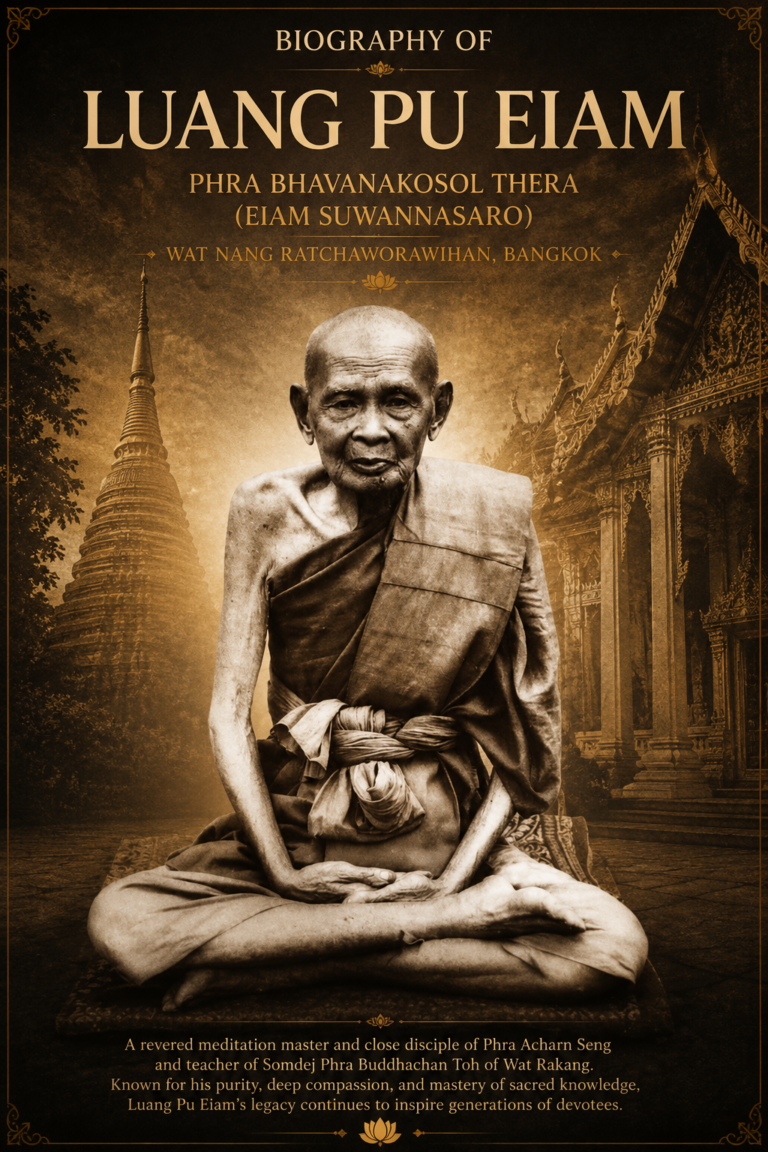
Luang Pu Eiam (หลวงปู่เอี่ยม), full monastic title Phra Bhavanakosol Thera Eiam Suwannasaro (พระภาวนาโกศลเถร เอี่ยม สุวณฺณสาโร), was born in BE 2375 (AD 1831) in Bang Khun Thian (บางขุนเทียน), Thonburi, present-day Bangkok. He served as the fifth abbot of Wat Nang Ratchaworawihan (วัดนางราชวรวิหาร) and is most celebrated among collectors for his exceptional Phra Pidta Yant Yung (พระปิดตายันต์ยุ่ง) amulets, widely regarded as among the finest protective amulets of the late Rattanakosin period. Read more ↓
Biography
Who Was Luang Pu Eiam (Phra Bhavanakosol Thera – Eiam Suwannasaro)?
Luang Pu Eiam (หลวงปู่เอี่ยม), full monastic title Phra Bhavanakosol Thera Eiam Suwannasaro (พระภาวนาโกศลเถร เอี่ยม สุวณฺณสาโร), was born in BE 2375 (AD 1831) in Bang Khun Thian (บางขุนเทียน), Thonburi, present-day Bangkok. He served as the fifth abbot of Wat Nang Ratchaworawihan (วัดนางราชวรวิหาร) and is most celebrated among collectors for his exceptional Phra Pidta Yant Yung (พระปิดตายันต์ยุ่ง) amulets, widely regarded as among the finest protective amulets of the late Rattanakosin period.
Early Life and Ordination
Luang Pu Eiam (หลวงปู่เอี่ยม) was born in BE 2375 (AD 1831) during the reign of King Rama III, in Bang Khun Thian (บางขุนเทียน), Thonburi, in what is today Bangkok. He was the son of Mr. Thong and Mrs. U, a farming family rooted in the riverside communities of the area.
At the age of eleven, he began his formal education in Buddhist scriptures, Thai and Khmer writing, and traditional sacred knowledge under the guidance of Luang Pu Rod (หลวงปู่รอด) at Wat Nang (วัดนาง). These foundational studies shaped both his monastic education and his eventual mastery of esoteric Buddhist practices, including sacred inscriptions and yantra science.
In BE 2397 (AD 1854), at the age of twenty-two, he was ordained at Wat Raj Orasaram (Wat Chom Thong) (วัดราชโอรสาราม, วัดจอมทอง) and received the monastic name Suwannasaro (สุวณฺณสาโร). Following his ordination, he took up residence at Wat Nang Nong (วัดนางนอง), where he continued his Vipassanā (วิปัสสนา) meditation training and deepened his knowledge of sacred sciences under Phra Bhavanakosol Thera Luang Pu Rod, becoming one of his teacher’s closest and most trusted disciples.
Spiritual Development and Practice
Luang Pu Eiam’s spiritual lineage flows directly from Phra Bhavanakosol Thera Luang Pu Rod (พระภาวนาโกศลเถร หลวงปู่รอด), one of the most respected monk-scholars of the mid-Rattanakosin era. Under Luang Pu Rod’s guidance, Luang Pu Eiam trained extensively in both Vipassanā (วิปัสสนา) insight meditation and Samatha (สมถะ) concentration practices, while simultaneously mastering the esoteric arts of sacred yantra inscription, Khom script, and the preparation of consecrated materials.
His practice reflected the city-temple tradition of Bangkok — rigorous in scriptural learning, deeply versed in protective Buddhist sciences, and closely connected to royal and aristocratic patronage. He was not a wandering forest monk but a scholar-practitioner who combined meditation with meticulous ritual craftsmanship, a combination that defined the amulet-creating tradition of the Rattanakosin period.
When Luang Pu Rod was stripped of his ecclesiastical rank during the later years of King Rama IV’s reign and relocated to Wat Khonon (วัดโคนอน) in present-day Phasi Charoen District (ภาษีเจริญ), Luang Pu Eiam followed without hesitation, continuing to serve his teacher loyally. This period at Wat Khonon proved formative, as Luang Pu Eiam began producing early examples of Phra Pidta (พระปิดตา), Phra Kring (พระกริ่ง), and other protective amulets within the sacred tradition established by his teacher. Following Luang Pu Rod’s passing, he succeeded him as abbot of Wat Khonon before eventually being called to lead Wat Nang Ratchaworawihan.
Major Amulet Consecrations and Ceremonies
Luang Pu Eiam (หลวงปู่เอี่ยม) created a remarkable variety of sacred amulets throughout his lifetime, spanning his tenures at both Wat Khonon (วัดโคนอน) and Wat Nang Ratchaworawihan (วัดนางราชวรวิหาร). Experienced researchers generally accept the view that approximately 25% of his surviving amulets were produced during his period at Wat Khonon, while the remaining 75% were created after he became abbot of Wat Nang in BE 2441 (AD 1898). Because he served as abbot of both temples at different stages of his life, many of his amulets share similar artistic characteristics, which has resulted in considerable confusion among collectors regarding their true origin.
His most celebrated and widely documented amulet type is the Phra Pidta Yant Yung (พระปิดตายันต์ยุ่ง), believed to have been created around BE 2453 (AD 1910) at Wat Nang. Each piece was individually crafted with exceptional attention to detail. Although similar in appearance to the famous Phra Pidta of Luang Phor Thap (หลวงพ่อทับ) of Wat Thong (วัดทอง), the Wat Nang examples are generally thinner and feature distinctive yantra engravings. They were produced in several metal compositions, including bronze with a high silver content and bronze with a high gold content. Extremely rare powder versions are also known to exist. The Phra Pidta Yant Yung is today considered one of the most heavily counterfeited amulets in Thailand, and collectors are strongly advised to exercise great caution when purchasing examples.
The full range of amulet types known to have been created by Luang Pu Eiam includes:
- Phra Pidta Yant Yung (พระปิดตายันต์ยุ่ง) — individually engraved with intricate yantra patterns; considered among the rarest and most valuable
- Phra Pidta Pim Prakob (พระปิดตาพิมพ์ประกอบ)
- Phra Pidta Betel Nut / Makham (พระปิดตามะขาม)
- Phra Pidta Lotus Base (พระปิดตาฐานบัว)
- Phra Pidta Rice Grain / Khao Taek (พระปิดตาข้าวแตก)
- Phra Pidta Knee-Level (พระปิดตาระดับเข่า)
- Phra Pidta Blooming Flower (พระปิดตาดอกไม้บาน)
- Phra Pidta Joined Mould (พระปิดตาพิมพ์ต่อ) — joined-mould examples are among the rarest surviving pieces
- Phra Pidta Sanghati Robe (พระปิดตาสังฆาฏิ)
- Phra Kring (พระกริ่ง)
- Phra Chaiwat (พระชัยวัต)
- Phra Udton (พระอุดร)
- Takrut (ตะกรุด)
- Sacred Yantra Cloths (ผ้ายันต์)
- First Edition Commemorative Medal (เหรียญรุ่นแรก)
- Numerous miniature Buddha images and several rare designs that do not fit standard classification categories
These amulets were crafted using a wide range of sacred materials, reflecting the depth of Luang Pu Eiam’s knowledge of traditional Thai sacred science:
- Wood
- Bronze with a high silver content
- Bronze with a high gold content
- Lead alloy
- Silver-tin alloy
- Mekphat alloy (เมขพัฒน์) — considered extremely rare
- Sacred powders (ผงศักดิ์สิทธิ์)
- Lacquer-mixed powders
- Burnt palm leaf powder
Detailed batch-by-batch records specifying precise BE consecration years and ceremony particulars for each amulet type are not widely documented in English sources. Collectors seeking granular catalogue data are advised to consult Thai-language temple records and established amulet reference books held at Wat Nang Ratchaworawihan and specialist Thai amulet societies.
Legacy and Temple Significance
In BE 2441 (AD 1898), the people of Bang Khun Thian invited Luang Pu Eiam to become the fifth abbot of Wat Nang Ratchaworawihan (วัดนางราชวรวิหาร), a position subsequently confirmed by royal appointment under King Rama V. On 13 November BE 2441, he received the royal ecclesiastical title Phra Khru Silakhuntharajarn (พระครูศีลคุณธราจารย์). On 10 November BE 2442 (AD 1899), he was elevated to Phra Bhavanakosol Thera (พระภาวนาโกศลเถร), the same distinguished title previously held by his own teacher, Luang Pu Rod — a rare and symbolically profound continuity of spiritual lineage.
Over more than twenty-seven years as abbot, Luang Pu Eiam restored the temple’s buildings, strengthened Buddhist education in the community, and revived Wat Nang as one of the most respected monasteries in the Bang Khun Thian area. One well-known historical account records that King Rama V received sacred protective blessings and amulets from Luang Pu Eiam before travelling to Europe, and was said to have returned safely after a successful royal mission — an event that further cemented the monk’s reputation for powerful spiritual intercession.
Luang Pu Eiam passed away peacefully on 26 April BE 2469 (AD 1926). He is remembered today as the monk who revitalised Wat Nang Ratchaworawihan and became one of the most influential spiritual leaders in the history of Bang Khun Thian. His famous teaching endures among devotees: “Good deeds bring good results. Bad deeds bring bad results. This is an unchanging law.” His amulets continue to surface from old family collections across Thailand, ensuring that the study of his sacred objects remains an active and evolving field for collectors and researchers alike.