Phra Ajarn Seetha Chayaseeno
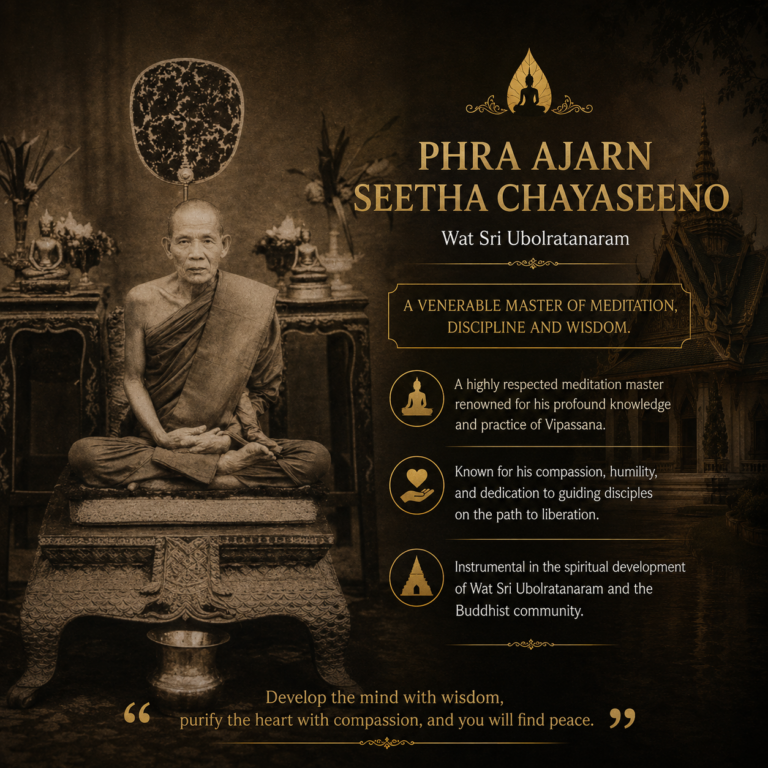
Phra Ajarn Seetha Chayaseeno (พระอาจารย์สีทา ชยเสโน) was a venerated Thai Buddhist monk born in BE 2396 (AD 1853) in Ubon Ratchathani Province, residing at Wat Sri Ubolratanaram (วัดศรีอุบลรัตนาราม), Mueang District, Ubon Ratchathani. He is most celebrated as the Kammavācācariya (พระกรรมวาจาจารย์) — the ordination preceptor — of two of Thailand's most revered forest meditation masters: Luang Phu Sao Kantasilo (หลวงปู่เสาร์ กันตสีโล) and Luang Phu Mun Bhuridatto (หลวงปู่มั่น ภูริทัตโต). Read more ↓
Biography
Who Was Phra Ajarn Seetha Chayaseeno?
Phra Ajarn Seetha Chayaseeno (พระอาจารย์สีทา ชยเสโน) was a venerated Thai Buddhist monk born in BE 2396 (AD 1853) in Ubon Ratchathani Province, residing at Wat Sri Ubolratanaram (วัดศรีอุบลรัตนาราม), Mueang District, Ubon Ratchathani. He is most celebrated as the Kammavācācariya (พระกรรมวาจาจารย์) — the ordination preceptor — of two of Thailand’s most revered forest meditation masters: Luang Phu Sao Kantasilo (หลวงปู่เสาร์ กันตสีโล) and Luang Phu Mun Bhuridatto (หลวงปู่มั่น ภูริทัตโต).
Early Life and Ordination
Phra Ajarn Seetha Chayaseeno (พระอาจารย์สีทา ชยเสโน) was born in BE 2396 (AD 1853) at Ban Nong Luang (บ้านหนองหลวง), Mueang District, Ubon Ratchathani Province (จังหวัดอุบลราชธานี), in the heartland of Thailand’s northeastern Isan region. He was the maternal uncle of Phra Bhavana Wisal Thera, known as Luang Phu Bunmi Chotipalo (หลวงปู่บุญมี โชติปาโล), of Wat Sara Prasan Suk (วัดสระประสานสุข), Ban Na Mueang, Mueang District, Ubon Ratchathani.
From a young age, he entered monastic life by taking pabbajja (novice ordination) at Wat Si Thong (วัดศรีทอง), which is today known as Wat Sri Ubolratanaram (วัดศรีอุบลรัตนาราม). He resided at this temple and continued his training until he reached the age of full ordination. He subsequently received upasampadā (higher ordination as a bhikkhu) at Wat Si Thong, with the Venerable Tewadhammi (M’ao) (ท่านเทวธัมมี ม้าว) serving as his Upajjhāya (พระอุปัชฌาย์), or presiding preceptor. His roots in this single temple — from novice through to fully ordained monk — shaped a lifetime of unwavering devotion to both the scholarly and contemplative dimensions of the Dhamma.
Spiritual Development and Practice
Phra Ajarn Seetha Chayaseeno (พระอาจารย์สีทา ชยเสโน) dedicated himself deeply to both the study of the Vinaya (monastic discipline) and the practice of vipassanā (วิปัสสนา — insight meditation). He became one of the most respected meditation teachers in the Isan tradition of his era, earning recognition as a senior elder of the vipassanā lineage — described in Thai sources as wipassanā thera (วิปัสสนาธุระ) — a fountainhead of the great Dhamma army that would transform Thai forest Buddhism.
His most enduring spiritual legacy is his role as Kammavācācariya (พระกรรมวาจาจารย์) — the chanting preceptor responsible for formally reciting the ordination motion — for two of the most influential monks in Thai Buddhist history. He performed this role at the Dhammayut (ธรรมยุต) ordination of Phra Ajarn Sao Kantasilo (พระอาจารย์เสาร์ กันตสีโล) and also at the ordination of Phra Ajarn Mun Bhuridatto (พระอาจารย์มั่น ภูริทัตโต). In Thai Buddhist tradition, the Kammavācācariya holds a role of immense spiritual gravity: without his precise recitation, the ordination itself is not valid. Phra Ajarn Seetha was therefore, in the most literal doctrinal sense, the spiritual grandfather of the entire Thai Forest Tradition as it flourished through the twentieth century. He also served as abbot of three temples: Wat Si Thong (Wat Sri Ubolratanaram), Wat Tai (วัดใต้), and Wat Burapha (วัดบูรพา).
Major Amulet Consecrations and Ceremonies
Detailed batch records — including specific BE years, batch names, and material compositions — for amulets formally consecrated by Phra Ajarn Seetha Chayaseeno (พระอาจารย์สีทา ชยเสโน) are not widely documented in English sources. Given his era (mid-to-late 19th century through BE 2468 / AD 1925) and his primary identity as a meditation master and ordination preceptor rather than a prolific amulet-batch creator in the modern commercial sense, formal records are largely preserved in Thai-language temple archives at Wat Sri Ubolratanaram (วัดศรีอุบลรัตนาราม) and Wat Burapha (วัดบูรพา). Collectors and researchers seeking precise batch documentation are advised to consult Thai-language sources directly with the temples.
What is historically documented and of profound significance to the collector community is Phra Ajarn Seetha’s extraordinary contribution as a master craftsman and sacred image maker. He was a highly skilled artisan — an ancient-style architect and wood sculptor — who personally carved the decorative panels, door and window reliefs, and corner carvings of the sala kan parian (ศาลาการเปรียญ — the sermon hall) at Wat Si Thong (Wat Sri Ubolratanaram). These carvings are preserved intact to this day and are regarded as sacred heritage objects in their own right.
Most significantly, he served as the master craftsman responsible for casting the principal Buddha image known as Phra Sappanyu Chao (พระสัพพัญญูเจ้า), the presiding Buddha image in the ordination hall (ubosot) of Wat Supat Naram Worawihan (วัดสุปัฏนารามวรวิหาร). This image — modelled on the famous Phra Buddha Chinnarat (พระพุทธชินราช) of Phitsanulok Province — is widely regarded as one of the most beautiful cast Buddha images in all of northeastern Thailand. For devotees and collectors of the Isan tradition, objects connected to Phra Ajarn Seetha carry the sacred resonance of a monk who did not merely bless sacred objects but physically created them with his own hands as an act of merit and devotion.
He also constructed a ho kaew (หอแก้ว — a crystal pavilion or bussabok throne) to enshrine the Phra Kaew Budsarakham (พระแก้วบุษราคัม — a topaz-coloured crystal Buddha image), which continues to be enshrined in the main ordination hall at Wat Sri Ubolratanaram to this day. Amulets and sacred items associated with Phra Ajarn Seetha are not yet catalogued in the Thai Amulets Collection (TAC) database; collectors are encouraged to visit the canonical monk page for updates as new inventory is verified.
Legacy and Temple Significance
Phra Ajarn Seetha Chayaseeno (พระอาจารย์สีทา ชยเสโน) passed away at Wat Burapha (วัดบูรพา), Mueang District, Ubon Ratchathani, in BE 2468 (AD 1925), at the age of 72. His passing marked the end of an era, but his spiritual influence has never diminished. As the ordination preceptor of both Luang Phu Sao Kantasilo (หลวงปู่เสาร์ กันตสีโล) and Luang Phu Mun Bhuridatto (หลวงปู่มั่น ภูริทัตโต) — the twin pillars of the Thai Forest Tradition — Phra Ajarn Seetha stands at the very root of a lineage that today encompasses thousands of forest monks across Thailand, Laos, Myanmar, and beyond.
Luang Phor Phut Thanio (หลวงพ่อพุธ ฐานิโย), the last surviving disciple of Phra Ajarn Sao Kantasilo, described the lineage succinctly: “Luang Phu Mun was a student of Phra Ajarn Sao. If you ask who Phra Ajarn Sao’s teacher was, you must say: Phra Ajarn Sao was a student of Phra Ajarn Seetha Chayaseeno. And if you ask further than that, one must say that Phra Ajarn Seetha was a student of the Lord Buddha himself — and it ends there.”
At Wat Sri Ubolratanaram (วัดศรีอุบลรัตนาราม), Phra Ajarn Seetha’s carved works and architectural contributions remain preserved as living heritage. His teaching — “Dhamma exists in abundance, never exhausted — everything in this world is Dhamma, yet there are two branches: one worldly, one true and unchanging. That is the Dhamma of the Lord Buddha” — continues to be cited by monks and lay practitioners throughout the Isan tradition.