Phra Thep Sutthacharn (Luang Pu Choti Khunsampanno) – Wat Wachiralongkorn
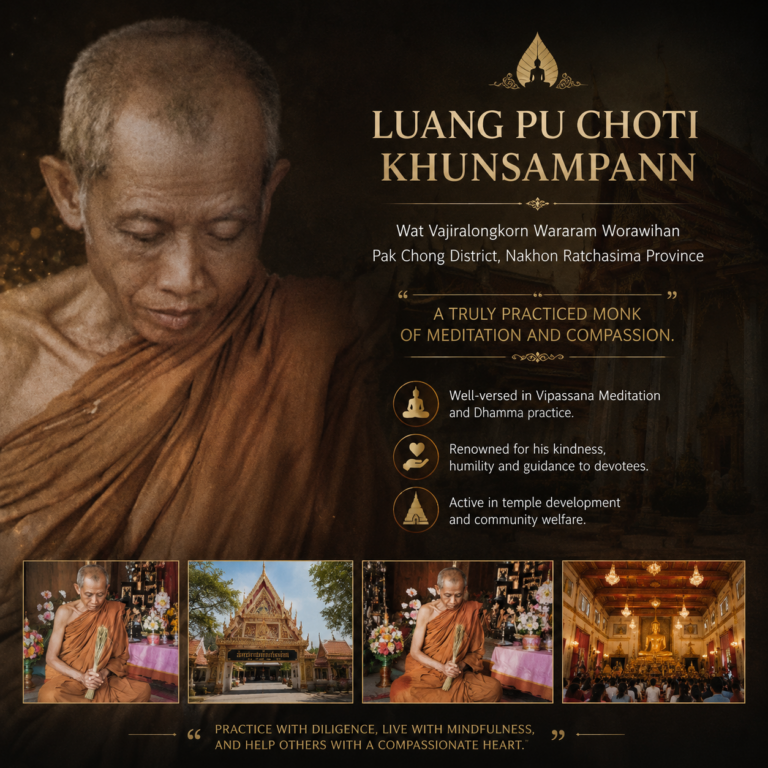
Phra Thep Sutthacharn (พระเทพสุทธาจารย์), reverently known as Luang Pu Choti Khunsampanno (หลวงปู่โชติ คุณสัมปันโน), was a highly venerated Thai Buddhist monk of the forest meditation tradition, born in Surin Province and ordained under the legendary Luang Pu Dool Atulo (หลวงปู่ดูลย์ อตุโล). He served as the founding abbot of Wat Wachiralongkorn (วัดวชิราลงกรณ์), Pak Chong District, Nakhon Ratchasima, and passed away on 24 March BE 2517 (AD 1974). He is most celebrated for his immaculate conduct within the Kammatthana forest meditation lineage tracing directly to Luang Pu Mun Bhuridatto (หลวงปู่มั่น ภูริทัตโต). Read more ↓
Biography
Who Was Phra Thep Sutthacharn (Luang Pu Choti Khunsampanno)?
Phra Thep Sutthacharn (พระเทพสุทธาจารย์), reverently known as Luang Pu Choti Khunsampanno (หลวงปู่โชติ คุณสัมปันโน), was a highly venerated Thai Buddhist monk of the forest meditation tradition, born in Surin Province and ordained under the legendary Luang Pu Dool Atulo (หลวงปู่ดูลย์ อตุโล). He served as the founding abbot of Wat Wachiralongkorn (วัดวชิราลงกรณ์), Pak Chong District, Nakhon Ratchasima, and passed away on 24 March BE 2517 (AD 1974). He is most celebrated for his immaculate conduct within the Kammatthana forest meditation lineage tracing directly to Luang Pu Mun Bhuridatto (หลวงปู่มั่น ภูริทัตโต).
Early Life and Ordination
Luang Pu Choti Khunsampanno was born with the lay name Choti Mueang Thai (โชติ เมืองไทย) at Ban Kathop, Tambon Na Bua (ตำบลนาบัว), Mueang District, Surin Province (จังหวัดสุรินทร์). He was the youngest son of Mr. Pae Mueang Thai (นายแป๊ะ เมืองไทย) and Mrs. Hrian Mueang Thai (นางเหรียญ เมืองไทย). His birth year is not widely documented in English sources, though Thai records place it in the early twentieth century BE 2400s (AD 1900s).
His mother, Ubāsikā Hrian (อุบาสิกาเหรียญ), was a devout lay Buddhist who never missed a single day of listening to the Dhamma teachings of Luang Pu Dool Atulo (หลวงปู่ดูลย์ อตุโล) of Surin Province. Whenever she attended the forest monastery, she brought her young son Choti along. By the age of twelve, the boy had grown so attached to monastic life that he no longer wished to return home.
Recognising the child’s deep spiritual inclination, Mrs. Hrian formally offered her son to Luang Pu Dool Atulo as a temple boy. When the boy came of suitable age, Luang Pu Dool Atulo personally conferred novice ordination (บรรพชา) upon him — making Samanera Choti Mueang Thai (สามเณรโชติ เมืองไทย) the very first novice ever ordained by Luang Pu Dool Atulo. Upon reaching full canonical age, he received full higher ordination (อุปสมบท) as a bhikkhu at Wat Sutthachinda (วัดสุทธจินดา), Nakhon Ratchasima, where he was given the Pali epithet Khunsampanno (คุณสัมปันโน).
Spiritual Development and Practice
Luang Pu Choti’s spiritual formation belongs entirely to the royal lineage of Thai forest meditation masters, tracing directly through Luang Pu Dool Atulo (หลวงปู่ดูลย์ อตุโล), whose own teacher was Luang Pu Mun Bhuridatto (หลวงปู่มั่น ภูริทัตโต), and whose grand-teacher was the founding patriarch of the tradition, Luang Pu Sao Kantasilo (หลวงปู่เสาร์ กันตสีโล). This Kammatthana (กรรมฐาน) forest lineage is widely regarded as the most rigorous and pure stream of Thai Theravāda practice.
As a young samanera, Choti accompanied Luang Pu Dool Atulo on thudong (ธุดงค์) — ascetic wandering pilgrimages — into dense and dangerous jungle terrain, including routes toward Khao Phra Wihan (เขาพระวิหาร) and into Cambodia. The wilderness was populated with wild elephants, tigers, and bears. On one such journey, a wild buffalo charged Luang Pu Dool Atulo from behind, tossing him and shredding his robes — yet the master emerged completely unharmed, an event Luang Pu Choti recounted throughout his life as a testament to his teacher’s spiritual attainment.
After being entrusted to Wat Sutthachinda for formal Pali scriptural study (พระปริยัติธรรม), Luang Pu Choti balanced academic learning with intensive meditation practice. Devotees and fellow monks described his bearing as characterised by natural, unforced composure — not a performative austerity but an authentic, deeply cultivated stillness rooted in sila (ศีล), samadhi (สมาธิ), and panna (ปัญญา). Luang Pu Dool Atulo is recorded as having often spoken of Luang Pu Choti with particular warmth and affection, describing him as the one disciple he had loved since childhood.
Those close to Luang Pu Choti noted that, from his youth, he possessed the rare and extraordinary quality of jati-sara (ระลึกชาติ) — the ability to recall past lives with clarity. This quality, rather than being a source of pride, deepened his commitment to non-harm and the cessation of kamma, embodying the Dhamma ideal of a being approaching the end of the cycle of rebirth.
Major Amulet Consecrations and Ceremonies
Luang Pu Choti Khunsampanno is primarily venerated as a supreme practitioner and meditation master rather than a prolific amulet creator in the conventional collector sense. Specific amulet batch records — including BE year of creation, batch names, and detailed materials — are not widely documented in English-language sources. Thai-language temple records at Wat Wachiralongkorn and archival sources within the Kammatthana community would be the authoritative references for complete batch details.
Within Thai collector circles, Luang Pu Choti is known to be associated with amulet types common to monks of his stature and era in the Northeastern forest tradition, including roop muean (รูปเหมือน — portrait effigies), rian (เหรียญ — coin medallions), and blessed objects consecrated through deep meditative absorption. Given that he passed away in BE 2517 (AD 1974), any surviving amulets bearing his blessing or likeness are considered historically significant early pieces. Collectors seeking specific batch information are strongly advised to consult Thai-language temple records, established auction houses in Bangkok, or certified authentication bodies such as G-Pra and the Samakom Phraphim Haeng Prathet Thai (สมาคมพระเครื่องแห่งประเทศไทย).
No specific amulet batches by Luang Pu Choti Khunsampanno are currently recorded in the Thai Amulets Collection (TAC) database. As TAC expands its records, this section will be updated with verified batch information.
Legacy and Temple Significance
Luang Pu Choti Khunsampanno holds a unique and irreplaceable place in the history of Thai Buddhism as the founding abbot of Wat Wachiralongkorn (วัดวชิราลงกรณวรารามวรวิหาร), Pak Chong District, Nakhon Ratchasima Province. His selection as the temple’s first abbot was a direct recognition of his exceptional purity of conduct, meditative attainment, and the weight of his spiritual lineage descending from Luang Pu Sao, Luang Pu Mun, and Luang Pu Dool.
During his lifetime, Luang Pu Choti rose through the ecclesiastical ranks, receiving successive honorary titles — from Phra Samuh (พระสมุห์) through Maha (มหา), Phra Khru (พระครู), Phra Thammatithinyan (พระธรรมฐิติญาณ), and Phra Ratchasutthacharn (พระราชสุทธาจารย์) — before attaining his highest distinction as Phra Thep Sutthacharn (พระเทพสุทธาจารย์).
In early BE 2517 (AD 1974), Luang Pu Choti fell gravely ill with jaundice and was admitted to Siriraj Hospital (โรงพยาบาลศิริราช), Bangkok. In a remarkable testament to his revered status, His Majesty King Bhumibol Adulyadej and Her Majesty Queen Sirikit personally accepted him as a royal patient under their care. He passed away peacefully on 24 March BE 2517 (AD 1974). Today, his memory is honoured by devotees throughout Nakhon Ratchasima and the broader Kammatthana community as a paragon of the forest monk ideal — a direct living link in the unbroken chain from Luang Pu Sao and Luang Pu Mun to the present generation.