Luang Pu Buapha Panyaphaso – Wat Pa Phra Sathit
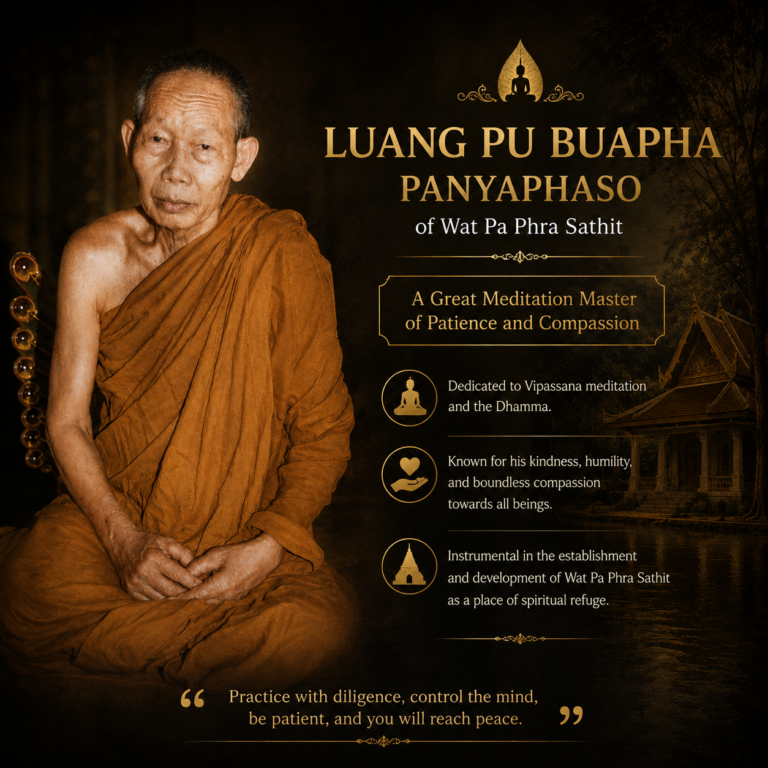
Luang Pu Buapha Panyaphaso (หลวงปู่บัวพา ปัญญาภาโส), also known by his ecclesiastical title Phra Khru Panyawisuit (พระครูปัญญาวิสุทธิ์), was a highly revered Thai forest-tradition monk of the Kammatthana lineage, a close personal disciple of the great master Luang Pu Sao Kantasilo (หลวงปู่เสาร์ กันตสีโล), and resided at Wat Pa Phra Sathit (วัดป่าพระสถิตย์), Si Chiang Mai District, Nong Khai Province, until his peaceful passing in BE 2535 (AD 1992) at the age of 81, having served 61 Rains Retreats. Read more ↓
Biography
Who Was Luang Pu Buapha Panyaphaso?
Luang Pu Buapha Panyaphaso (หลวงปู่บัวพา ปัญญาภาโส), also known by his ecclesiastical title Phra Khru Panyawisuit (พระครูปัญญาวิสุทธิ์), was a highly revered Thai forest-tradition monk of the Kammatthana lineage, a close personal disciple of the great master Luang Pu Sao Kantasilo (หลวงปู่เสาร์ กันตสีโล), and resided at Wat Pa Phra Sathit (วัดป่าพระสถิตย์), Si Chiang Mai District, Nong Khai Province, until his peaceful passing in BE 2535 (AD 1992) at the age of 81, having served 61 Rains Retreats.
Early Life and Ordination
The precise birth date and family background of Luang Pu Buapha Panyaphaso (หลวงปู่บัวพา ปัญญาภาโส) are not widely documented in English sources. Working from the details of his passing — on Sunday, 11 October BE 2535 (AD 1992), at the age of 81 years, 11 months, and 11 days — his birth can be calculated to have occurred in approximately BE 2453 (AD 1910), most likely in the Nong Khai region of northeastern Thailand, an area deeply embedded in the Isan forest-monk tradition.
He entered the monastic life with deep sincerity and was ordained as a bhikkhu (Buddhist monk) at a young age. Given that he completed 61 Rains Retreats (พรรษา) at the time of his death, his formal ordination would have taken place around BE 2474 (AD 1931). He was drawn early in his monastic career toward the ascetic Dhutanga (ธุดงค์) forest tradition, renouncing comfort and worldly entanglement in pursuit of meditative liberation — a calling that would define the entire course of his spiritual life and lead him directly into the orbit of the most celebrated forest masters of twentieth-century Thailand.
Spiritual Development and Practice
Luang Pu Buapha Panyaphaso (หลวงปู่บัวพา ปัญญาภาโส) stands as one of the most distinguished senior disciples within the forest Kammatthana (กรรมฐาน) lineage of Luang Pu Sao Kantasilo (หลวงปู่เสาร์ กันตสีโล). His relationship with Luang Pu Sao was not merely that of student and teacher — he served as a personal attendant, performing acts of humble service including the most intimate duties of caring for his ageing teacher. Thai devotional tradition holds that such selfless, egoless service is itself a profound form of spiritual practice, and the accumulated merit and wisdom of Luang Pu Sao were considered by disciples to have passed directly into Luang Pu Buapha through this closeness.
Beyond Luang Pu Sao, Luang Pu Buapha also travelled and practised alongside the supreme forest master Luang Pu Mun Bhuridatto (หลวงปู่มั่น ภูริทัตโต), accompanying both teachers on Dhutanga pilgrimages throughout the forests and mountains of Thailand. His practice followed the strict schedule established by the model of Chao Khun Ubali Khunupamajan (เจ้าคุณอุบาลีคุณูปมาจารย์, Janta Sirijanto): intensive walking meditation (kinhin/จงกรม), seated Samatha and Vipassana meditation from dusk, mandatory rest at 10 p.m., and rising again at 3 a.m. Conversation was minimal. Luang Pu Buapha famously internalised his teacher’s reticence — answering only what was asked, never embellishing, a quality that earned him profound respect among monastics and laypeople alike.
Major Amulet Consecrations and Ceremonies
Detailed batch-specific records — including BE year, official batch names, materials used, and ceremony particulars — for amulets associated with Luang Pu Buapha Panyaphaso (หลวงปู่บัวพา ปัญญาภาโส) are not widely documented in English sources. Thai-language temple archives and specialist amulet publications from Wat Pa Phra Sathit (วัดป่าพระสถิตย์) would be the authoritative references for complete batch records. Collectors and devotees generally seek amulets in formats typical of the northeastern forest-monk tradition, including roop muean (รูปเหมือน — monk-likeness effigies), rian (เหรียญ — medallion coins), and sacred phong (ผง — blessed powder) votive tablets. Any piece bearing Luang Pu Buapha’s image or consecration should be verified against Thai-language temple documentation and authenticated through recognised bodies before acquisition. Prospective collectors are encouraged to consult Thai Amulets Collection (TAC) specialists for guidance on currently available pieces and their provenance.
Legacy and Temple Significance
Luang Pu Buapha Panyaphaso (หลวงปู่บัวพา ปัญญาภาโส) left behind a legacy defined not by prolific speech or grand ceremony, but by the silent power of authentic practice. As one of the last direct personal disciples of Luang Pu Sao Kantasilo (หลวงปู่เสาร์ กันตสีโล) — himself considered the co-patriarch of the Thai forest tradition alongside Luang Pu Mun Bhuridatto (หลวงปู่มั่น ภูริทัตโต) — Luang Pu Buapha represents a living link to the origins of modern Thai forest Buddhism. He remained at Wat Pa Phra Sathit (วัดป่าพระสถิตย์), Si Chiang Mai District, Nong Khai Province, for the remainder of his life, never seeking fame or material accumulation.
He passed away peacefully on the auspicious occasion of the Wan Maha Pawana Ok Phansa (วันมหาปวารณาออกพรรษา) — the grand conclusion of the Buddhist Rains Retreat — on Sunday, 11 October BE 2535 (AD 1992), at 8:45 p.m., aged 81 years, 11 months, and 11 days, having completed 61 Rains Retreats. The sangha and his disciples held a royal cremation ceremony on 28 February BE 2536 (AD 1993) at the crematorium of Wat Pa Phra Sathit, honouring a monk whose entire life embodied the highest ideals of the Dhutanga forest path. His teachings on the direct knowledge of dukkha (ทุกข์ — suffering) as the gateway to true mental stillness continue to be studied and revered by Kammatthana practitioners throughout Thailand and beyond.