Luang Phor Daeng Wat Si Maha
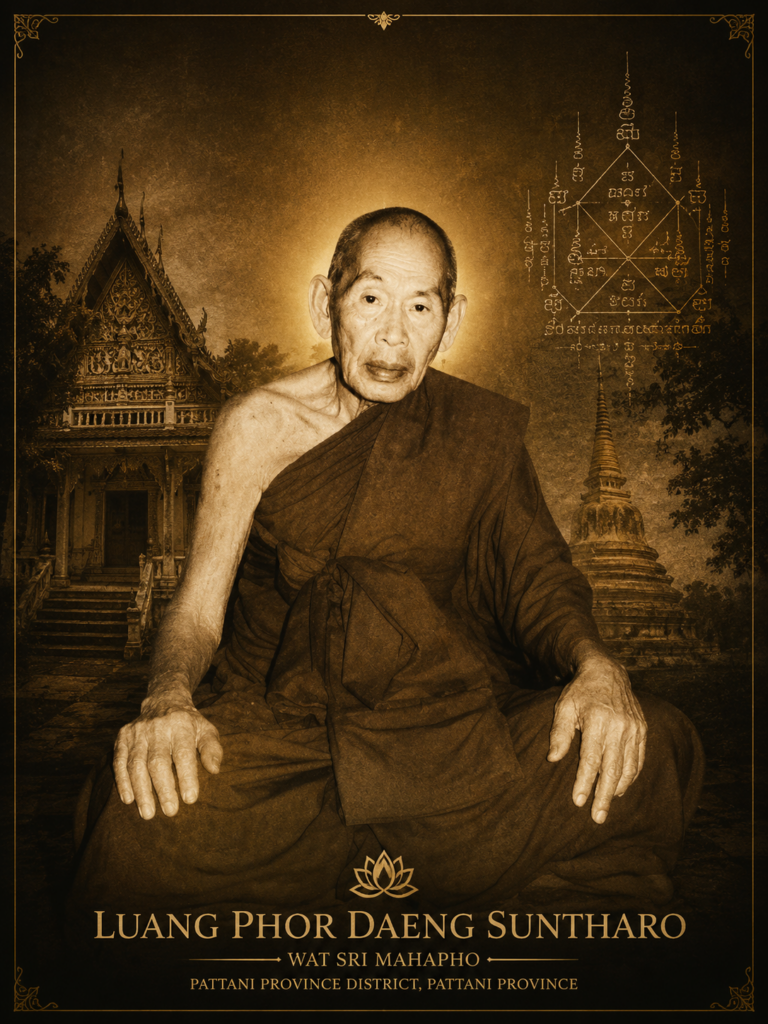
Luang Pho Daeng Suntharo, formally known by his monastic title Phra Khru Wirachasophon, was the former abbot of Wat Sri Mahapho, Kok Pho District, Pattani Province. He is widely regarded as one of the southern Thailand’s most accomplished monk-practitioners of the mid-twentieth century, and his name is inseparable from the landmark consecration of the first ... Read more ↓
Amulets by Luang Phor Daeng Wat Si Maha 1 total · 1 available
Biography
Luang Pho Daeng Suntharo, formally known by his monastic title Phra Khru Wirachasophon, was the former abbot of Wat Sri Mahapho, Kok Pho District, Pattani Province. He is widely regarded as one of the southern Thailand’s most accomplished monk-practitioners of the mid-twentieth century, and his name is inseparable from the landmark consecration of the first batch of Luang Pu Thuad amulets at Wat Chang Hai in 1954 — an event initiated by Phra Khru Wirachasophon, also known as Phra Ajarn Tim Thammatero.
Early Life and Family Background
Luang Pho Daeng was born into the Chindawong family on Friday, 18 June 1902, the Year of the Tiger, in Ban Plak Ao, Tambon Khlong Rang, Amphoe Hat Yai, Songkhla Province — a district now administered as Amphoe Na Mom, Songkhla Province. He was the fourth of five children born to a farming family.
From an early age he showed a notable appetite for knowledge, regularly seeking guidance from parents, elders, and adults in the community. When he was seven years old, a smallpox epidemic swept through the village, prompting his father to relocate the family to Ban Kapho, Khok Pho District, Pattani Province.
Monastic Formation and Ordination
In Khok Pho, the young Chindawong became a disciple of Luang Pho Siphut (Phra Khru Manatsamanankun), the abbot of Wat Kapho (also known as Wat Maduea Thong) — a monk revered throughout the region for his compassion and spiritual power. Under Luang Pho Siphut’s guidance he pursued a rigorous programme of study from the age of fourteen:
- Thai language literacy
- Occult sciences
- The Seven Legends of the Sutras
- Recitation of the Patimokkha (Buddhist monastic rules)
He memorised the Patimokkha completely within two years and received his novice ordination at the age of eighteen. At the age of twenty-one he received full ordination at Wat Kapho, with:
- Luang Pho Siphut — preceptor
- Phra Adhikan Suk of Wat Prangmadan — co-ordaining monk
- Phra Nuam of Wat Kapho — co-ordaining monk
He received the monastic name Suntharo. His progress as a scholar-monk was swift: within his first year in robes he had memorised key scriptures accurately, and by his third year he passed the first level of the Buddhist doctrinal examination.
Spiritual Lineage and Esoteric Training
Luang Pho Daeng’s reputation for supernatural attainment rested on a foundation of disciplined, authenticated training. Having studied directly under Luang Pho Siphut, he subsequently received advanced mental training from Abbot Suk of Wat Maprang Dan, through which he mastered Kasiṇa meditation. He also became a formal disciple of the renowned Khao O School of Buddhist magic, one of the most respected esoteric lineages in southern Thailand.
Luang Pho Daeng was characteristically measured in how he spoke about sacred knowledge and its application. He employed a well-known analogy to convey its dual nature:
“Like a knife, we can use it for anything — killing people, harming people, self-defense, cutting wood, preparing food. A knife isn’t just for harming; it has many other uses.”
Abbotship and Service to the Community
Wat Maduea Thong
In 1940, Luang Pho Daeng resided at Wat Tohteng in Suai Padi, Narathiwat Province. When World War II broke out in 1941, he returned to Khok Pho and was appointed acting abbot of Wat Maduea Thong following the passing of his teacher, Luang Pho Siphut. To mark the royal cremation ceremony for Luang Pho Siphut, the first batch of amulets depicting Luang Pho Si Phut was created and distributed as commemorative items to those attending — pieces now considered collectible in their own right.
Under his stewardship, Wat Maduea Thong prospered considerably and Luang Pho Daeng became a central figure of spiritual support for the surrounding villages.
Establishment of Wat Sri Mahapho
In 1951, Phra Thep Yanamoli, abbot of Wat Tani Norasamosorn and head of the monastic order in Pattani Province, instructed Phra Kru Yanavimol (Kimsuy), head of the monastic order in Khok Pho District, to renovate an old, abandoned temple known as Wat Ban Don. With the active cooperation of local villagers, the restoration was completed successfully. The temple was renamed Wat Sri Maha Bodhi, and Phra Kru Yanavimol assumed the position of abbot. Luang Pho Daeng’s involvement in the development of this institution deepened over the subsequent decades, and the temple is now commonly referred to as Wat Sri Mahapho.
Amulet Creation
Luang Pho Daeng approached the creation of amulets as an act of compassionate service — producing them in response to the faith of his disciples, drawing on his accumulated knowledge to extend blessings, offer protection, and provide a spiritual anchor for the people under his care.
The principal amulet series associated with Luang Pho Daeng Suntharo are as follows:
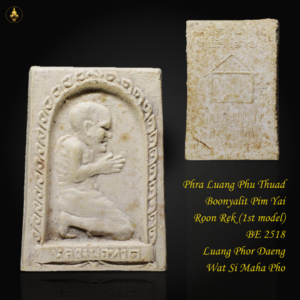
- 1975 — First series; includes the Luang Pu Thuad Bunyarit set
- 1982 — Luang Pho Daeng coin
- 1984 — 83rd birthday celebration coin
- 1993 — Amulets and coins from Wat Sri Mahapho
- 1994 — Herbal amulets and oval coins
- 1995 — Worship statues and special-edition Luang Pho Thuad herbal amulets
His participation in the historic 1954 Wat Chang Hai consecration of the first Luang Pu Thuad batch further cements his significance within the broader southern Thai amulet tradition.
Passing
Luang Pho Daeng Suntharo passed away peacefully on 27 February 1996 at the age of 94, having spent 73 years in the monastic order. His legacy endures through the institutions he served, the lineages he transmitted, and the amulets he consecrated.