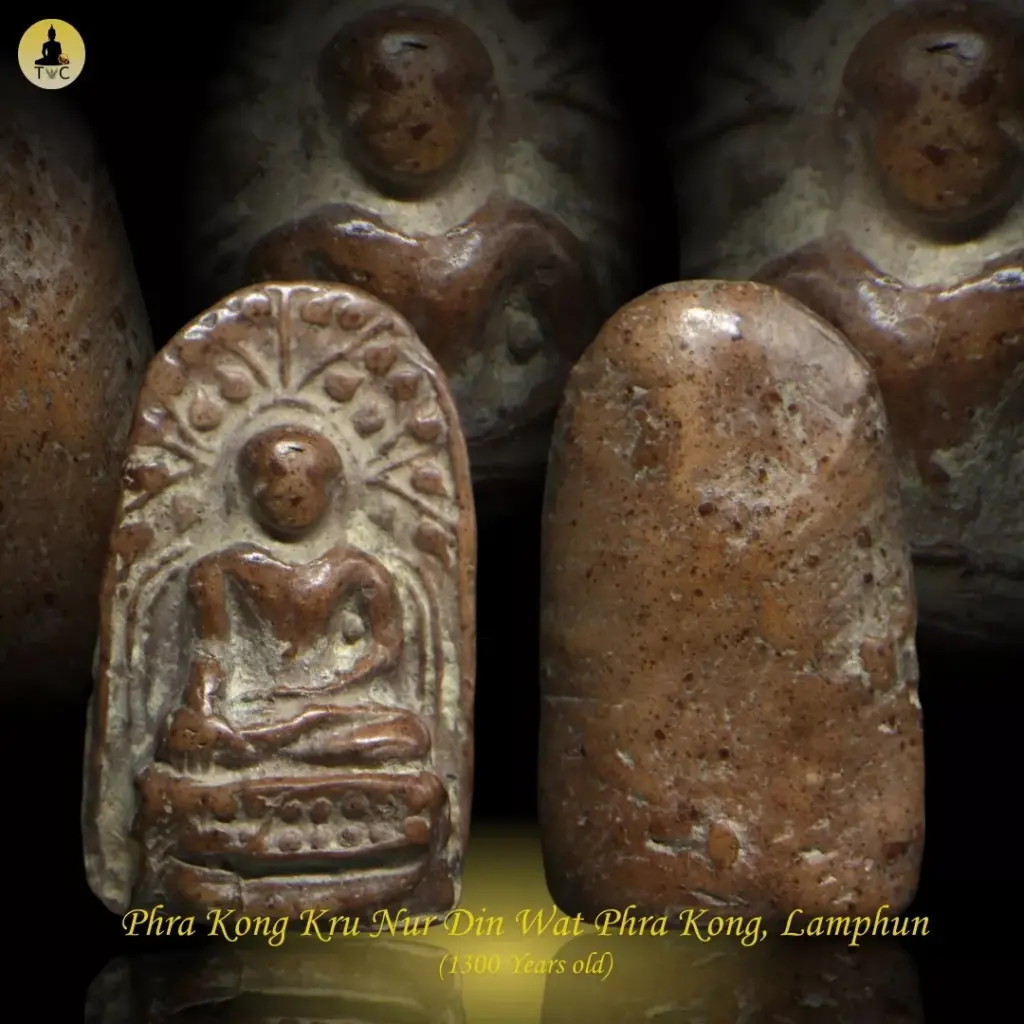
Phra Kong Kru Nur Din Wat Phra Kong, Lamphun (1300 Years old)
| Temple | Wat Phra Kong |
| Material | Din |
| SKU | TAC-0397 |
Authentic Phra Kong Kru Nur Din Wat Phra Kong, Lamphun (1300 Years old). Northern clay kru tablet, Hariphunchai–Lanna lineage.
What is the Phra Kong Kru Nur Din Wat Phra Kong, Lamphun (1300 Years old)?
The Phra Kong Kru Nur Din Wat Phra Kong, Lamphun (1300 Years old) is a Northern Thai clay tablet recovered from a kru (temple crypt/stupa deposit) at Wat Phra Kong in Lamphun. Pressed from nuea din (clay) blended with temple soil, powdered brick, and mineral grit, it belongs to the Hariphunchai–Lanna devotional lineage and is traditionally held to be approximately 1,300 years old.
Where this tablet comes from — and why that matters to a collector
Wat Phra Kong sits within the Hariphunchai–Lanna cultural sphere, one of the oldest Buddhist zones in the North. Lamphun itself predates Chiang Mai as a centre of Northern devotional practice, and the tablets recovered from its stupas carry the material record of that continuity. The age claim of roughly 1,300 years is rooted in local temple tradition; scholarly estimates vary depending on findspot and clay analysis, so collectors treat it as a traditional attribution rather than a forensic date.
These tablets were not made as individual commissions. They were pressed in volume for stupa dedication — communal merit objects intended to bless a locality through enshrinement. That purpose shaped everything: modest proportions, a compact Northern pim (mould profile), gentle facial contour. Functional, not decorative. The Thai Buddhist amulet tradition has deep roots in exactly this kind of kru deposit, where the act of enshrinement itself was the primary consecration.
How it was made and what authenticators look at
The nuea (material/substance) here is Nur Din — a clay body enriched with temple soil, powdered brick, and micro-mineral grit. Some examples carry faint traces of herbal admixtures known as wahn. The tablets were low-heat set or sun-cured, then sealed inside a chedi for an extended period. Long stupa residence produces the layered clay lamina, mineral freckles, and stable surface sheen that authenticators look for first.
Consecration happened in two stages. The primary event was the enshrinement rite itself — the kru deposit. When chedis were later opened for conservation or community redistribution, many tablets received a secondary ceremonial reblessing, a phutthaphisek (formal consecration ceremony), completing the ritual cycle. That dual consecration history is part of what collectors in this category document.
For authentication, experienced eyes focus on:
- Mature earth-tone patina with layered clay lamina — not a uniform surface
- Mineral freckles and micro-voids consistent with the original clay mix and burial period
- Stable surface sheen from prolonged stupa microclimate exposure, not applied coating
- Intact, un-restored edges with natural press-edge rounding
- Readable facial planes on the obverse and an undisturbed plain or faint-texture reverse field
Intact examples that show all these markers are used as teaching references within Northern collections — benchmarks for understanding early nuea composition and stupa-aging behaviour.
What collectors actually value in a piece like this
Collector-grade Kru Lamphun pieces anchor Northern collections precisely because genuine early examples are not being made again. The pool of intact tablets with undisturbed profiles shrinks as restored or damaged pieces circulate. A readable face and a clean reverse field together on one tablet is rarer than new collectors sometimes expect.
Traditionally, Phra Kong tablets from this lineage are carried for Klaew Klaad — the Thai belief in averting mishaps and danger — alongside Baramee, the accumulation of wholesome virtue and personal authority. Devotees have long associated this class of tablet with travel safety and protection of livelihood. These associations are part of the tablet’s living tradition, not a specification collectors should treat as a guarantee.
We at TAC handle this piece as collector-grade Kru Lamphun material — a category where intact examples with undisturbed profiles and legible facial planes are genuinely hard to source. For collectors building a Northern reference set or studying early Nur Din composition and stupa-aging, this is the type of piece worth documenting carefully.
Attributes reflect Thai Buddhist devotional tradition and are not measurable claims.