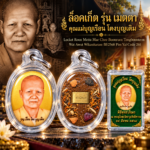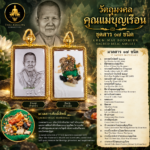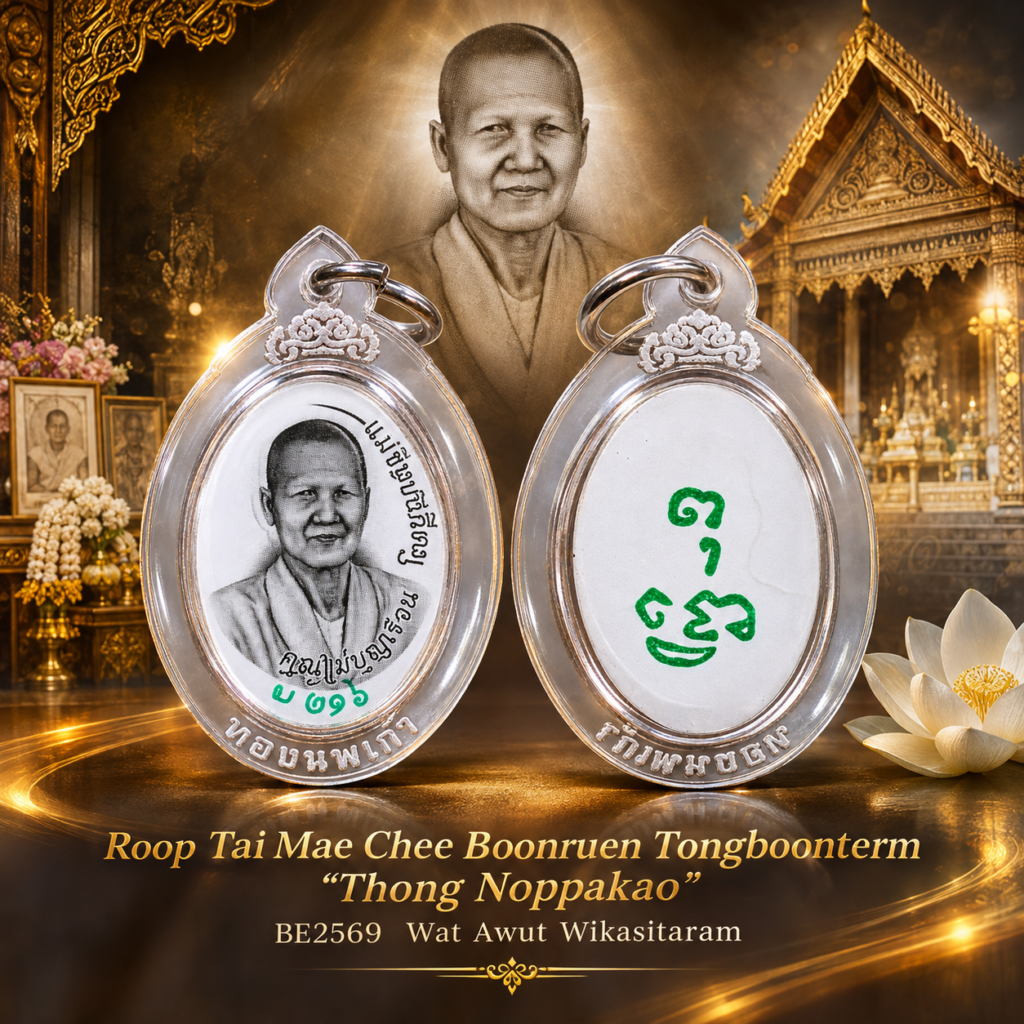
Roop Tai Mae Chee Boonruen Tongboonterm “Thong Noppakao” BE2569 Wat Awut Wikasitaram
| Type | Roop Tai Mae Chee Boonruen Tongboonterm "Thong Noppakao" |
| Monk | Maechee Boonruen Tongboonterm Wat Awutwikasitaram, Bangkok |
| Temple | Wat Awutwikasitaram |
| B.E. Year | 2569 |
| Material | Nur Roop Tai |
| Condition | Excellent |
| SKU | TAC-RoopTaiMaeCheeBoonruenTongboonterm"ThongNoppakao"--001 |
Roop Tai Mae Chee Boonruen Tongboonterm "Thong Noppakao" BE 2569, Wat Awut Wikasitaram Bangkok. Nur Roop Tai with sacred muan sarn. 3-stage consecration. Singapore dealer TAC.
What is the Roop Tai Mae Chee Boonruen Tongboonterm “Thong Noppakao” and where was it made?
The Roop Tai Mae Chee Boonruen Tongboonterm “Thong Noppakao” is a photo-pendant amulet produced in BE 2569 at Wat Awut Wikasitaram, Bangkok. Made from nur roop tai (photographic image material), it is encased in a clear acrylic frame with hanging loop, and carries sacred muan sarn from the historical lineage of Khun Mae Boonruen Tongboonterm on the reverse.
Who is Khun Mae Boonruen Tongboonterm and why do collectors take her seriously
Khun Mae Boonruen Tongboonterm is one of the most significant Thai Buddhist laywomen of the modern era. She was not ordained as a monk, yet her spiritual attainments, documented healing work, and deep Dhamma practice earned her a following that few ordained figures can match. Her barami — the accumulated spiritual virtue that Thai collectors believe transfers into objects she blessed — is the entire reason this run exists.
She is closely linked to Wat Awut Wikasitaram in Bangkok, where she spent time in practice. Beyond Bangkok, her legacy extends to Wat Sarnath Dhammaram in Rayong Province, a temple she helped establish by raising the funds to build its primary presiding Buddha image, Phra Phuttho Phass Chinarat Jom Muni, back in 1951. That is not incidental detail. The fact that the final consecration stage of the Tong Noppakao edition was held at that exact temple — 75 years after she built it — is what ties this batch to the core of her wealth-attraction legacy.
Her sacred mantra, the Phra Chimphli Mantra (คาถาพระฉิมพลี), was reputedly given to her by a divine entity specifically for drawing continuous wealth and good fortune. Devotees who wear or keep this pendant recite it nine times daily: Na Chaa Lee Ti, Chim Phaa Lee Cha Ma Haa The Ro / Su Wan Na Maa Maa, Pho Cha Na Maa Maa / Wat Thu Wat Thaa Maa Maa, Pha La Pha Lang Maa Maa / Pho Kha Maa Maa, Ma Haa Laa Pho Maa Maa / Sap Phe Chaa Naa, Pha Hoo Chaa Naa Pha Wan Tu Me.
The three-stage pluk sek — why this batch was structured the way it was
The Tong Noppakao edition went through a formal three-stage pluk sek (consecration sequence), each stage at a location chosen for its direct connection to Khun Mae Boonruen’s story. This is not a marketing construct — the structural logic holds up.
- Stage 1 — 5 September 2026, Khun Mae Boonruen Pavilion, Wat Awut Wikasitaram, Bangkok. The opening ceremony was conducted at the temple itself, invoking her historical presence and barami at the site of her practice. Luang Phor Lek was among the master monks who directed meditative energy into the batch.
- Stage 2 — 9 September 2026, Wat Tha Pha, Ratchaburi Province. A regional assembly of Geji teachers gathered to empower the amulets with prayers for Klaew Klaad (protection from harm) and Metta (loving-kindness).
- Stage 3 — 10 September 2026, Wat Sarnath Dhammaram, Rayong Province. The final and most symbolically weighted stage. Consecrating the amulets at the temple she funded in 1951 anchors the batch directly to her legacy of large-scale merit-making and abundance.
Three locations, three distinct ritual intentions, all grounded in verifiable historical connections. That is the kind of consecration structure that gives a collector something concrete to point to, beyond the usual broad claims about “top monks.” For more on how Thai amulet consecration works within the broader Buddhist tradition, see the Thai Buddhist amulet tradition overview.
What is inside the reverse and what a collector should check
The back of this pendant contains a pressed arrangement of muan sarn sourced directly from Khun Mae Boonruen’s historical amulet lineage. Specifically, it incorporates crushed material and powders from original BE 2494 Phra Phuttho Noi amulets, along with fragments from the BE 2499 and BE 2516 iterations of her series. Getting her historical powder into a BE 2569 batch is not straightforward — it requires genuine access to original pieces from those earlier runs, and that provenance is what separates this edition from a simple commemorative photo pendant.
Collectors examining this piece should look at the clarity and evenness of the acrylic casing, check that the rear muan sarn panel is intact and properly sealed, and confirm the pendant is from the Tong Noppakao run produced for Wat Awut Wikasitaram. The edition was produced in part to raise funds for the temple’s scholarship programme and monk meal offerings — a detail that matters for provenance, as it confirms the institutional origin of the batch.
This is the Tong Noppakao edition Roop Tai Mae Chee Boonruen Tongboonterm from Wat Awut Wikasitaram, BE 2569 — a photo pendant with historical muan sarn from her BE 2494, 2499 and 2516 lineage pressed into the reverse, and a documented three-stage consecration across Bangkok, Ratchaburi and Rayong. We at TAC handle this for collectors who want Khun Mae Boonruen material with a clear provenance trail, particularly those focused on wealth-attraction and business-protection pieces.
Attributes reflect Thai Buddhist devotional tradition and are not measurable claims.