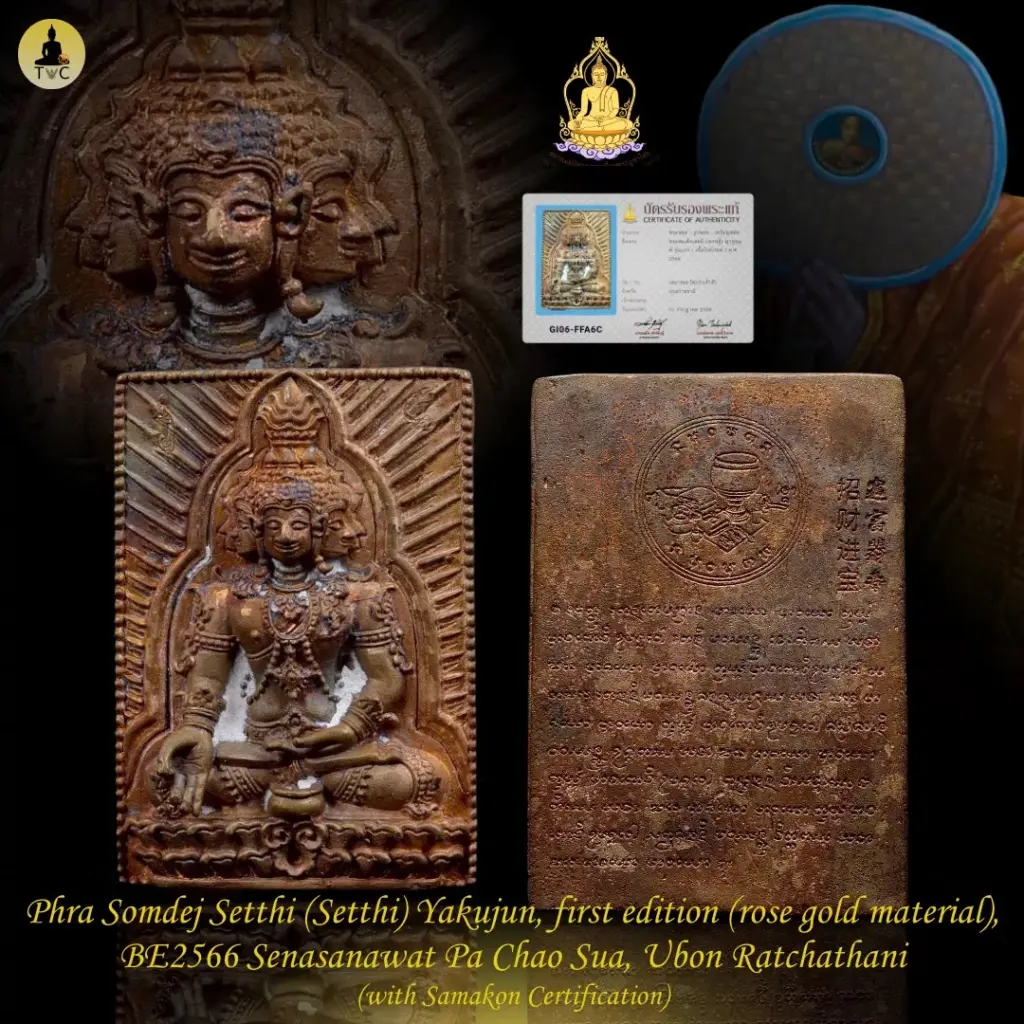
Phra Somdej Setthi Yakujun (YKJ), first edition BE2566 Wat Pa Chao Sua
| Type | Phra Somdej |
| Temple | Wat Pa Chao Sua |
| B.E. Year | 2566 |
| SKU | TAC-0256 |
Authentic Phra Somdej Setthi Yakujun (YKJ), run raek BE 2566, Wat Pa Chao Sua, Ubon Ratchathani. Rose-gold alloy cast. No cert listed. Singapore dealer TAC.
What is the Phra Somdej Setthi Yakujun (YKJ) First Edition from Wat Pa Chao Sua?
The Phra Somdej Setthi Yakujun (YKJ) is a run raek (first edition) Somdej amulet consecrated in BE 2566 at Wat Pa Chao Sua (Senasanawat Pa Chao Sua), Ubon Ratchathani. Cast in a rose-gold alloy of gold, copper, and silver, it follows orthodox Somdej throne geometry and carries the paired intent of Setthi (wealth-generating rites) and Yakujun (yaksha-guardian protection).
A forest monastery that rarely issues amulets — and why that matters
Wat Pa Chao Sua is a pa (forest monastery) in Ubon Ratchathani, operating under Dhutanga ascetic practice and strict Vinaya discipline. Forest houses focus on seated meditation and contemplative rigor. They do not run amulet programmes as a matter of course, so when one does, the output is modest in scale and the intent behind it tends to be clear. That combination — institutional restraint plus limited issue — is exactly what serious collectors pay attention to in the Thai Buddhist amulet tradition.
This run raek (first edition) is the inaugural precious-metal release from the temple. First editions from forest monasteries carry a particular weight in the collector community: they represent a documented starting point, and the numbers do not grow after the fact.
The rose-gold alloy and what the pim tells you
The nuea (material/substance) here is a rose-gold alloy — gold, copper, and silver in a composite that requires precise thermal control during casting. An uneven pour shows in the shoulder line or halo edge. On this piece, the Somdej profile stays orthodox: firm shoulders, balanced torso, compact oval halo, and clean step stratification on the throne base. Uniform metallic flow and controlled cooling grain on the reverse are the technical markers collectors check first.
Compared to powder-pressed Somdej, a metal-cast pim (mould form) yields harder edges and greater durability for daily wear. The rose-gold finish also gives the piece a distinct devotional presence — warmer in tone than silver or bronze, without the visual weight of full gold.
- Step ratio: orthodox late-Rattanakosin proportion, not compressed or elongated
- Halo contour: compact oval, reading cleanly from arm’s length
- Metallic flow: even fill with no visible cold-shut lines on the face
- Reverse grain: uniform, indicating controlled cooling
- Consecration traces: surface markings consistent with pluk sek (consecration ceremony) at Wat Pa Chao Sua BE 2566
No certificate is listed for this edition. Buyers should authenticate against the physical pim markers above and documented reference images from the temple’s own run raek records.
What collectors traditionally associate this piece with
The Somdej form functions as a portable focal point for Buddhist practice — a compact mandala of cosmological order worn or carried through daily life. The name Setthi Yakujun combines two specific intentions: Setthi references wealth-generating rites framed by ethical conduct, while Yakujun invokes the yaksha-guardian motif — protection through discipline rather than force. Collectors associate this pairing with a balance of material aspiration and contemplative restraint, which is consistent with the forest-monastery lineage behind it.
Within Thai Buddhist belief, Somdej amulets are traditionally carried for choke lap (auspicious opportunity and livelihood support), maha saneh (interpersonal appeal in negotiation and rapport), klaew klaad (avoidance of hazards), and kongkrapan (protective field). These are cultural associations rooted in practice — outcomes depend on conduct, effort, and conditions, not the object alone.
This is the run raek (first edition) metal Somdej from Wat Pa Chao Sua — a forest monastery in Ubon Ratchathani that issues amulets rarely, which is precisely why this piece warrants attention. The rose-gold alloy (gold–copper–silver composite) is a minority nuea choice for a Somdej, and the orthodox pim geometry has held well in casting. We at TAC see the combination of forest-lineage provenance, first-issue status, and durable precious-metal nuea as a coherent collector proposition — particularly for those building a studied Somdej collection rather than chasing high-circulation names.
Attributes reflect Thai Buddhist devotional tradition and are not measurable claims.


