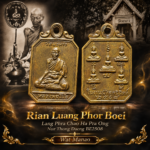
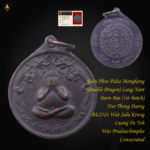
Rian Luang Pu Kuhasawan Wat Nakhwang, Roon 2 BE2523 Nur Thong Daeng Sao 5 Edition consecrated Wat Kalong Luang Phor Kalong
| Type | Rian |
| Monk | Luang Phor Kalong |
| Temple | Wat Nakhwang |
| B.E. Year | 2523 |
| Material | Thong Daeng |
| SKU | TAC-0261 |
Rian Luang Phor Kalong, Wat Nakhwang BE 2523, roon 2 Sao 5 edition in nuea thong daeng. Consecrated at Wat Kalong. Available from TAC Singapore.
What is the Rian Luang Phor Kalong from Wat Nakhwang, BE 2523?
The Rian Luang Phor Kalong issued at Wat Nakhwang in BE 2523 is a roon 2 (second-batch) copper monk-portrait medallion pressed in nuea thong daeng (copper alloy). Identified as a Sao 5 edition, this run was consecrated at Wat Kalong with Luang Phor Kalong presiding, giving it a distinct ritual identity that collectors still reference today.
The monk behind this medallion and why the consecration matters
Luang Phor Kalong’s name carries real weight in Thai amulet circles. His involvement in a consecration ceremony — a phutthaphisek — was not a formality. When his name is attached to a specific run, collectors treat that ritual connection as part of the piece’s documented identity, not just a marketing note.
This particular medallion belongs to Luang Pu Kuhasawan of Wat Nakhwang, issued as roon 2 in BE 2523. The fact that the phutthaphisek took place at Wat Kalong — Luang Phor Kalong’s own base — rather than at Wat Nakhwang itself is worth noting. It places this batch within a wider network of respected blessing activity from that period, and it is precisely the kind of cross-temple ritual detail that serious medallion collectors document. The Thai Buddhist amulet tradition has long valued such ceremonial provenance as a marker of authenticity and intent.
The Sao 5 framing adds another layer. Sao Ha — a Saturday falling on the fifth day of a particular lunar configuration — is traditionally regarded as an auspicious blessing window. When a batch is timed to this, devotees and collectors alike read it as deliberate ritual care on the issuing temple’s part.
Nuea thong daeng: what the copper tells a collector
Nuea thong daeng (copper alloy material) was a standard choice for temple medallions of this era, and for good reason. It strikes cleanly, holds portrait detail well, and develops a surface character over decades that you simply cannot fake convincingly. A BE 2523 piece that has been worn or stored properly will show soft darkening in the recessed areas, a steady field tone, and handling wear that feels gradual rather than mechanical.
Collectors of older copper rian do not look for polish. They look for honesty. An artificially brightened surface is an immediate red flag. The medallion format here presents Luang Pu Kuhasawan in a straightforward devotional portrait — what matters is how clearly that likeness reads through the relief, and whether the reverse inscription and edge integrity hold up to close study.
- Portrait relief: sharpness and balance of the monk’s likeness on the obverse
- Surface tone: age-consistent copper darkening in recesses, stable field colour
- Reverse: inscription clarity and batch markings consistent with the roon 2 Sao 5 identity
- Edge: no signs of filing, re-striking, or artificial wear
- Overall patina: natural oxidation preferred; any brightening warrants scrutiny
This is not a visually ornate piece. That is not a weakness. Many of the most consistently valued temple medallions from the BE 2520s are straightforward copper issues — their weight comes from lineage, ritual context, and material honesty, not decorative complexity.
What collectors look for and how this piece is positioned
A roon 2 issue occupies an interesting position. It sits close enough to the earlier devotional phase of a monk’s following to carry real lineage relevance, while being more accessible than a roon raek (first batch). For Luang Pu Kuhasawan of Wat Nakhwang, this BE 2523 batch has a clearly stated identity — monk, temple, edition, material, and consecration context — and that documentary clarity is itself a collector asset.
No certificate accompanies this piece. That means condition study and cross-reference against known examples become more important. Collectors approaching this medallion should focus on the surface character and portrait strike as primary reference points, and compare against documented BE 2523 Wat Nakhwang issues where available.
For those who collect by ritual context rather than by monk lineage alone, the Wat Kalong consecration note gives this run a specific ceremonial identity that sets it apart from a generic temple issue of the same period.
We at TAC are offering this BE 2523 roon 2 Sao 5 medallion of Luang Pu Kuhasawan from Wat Nakhwang — a copper rian with a clearly stated ritual identity, consecrated at Wat Kalong with Luang Phor Kalong presiding. For collectors focused on the BE 2520s temple medallion period, the cross-temple consecration note and Sao 5 framing give this run more definition than most copper issues of comparable age — and at this price point, it remains a practical entry into the Wat Nakhwang catalogue.
Attributes reflect Thai Buddhist devotional tradition and are not measurable claims.