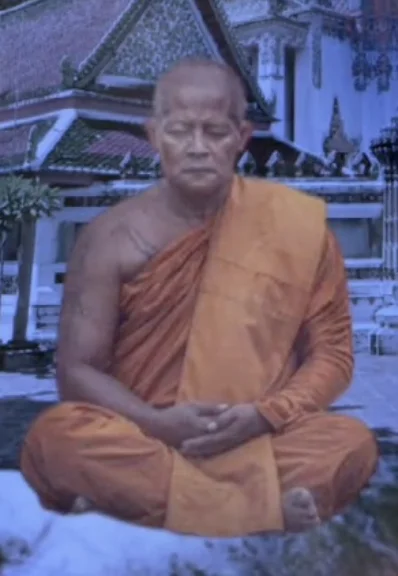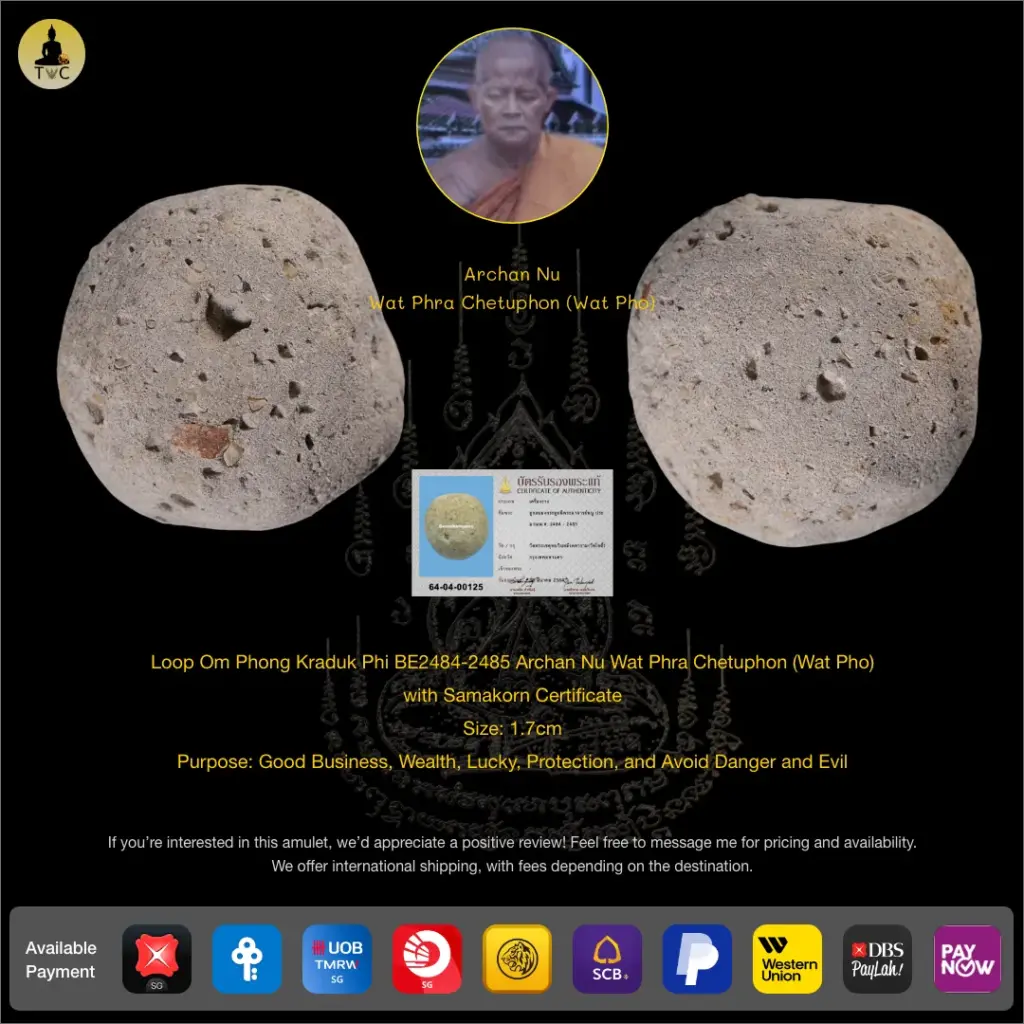
Loop Om Phong Kraduk Phi BE2484-2485 Archan Nu Wat Phra Chetuphon (Wat Pho)
| Monk | Archan Nu Wat Phra Chetuphon (Wat Pho), Bangkok |
| Temple | Wat Phra Chetuphon |
| B.E. Year | 2484 |
| SKU | TAC-0387 |
Authentic Loop Om Phong Kraduk Phi BE2484-2485 Archan Nu Wat Phra Chetuphon (Wat Pho) by Archan Nu Wat Phra Chetuphon (Wat Pho), Bangkok. Phong kraduk phi nuea.
What is the Loop Om Phong Kraduk Phi BE2484-2485 Archan Nu Wat Phra Chetuphon (Wat Pho) by Archan Nu Wat Phra Chetuphon (Wat Pho), Bangkok?
The Loop Om Phong Kraduk Phi BE2484-2485 Archan Nu Wat Phra Chetuphon (Wat Pho) by Archan Nu Wat Phra Chetuphon (Wat Pho), Bangkok is a wartime-era spherical carry amulet pressed from phong kraduk phi — a ritually prepared powder blend described as bone-ash based with sacred powders — produced at Wat Phra Chetuphon between BE 2484 and 2485 (CE 1941–1942), and accompanied by a Samakom (Samakorn) certificate.
A wartime piece from one of Bangkok’s most established temples
Wat Phra Chetuphon Wimon Mangkhalaram — better known as Wat Pho — sits at the centre of Bangkok’s oldest royal district and carries one of the longest continuous sacred-art traditions in the country. Amulets attributed to its monks carry that institutional weight. Within the broader Thai Buddhist amulet tradition, pieces tied to a specific temple lineage and a named ritual master are the ones collectors track most closely.
BE 2484–2485 places this Loop Om squarely inside the Second World War. Thailand was navigating occupation and conflict, and demand for protection talismans was high and specific — people wanted something compact enough for daily carry, not a shelf piece. The loop om (ลูกอม) spherical form answers that exactly: small, discreet, worn on the body or kept close at all times.
Archan Nu Wat Phra Chetuphon (Wat Pho), Bangkok is recorded as a respected monk and ritual master active at Wat Pho during this period, known for producing protective talismans suited to wartime conditions. His work drew on both Lanna and Ayutthaya incantation traditions — a combination that signals broader ritual knowledge rather than a single regional school.
The nuea: what phong kraduk phi actually means
The material name translates directly as “bone powder of ghosts” (ผงกระดูกผี). In Thai amulet culture this is a recognised protection-oriented nuea (material/substance) — the powder blend is described as bone-ash based, combined with other sacred powders to form the muan sarn. This naming convention is not decorative; it signals the specific ritual lineage the piece belongs to and the kind of protection it was made for.
The loop om form compresses that muan sarn into a sphere. There is no pim (mould) in the conventional flat-amulet sense — authentication here relies on the powder composition, the period patina, and documentary evidence rather than mould comparison. The Samakom (Samakorn) certificate shown with this piece provides that documentary anchor.
Consecration is described as following both Lanna and Ayutthaya incantation traditions. Collectors use the term pluk sek (consecration ceremony) loosely across many pieces, but the dual-lineage framing here is specific enough to be meaningful — it suggests Archan Nu was drawing on a wider corpus of protective verse than a single regional tradition would provide.
What collectors look for and how this piece is certified
For a powder-form amulet of this age, authentication rests on a few concrete points:
- Surface texture and patina consistent with 80-plus years of natural aging in a tropical climate
- Powder composition matching the documented phong kraduk phi nuea — colour, density, and the way the surface holds detail over time
- The Samakom (Samakorn) certificate, which provides committee-level attribution to Archan Nu and Wat Phra Chetuphon for the BE 2484–2485 production period
- Provenance consistency — the piece should arrive with documentation that aligns with the certificate rather than contradicting it
Wartime-era loop om pieces in documented condition are uncommon. Most circulate without certificates; the presence of Samakom paper changes the collector calculus significantly. It moves the piece from “attributed” to “certified attributed,” which is a meaningful distinction at this age bracket.
We at TAC are offering this Loop Om Phong Kraduk Phi from BE 2484–2485, attributed to Archan Nu of Wat Phra Chetuphon (Wat Pho), Bangkok — a wartime-era powder-form piece that comes with a Samakom (Samakorn) certificate, which is the key differentiator at this age bracket. For collectors focused on documented Wat Pho lineage material from the Second World War period, certified examples like this are genuinely hard to source.
Attributes reflect Thai Buddhist devotional tradition and are not measurable claims.