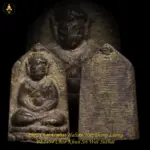
Phra Kring Ayu Wanno Sukhang Phalang Nur Thong Daeng BE2551 Wat Suthat Thepwararam Code 415
| Type | Phra Kring |
| Temple | Wat Suthat |
| B.E. Year | 2551 |
| Material | Thong Daeng |
| SKU | TAC-0047 |
Authentic Phra Kring Ayu Wanno Sukhang Phalang, Wat Suthat Thepwararam BE2551. Nuea Thong Daeng, Code 415, royal-temple Phutthaphisek.
What is the Phra Kring Ayu Wanno Sukhang Phalang from Wat Suthat BE2551?
The Phra Kring Ayu Wanno Sukhang Phalang is a cast-metal Thai Buddhist amulet produced at Wat Suthat Thepwararam, Bangkok, in BE2551 (CE2008). Pressed in nuea (material/substance) Thong Daeng — red-bronze alloy — it carries a sealed internal kring bead and was consecrated by the temple’s senior monastic assembly under royal-standard Phutthaphisek rites. Registered Code 415 confirms batch provenance.
A royal-temple edition with a clear doctrinal purpose
Wat Suthat Thepwararam is one of Bangkok’s first-class royal monasteries. Founded under King Rama I and substantially completed under Rama III, it houses one of the largest bronze Buddha images in Thailand and operates under royal ecclesiastical oversight — which means every amulet edition it sanctions goes through formal institutional accountability, not just temple-level approval. That matters to collectors who need to know the consecration was conducted to a verified standard.
The BE2551 edition was produced as a fundraising batch for ongoing temple restoration. That situates it within a well-established Thai practice: merit-making and material support running in parallel, with the edition’s name encoding exactly what the consecration was directed toward. Ayu Wanno Sukhang Phalang draws from Pali formulas in Theravada merit-transfer texts — longevity (ayu), radiant vitality (wanno), happiness (sukhang), strength (phalang). Four attributes, precisely stated. It is not a generic blessing formula.
The phutthaphisek (Buddha-empowerment consecration ceremony) followed royal court liturgical sequences. Protective paritta chanting cycles, including the Phong Monthon and Itthipiso formulas associated with healing and longevity, formed the ritual core. No single named monk is listed as consecrator — this was a collegiate rite by the senior monastic assembly, consistent with how first-class royal temples conduct major amulet editions. For collectors accustomed to pieces attributed to a single ajarn, that is worth understanding rather than treating as a gap.
Nuea Thong Daeng — what the material tells you
Thong Daeng (red-bronze) is the traditional casting alloy for the Phra Kring type. It is valued for workability, for its acoustic properties — directly relevant to the kring bead’s resonance — and for its symbolic association with warmth and vitality within both Theravada and Brahmanical Thai ritual traditions. The BE2551 Wat Suthat batch incorporated selected blessed metals contributed by affiliated temples and supporters, adding both symbolic lineage and material complexity to the base alloy.
The internal kring bead is cast separately and sealed within the hollow base cavity during final assembly. Its weight and diameter are calibrated to produce a specific tone. For collectors assessing the Thai Buddhist amulet tradition from first principles, this is where the Phra Kring type distinguishes itself from flat votive tablets: the resonance is structural, functional, and the primary condition benchmark in the secondary market.
Thong Daeng patinates predictably. With age and handling, authentic red-bronze develops a warm reddish-brown surface, deepening where the piece is touched and staying brighter in relief recesses. Experienced collectors read this patina profile alongside batch documentation as a paired reference — neither alone is sufficient.
What collectors check on this piece
Phra Kring authentication is its own sub-field, with dedicated reference publications and active auction categories in Bangkok, Chiang Mai, and Singapore. For the Wat Suthat BE2551 edition specifically, these are the points that matter:
- Acoustic integrity: A clear, distinct ring upon gentle movement confirms the kring bead is intact and the cavity seal is sound. A dull or absent sound may indicate bead displacement or cavity damage — this materially affects both devotional use and collector valuation.
- Casting quality: Look at the crispness of the crown detail, the relief definition across the robing, and the facial expression. The Wat Suthat pim (mould collectors authenticate against) is noted for compositional stability — a well-proportioned bell base relative to the upper figure, clean casting lines.
- Red-bronze patina: Consistent with a BE2551 casting. Bright, unaged surfaces on a piece of this age warrant closer inspection.
- Registered Code 415: Stamped or cast onto the piece as an edition control measure, linking the specimen to the official Wat Suthat BE2551 issue record. This is the primary documentary provenance anchor for this edition.
No independent third-party certificate accompanies this piece. Provenance rests on the Registered Code 415 batch marking and the institutional standing of the issuing temple. Collectors building a study reference of modern royal-temple Phra Kring production will recognise that for editions of this type, batch registration is the standard provenance mechanism.
This is a clean royal-temple Phra Kring from Wat Suthat's BE2551 fundraising edition — one of the more clearly documented modern Phra Kring issues we carry, with Registered Code 415 batch marking tying each piece to the official issue record. We at TAC include this in our study reference range for collectors building a serious Phra Kring collection, particularly those interested in how first-class royal temples approach edition standards versus privately commissioned pieces.
Attributes reflect Thai Buddhist devotional tradition and are not measurable claims.