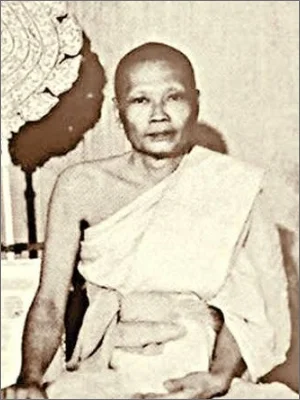
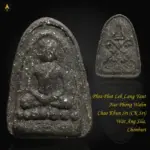
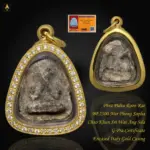
Phra Chai Umbat Halian (Phra Chaiwat) Nur Thong Lueng BE2494 Chao Khun Sri Wat Suthat
| Type | Phra Chaiwat |
| Monk | Chao Khun Sri Wat Suthat |
| Temple | Wat Suthat |
| B.E. Year | 2494 |
| Material | Thong Lueng |
| SKU | TAC-0064 |
Authentic Phra Chaiwat by Chao Khun Sri Wat Suthat, cast in Thong Lueng brass, BE 2494. Halian pentagonal form from Wat Suthat. Singapore dealer TAC.
What is the Phra Chaiwat by Chao Khun Sri Wat Suthat?
The Phra Chaiwat Chao Khun Sri Wat Suthat is a cast brass amulet produced at Wat Suthat in BE 2494 (1951), attributed to the line of Chao Khun Sri. Cast in nuea (material/substance) Thong Lueng — brass — and pressed in the Halian pentagonal frame, it represents the disciplined casting tradition that Wat Suthat is known for among Bangkok temple collectors.
Chao Khun Sri and the Wat Suthat Metal Tradition
Wat Suthat has long been one of Bangkok’s key centres for metal amulet craft, particularly the Phra Kring and Phra Chai families. The emphasis there was never on ornate surface decoration — it was on controlled casting, proper temple standards, and a consecration environment grounded in monastic discipline. Pieces attributed to the Chao Khun Sri line sit squarely within that tradition.
The Phra Chai family is generally understood among collectors as the companion line to Phra Kring — compact Buddha forms made for daily wear rather than display. The term “Umbat” identifies a specific stylistic line within this family. Produced in BE 2494, this piece belongs to a post-war era when Wat Suthat was still maintaining strict temple casting standards before production scales changed in later decades.
Nuea Thong Lueng and the Halian Form
Thong Lueng (ทองเหลือง) is brass. It was a favoured nuea for Wat Suthat-era pieces because it holds casting detail cleanly, ages with a warm surface depth, and develops a patina that collectors describe as “old metal character” — distinct from anything plated or recently finished. Genuine aged brass from a 1951 piece will show consistent tone across the surface, not bright or uneven.
The Halian (ห้าเหลี่ยม) form is a pentagonal frame. Practically speaking, it cases well and sits comfortably against the body — one reason the Phra Chai Halian became a standard carry piece rather than a shelf piece. The Thai Buddhist amulet tradition has always favoured forms that could be worn through daily life, and the Halian proportions reflect that intent directly.
What collectors look for in this pim (mould collectors authenticate against):
- Casting definition: Clean facial lines and robe folds — Wat Suthat pieces from this era were not rough-cast.
- Surface patina: Consistent aged brass tone, no signs of re-polishing or artificial darkening.
- Edge profile: The Halian border should be evenly formed with no slippage in the frame outline.
- Back face: Surface texture and any markings consistent with BE 2494 Wat Suthat production.
No certificate accompanies this piece. Collector assessment relies on the physical nuea, the pim profile, and familiarity with comparable Wat Suthat Thong Lueng examples from the same era.
Why Collectors Still Carry This
Among Singapore and Malaysia collectors who follow Bangkok temple lines, Wat Suthat metal pieces occupy a specific niche — “classic Bangkok,” wearable every day, with a lineage that does not require explanation to anyone who knows the tradition. This particular piece is small enough for practical daily carry but carries enough identity in its casting character to read clearly as a genuine old Bangkok temple piece.
Collectors traditionally associate Phra Chai pieces with khuam klang jai (confidence and inner calm), protection during travel, and steady personal presence. These are the same qualities associated with the broader Phra Kring / Phra Chai temple line. Serious collectors will note, as they usually do, that the amulet functions as a companion and a reminder of one’s own conduct — not a guarantee of outcome.
This Phra Chaiwat Chao Khun Sri Wat Suthat is a straightforward old Bangkok temple piece — cast in Thong Lueng brass at Wat Suthat in BE 2494, Halian form, no certificate. We carry it as a clean, wearable representative of the Wat Suthat metal tradition for collectors who know the line and can assess the nuea directly.
Attributes reflect Thai Buddhist devotional tradition and are not measurable claims.