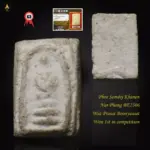
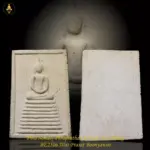
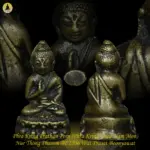
Phra Putta Chinnaraj Nur Phong BE2506 Wat Prasat Boonyawat (Big Ceremony)
| Temple | Wat Prasat |
| B.E. Year | 2506 |
| Material | Phong |
| SKU | TAC-0490 |
Authentic Phra Putta Chinnaraj Nur Phong BE2506 Wat Prasat Boonyawat (Big Ceremony) by Ajarn Tim of Wat Chang Hai, Wat Prasat BE2506. Phong.
What is the Phra Putta Chinnaraj Nur Phong BE2506 Wat Prasat Boonyawat (Big Ceremony) by Ajarn Tim of Wat Chang Hai?
The Phra Putta Chinnaraj Nur Phong BE2506 Wat Prasat Boonyawat (Big Ceremony) Ajarn Tim of Wat Chang Hai is a sacred powder amulet pressed for the landmark Wat Prasat BE2506 temple restoration project. Made from a complex phong (sacred powder) blend and consecrated across two extended ceremonies in BE2506, it was led by Ajarn Tim of Wat Chang Hai alongside more than 200 masters drawn from across Thailand at Wat Prasat.
The Wat Prasat BE2506 Project — Why This Batch Stands Apart
After a devastating fire left Wat Prasat Boonyawat in need of full restoration, the temple’s BE2506 series was conceived as both a fundraising effort and a genuine act of collective merit-making. The guiding vision was to rebuild the temple while preserving rare sacred materials for future generations — a dual purpose that shaped every decision about what went into the phong blend and how the ceremonies were structured.
The consecration ran across two separate events: three days and three nights in March BE2506, then four days and four nights in November BE2506, with continuous chanting throughout. In scope, it is often placed alongside the BE2485 nationwide Phra Kring rite and the BE2500 millennium celebrations — that is the tier of ambition the organising committee set for themselves.
The Ajarn Tim of Wat Chang Hai anchored the project through wicha Luang Phor Thuad — the protective lineage of the famed Luang Phor Thuad of Wat Chang Hai. Masters including Luang Phor Kuay, Luang Phor Toh, Luang Phor Ngern, Luang Phor Pae and many others each contributed their own specialties across protection, metta (loving-kindness energy), authority, and contemplative depth. City and forest traditions, ritual and meditative practice, were combined into a single unified act. That breadth of participation is what gives the Wat Prasat BE2506 family its particular standing within the Thai Buddhist amulet tradition.
Nuea, Pim and What to Look For
The nuea (material/substance) here is a multi-source phong blend assembled specifically for the BE2506 project. It incorporates fragments of old Phra Somdej, BE2497 Luang Phor Thuad powder, royal and monastic sacred powders, pollen, scripture ash, and temple soils collected from over 300 temples nationwide. That accumulation of source materials across so many sites is genuinely unusual and accounts for the complexity of the powder surface on well-preserved examples.
The pim (mould collectors authenticate against) follows a Sukhothai-style Chinnaraj Buddha seated in Maravichai posture — the earth-witness gesture — with a triple-flame halo and a stepped base. Key authentication points collectors check:
- Sharp yet organic robe lines — crisp definition without the mechanical flatness of later copies
- Subtle natural rounding at the halo tips, not uniform or over-cut
- Micro-pitting across the powder matrix — the surface should feel alive, not sealed or “dead”
- Clean original edges with natural wear pattern consistent with age and handling
- Visible powder stratification in edge and side views, distinguishing hand-pressed originals from recasts
No certificate is currently on record for this piece. Collectors working with uncertified Wat Prasat BE2506 examples typically cross-reference against established niyom (collector-standard reference pieces) and published comparison photography before making a decision.
How Collectors Position This Piece
Within the Wat Prasat BE2506 family, the Somdej form tends to draw the most immediate recognition. The Chinnaraj Nur Phong variant is collector-grade when the facial expression, halo flames and base lines remain sharp and the powder matrix is unpolished and intact. Well-preserved examples are increasingly treated as study anchors in advanced mid-20th-century powder amulet collections.
As documentation of the BE2506 project becomes more thorough, serious collectors treat original unaltered examples — regardless of sub-type — as important reference points. A clean Chinnaraj variant with strong surface detail holds its own against the more commonly cited forms from the same run.
We at TAC consider the Phra Putta Chinnaraj Nur Phong BE2506 Wat Prasat Boonyawat (Big Ceremony) one of the more compelling sub-types from the Wat Prasat BE2506 restoration project — the scale of that consecration, two extended pluk sek ceremonies in a single year with over 200 participating masters led by Ajarn Tim, is genuinely difficult to match in modern Thai amulet history. For collectors focused on mid-20th-century phong amulets, a well-preserved Chinnaraj variant from this series makes a strong reference piece alongside the better-known Somdej forms from the same batch.
Attributes reflect Thai Buddhist devotional tradition and are not measurable claims.