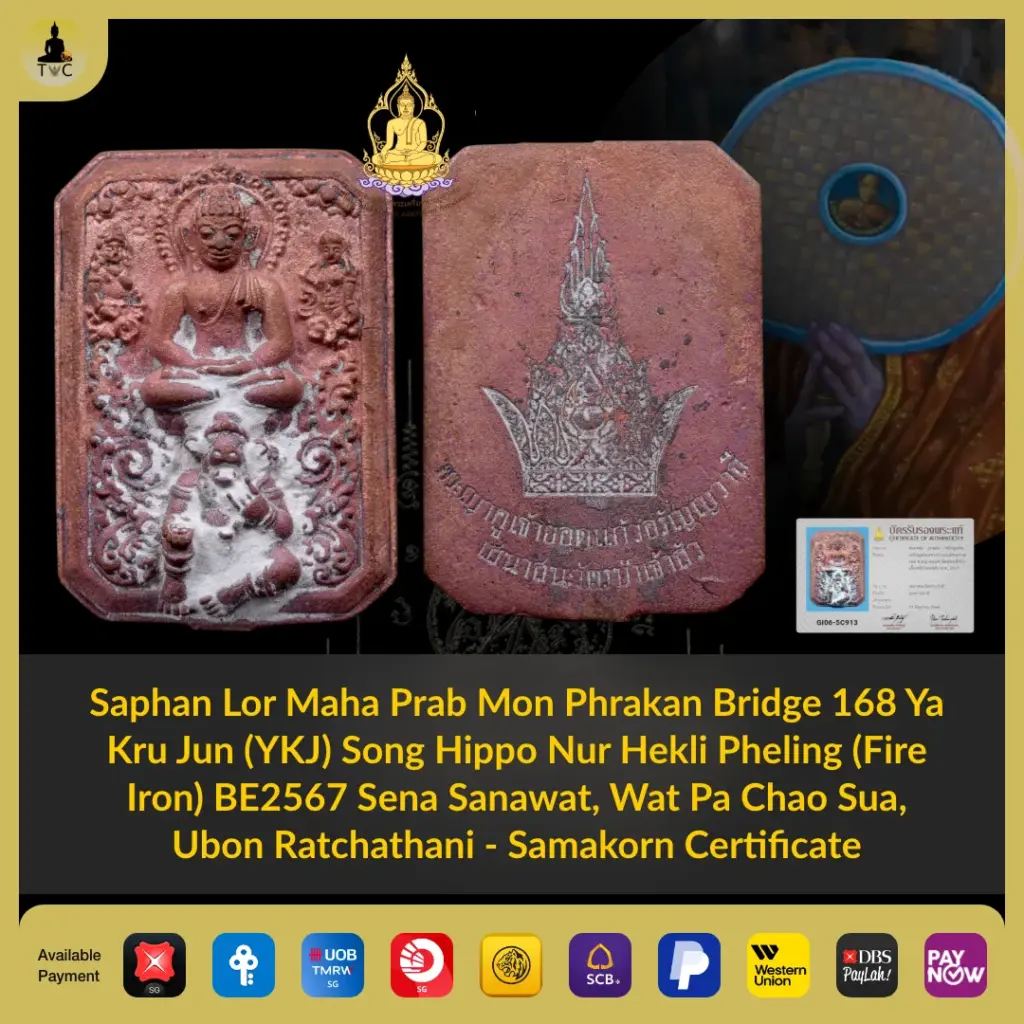
Saphan Lor Maha Prab Mon Phrakan 168 YKJ Hippo (Red) BE2567 Wat Pa Chao Sua
| Temple | Wat Pa Chao Sua |
| B.E. Year | 2567 |
| SKU | TAC-0526 |
Authentic Saphan Lor Maha Prab Mon Phrakan 168 YKJ Hippo (Red) BE2567 Wat Pa Chao Sua by Sena Sanawat. Nur Hekli Pheling sacred forged iron. Samakorn certified.
What is the Saphan Lor Maha Prab Mon Phrakan 168 YKJ Hippo (Red) BE2567 Wat Pa Chao Sua by Sena Sanawat?
The Saphan Lor Maha Prab Mon Phrakan 168 YKJ Hippo (Red) BE2567 Wat Pa Chao Sua by Sena Sanawat is a limited-production sacred iron amulet consecrated at Wat Pa Chao Sua in Ubon Ratchathani, BE2567. Cast in Nur Hekli Pheling — ritually forged sacred iron known as Lek Fai — it depicts Phraya Ku Jun in hippopotamus form and was issued exclusively to 168 Kamagam committee members with Samakorn authentication.
The piece, the monk, and why this run matters
Only 168 pieces were produced. That number carries deliberate weight in Thai Buddhist culture — associated with perpetual prosperity — and it also reflects the practical reality of a gammakan (committee edition) release: restricted access, documented circulation, no open market distribution at launch. Each piece comes with Samakorn Committee certification, which gives collectors a clear chain of custody from consecration to hand.
Sena Sanawat directed both the spiritual and material process at Wat Pa Chao Sua. Under his guidance the temple has built a consistent record of producing amulets that sit within the Isan forest-monastery lineage — austere in practice, specific in ritual protocol. That lineage matters when you are evaluating a contemporary piece, because it tells you the consecration was not a commercial ceremony bolted on at the end. The phutthaphisek (consecration ceremony) here incorporated ancient Isan fire rituals alongside Buddhist chanting, in keeping with the temple’s thudong (forest ascetic) tradition.
The iconography centres on Phraya Ku Jun, a protective figure from northeastern Thai folklore often depicted in hippopotamus form. This is not decoration — the hippo references territorial guardianship and the capacity to overpower malevolent forces, which is the core function collectors and devotees associate with this piece. The syncretic blend of pre-Buddhist animism and Theravada practice is characteristic of Isan amulet culture, and Wat Pa Chao Sua is one of the temples that preserves rather than dilutes it.
Nuea and how it was made
The nuea (material/substance) here is Nur Hekli Pheling — sacred forged iron, the same family as Lek Fai (fire iron). This is not standard cast metal. The iron is repeatedly heated and worked while specific mantras are recited, a process that is labour-intensive by any measure and rarely used in volume production. The result is a material composition distinct from die-cast amulets, with surface characteristics that experienced collectors can read. For a broader introduction to how material and consecration interact in this tradition, see the Thai Buddhist amulet tradition overview on Wikipedia.
The red colouration of this variant is a deliberate production choice within the 168-piece run — collectors tracking the YKJ Hippo series should note the colour designation when referencing or comparing pieces. The pim (mould) produces the recognisable hippopotamus silhouette with consecration markings on the reverse. Authentication against the pim is one of the first steps any serious collector takes.
What to check and what sets the value
For authentication, focus on these points:
- Samakorn Committee certificate — verify the serial number matches the piece and the documentation format matches issued examples from this run
- Surface texture consistent with hand-forged Lek Fai iron, not the uniform smoothness of cast production
- Pim profile — the hippopotamus form and reverse markings should align with documented reference examples from the 168-piece batch
- Colour: this is the red variant; pieces described otherwise are a different sub-run
- Kamagam distribution provenance — original committee-issued pieces often come with additional paperwork confirming the recipient’s membership status
Value in a contemporary gammakan piece like this is driven by the tightness of the run, the completeness of documentation, and condition. With only 168 pieces produced and no open-market release at consecration, dispersion across collections is already underway. Pieces in clean condition with the full Samakorn certificate intact represent the benchmark. As time puts distance between collectors and the BE2567 consecration date, documentation integrity will matter more, not less.
We at TAC sourced this piece from the original Kamagam (committee) distribution at Wat Pa Chao Sua, Ubon Ratchathani — one of 168 produced under Sena Sanawat's consecration in BE2567. What stands out about this run is the combination of genuine Lek Fai forging — a technique rarely used at this scale in contemporary production — and the tight, documented distribution that limits secondary market supply from the outset. Collectors focusing on certified contemporary Isan pieces with verifiable gammakan provenance should look at this one carefully.
Attributes reflect Thai Buddhist devotional tradition and are not measurable claims.