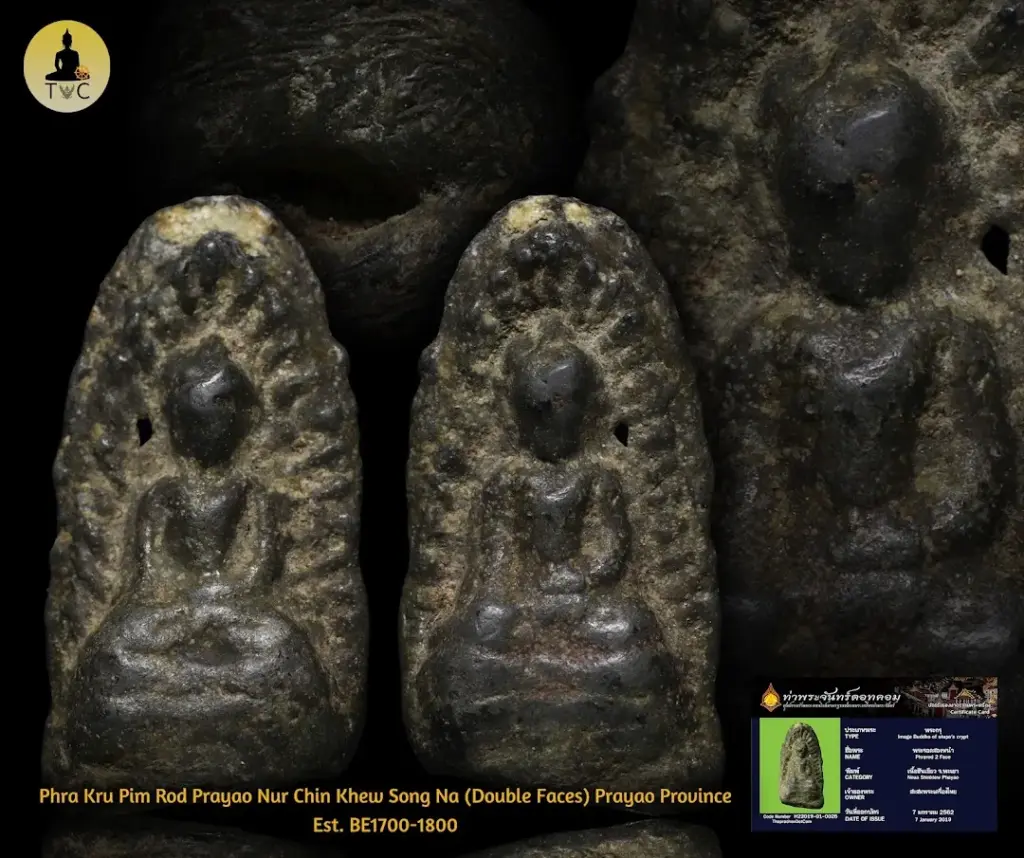
Phra Kru Pim Rod Prayao Nur Chin Khew Song Na (Double Faces) Prayao Province Est. BE1700-1800
| B.E. Year | 1700 |
| Material | Nur Chin Khew Song Na |
| SKU | TAC-0655 |
Authentic Phra Kru Pim Rod Prayao Nur Chin Khew Song Na (Double Faces) Prayao Province Est. BE1700-1800.
What is the Phra Kru Pim Rod Prayao Nur Chin Khew Song Na (Double Faces) Prayao Province Est. BE1700-1800?
The Phra Kru Pim Rod Prayao Nur Chin Khew Song Na (Double Faces) Prayao Province Est. BE1700-1800 is an ancient Northern Thai amulet from Prayao Province, estimated between BE1700 and BE1800. Pressed in nuea (material/substance) Chin Khew — an ancient alloy classified by collectors — it carries the rare Song Na (double faces) configuration and is supported by a Thaprachan Certificate.
What makes the Song Na configuration a serious collector cue
Among Prayao family pieces, the Song Na — literally “two faces” — is not decorative. It is a primary identity marker that collectors read across both sides of the piece to confirm pim (the mould collectors authenticate against) consistency. Both faces must present clearly; any ambiguity on the secondary face is a red flag for advanced buyers.
Within Northern Thai amulet collecting, double-face pieces from Prayao are notably scarce compared to single-face variants. That scarcity, combined with the age of the nuea Chin Khew alloy itself, is what drives genuine collector interest. The Thai Buddhist amulet tradition in the North developed distinct casting and pressing conventions, and the Prayao rod (rod meaning “cylindrical” or “elongated” in the pim classification) is one of the more specific forms within that Northern canon.
This piece is accompanied by a Thaprachan Certificate, which gives collectors a recognised authentication anchor. In practical terms, that certificate makes it easier to document, easier to compare against reference pieces, and more straightforward to include in a formal collection inventory.
Reading the nuea and knowing what to check
Nuea Chin Khew is an ancient alloy — the collector classification points to a specific metal tone and surface character that develops over centuries. Genuine age shows in the patina consistency across the front face, secondary face, and base. Inconsistency between surfaces — where one reads old and another reads artificially treated — is the first thing to flag.
For this pim, authentication comes down to a short checklist:
- Surface age and metal tone: consistent across all three surfaces (front, back, base), not localised to one area.
- Song Na identity: both faces reading clearly as distinct facial presentations, not blurred or worn to the point of ambiguity.
- Edge integrity: the rod profile should hold its form; edges collapsing or showing casting irregularities inconsistent with the period are a concern.
- Thaprachan Certificate: match the piece in hand against the certificate photo references — front, back, and base images should correspond.
The Thaprachan Certificate included with this piece provides that photo-matched documentation. For collectors who track provenance carefully, this is the difference between a piece you can confidently show and one that sits in a grey area.
We at TAC are offering this Phra Kru Pim Rod Prayao Nur Chin Khew Song Na (Double Faces) Prayao Province Est. BE1700-1800 — a genuinely scarce piece within the Prayao family, specifically because the Song Na configuration is far less common than single-face variants from the same province. The Thaprachan Certificate gives this piece a clear documentation advantage for collectors who track provenance formally.
Attributes reflect Thai Buddhist devotional tradition and are not measurable claims.