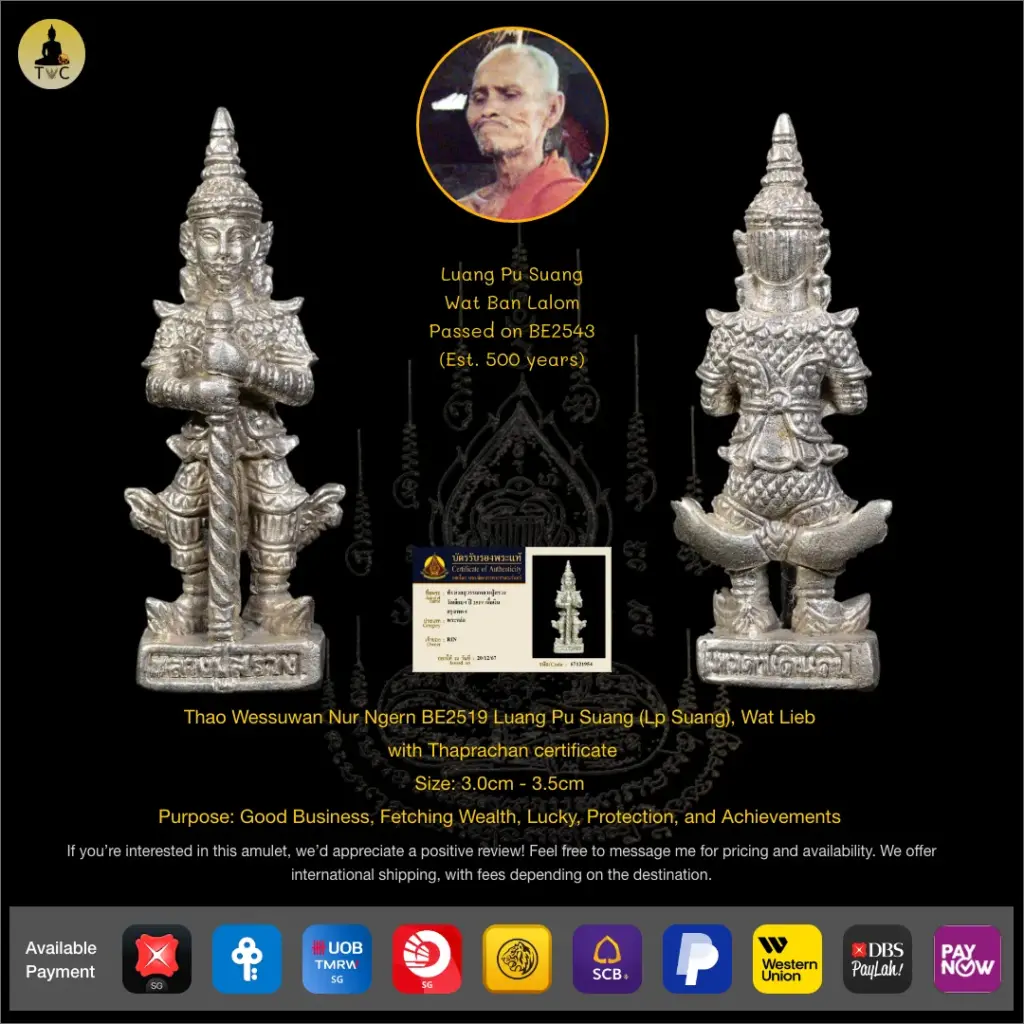
Taowesuwan Nur Ngern BE2519 Luang Pu Suang , Wat Lieb
| Monk | Luang Pu Suang |
| Temple | Wat Lieb |
| B.E. Year | 2519 |
| Material | Ngern |
| SKU | TAC-0659 |
Authentic Taowesuwan Nur Ngern BE2519 Luang Pu Suang, Wat Lieb by Luang Pu Suang. Silver, Thaprachan certified, Sisaket. Available now from TAC Singapore.
What is the Taowesuwan Nur Ngern BE2519 Luang Pu Suang, Wat Lieb by Luang Pu Suang?
The Taowesuwan Nur Ngern BE2519 Luang Pu Suang, Wat Lieb is a silver (nuea ngern) guardian-king amulet consecrated by Luang Pu Suang at Wat Lieb, Sisaket, in BE 2519 (1976 CE). It depicts Thaowesuwan (ท้าวเวสสุวรรณ) — the boundary-guardian king of the northern realm — and carries a Thaprachan certificate.
Luang Pu Suang and why this issue from Wat Lieb holds weight
Luang Pu Suang of Wat Lieb, Sisaket is remembered for an unusual life story and a strong reputation in protective wicha (วิชา — sacred knowledge and practice). Serious collectors draw a clear line between popular epithet and verified biography, but that reputation is consistent enough across the Sisaket collector community to anchor market confidence in his issues.
BE 2519 places this piece squarely in an older era. Temple releases from that period were typically tied to local community needs — monastic fundraising, temple upkeep, welfare — rather than mass-market production. That context matters. The closer an issue sits to a specific community purpose, the harder it is to replicate convincingly.
Within the broader Thai Buddhist amulet tradition, Thaowesuwan occupies a distinct position. He is not a decorative figure. The iconography frames him as a boundary enforcer — authority in armour, weapon in hand — and collectors who seek this image are usually after that specific protective energy, not general merit-making imagery.
Nuea ngern: what silver tells you as a collector
Nuea ngern (เงิน — silver) is the material here, and it gives you a clear surface language to read. Natural toning, age patina, and edge definition on a genuine older silver piece all develop together in a way that is difficult to fake convincingly. That is one reason silver issues from this period attract careful scrutiny — the surface tells the story if you know what to look for.
The pim (พิมพ์ — the mould collectors authenticate against) for Thaowesuwan issues shows specific iconographic markers: facial geometry, crown or helmet edge treatment, armour plate sharpness, and the silhouette of the weapon hand. On a silver strike, those micro-lines are especially readable — or notably absent if a piece has been harshly polished. Polishing erases age signals and directly reduces collector value.
- Surface check: consistent toning across the face and recesses; uneven bright spots suggest cleaning or replating.
- Pim geometry: compare facial plane, crown edges, and weapon hand against reference examples for this issue.
- Edge integrity: rim definition and casting depth should be consistent; look at the profile for thickness and uniformity.
- Documentation: the Thaprachan certificate accompanying this piece adds a verification layer that older issues often lack.
The Thaprachan certificate here is a concrete provenance asset. In older silver issues where mintage figures and run (รุ่น — edition) documentation were rarely published, a certificate is frequently what separates a well-regarded piece from a cleanly documented one. If you have original temple papers or casing notes as well, those only strengthen the case further.
What sets value and what collectors watch for
Strike quality on silver is the first variable. A piece can be entirely genuine yet carry softer collector demand if the strike is weak or the surface over-worn. The best examples from this issue will show clean facial expression, legible armour detail, and a weapon silhouette that reads clearly. That sharpness, combined with honest age patina rather than artificial toning, is what the top end of the market prices for.
Age bracket matters too. BE 2519 is now approaching fifty years old. Pieces from this era consistently draw stronger attention than modern releases, and silver versions in particular tend to be more carefully kept by their owners — which means surface-intact examples are proportionally rarer in the secondary market.
Taowesuwan (ท้าวเวสสุวรรณ) in Nur Ngern is a pairing we at TAC regard with particular care — silver as a material carries its own doctrinal weight in Thai Buddhist iconography, and when cast under a regionally respected master such as Luang Pu Suang of Wat Lieb, Sisaket, the combination speaks directly to the serious collector rather than the casual buyer. The BE2519 (1976) date places this piece in an era when provincial temple issues were still deeply community-rooted, produced in limited numbers for local merit-making rather than wider commercial distribution, which lends the batch a quiet authenticity that later issues rarely replicate. The accompanying Thaprachan certificate provides the baseline provenance assurance we require before offering any piece through TAC, and collectors building a focused Taowesuwan or Sisaket-master study will recognise this BE2519 Wat Lieb issue as a coherent and honest addition to that lineage.
Attributes reflect Thai Buddhist devotional tradition and are not measurable claims.