Phra Somdej Prok Pho Nur Nae BE2566 Luang Pu Maha Sila (Lp Maha Sila) Wat Pa Si Saat, Ubon Ratchathani
| Monk | Luang Pu Maha Sila |
| Temple | Wat Pa Si Saat |
| B.E. Year | 2566 |
| Material | Nae |
| SKU | TAC-0777 |
Authentic Phra Somdej Prok Pho Nur Nae BE2566 Luang Pu Maha Sila (Lp Maha Sila) Wat Pa Si Saat, Ubon Ratchathani by Luang Pu Maha Sila.
What is the Phra Somdej Prok Pho Nur Nae BE2566 Luang Pu Maha Sila (Lp Maha Sila) Wat Pa Si Saat, Ubon Ratchathani by Luang Pu Maha Sila?
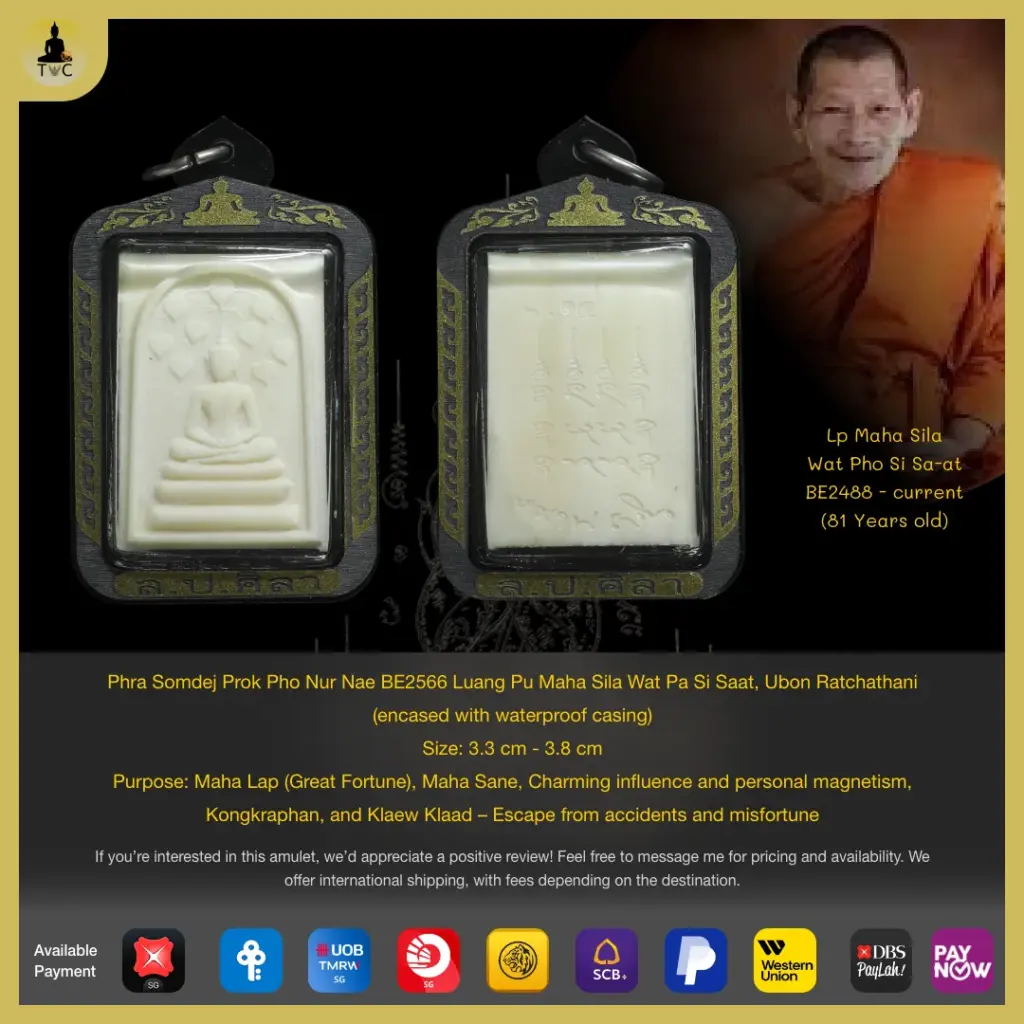
The Phra Somdej Prok Pho Nur Nae BE2566 Luang Pu Maha Sila (Lp Maha Sila) Wat Pa Si Saat, Ubon Ratchathani is a sacred amulet pressed in nuea nae — compressed herbal sacred powder — and personally authorised and consecrated by Luang Pu Maha Sila at Wat Pa Si Saat, Ubon Ratchathani in BE2566, the final year of his life at age 96.
The monk behind this piece — and why BE2566 matters
Luang Pu Maha Sila (หลวงปู่มหาศีลา คุตฺตจิตโต) was born in BE2470 and ordained in the Dhammayut forest lineage. He trained under Ajahn Singh and Ajahn Sao, two of the most respected masters in the northeast Thai forest tradition. His practice centred on sati (mindfulness), kanti (endurance), and a deliberately simple monastic life.
He passed away peacefully in BE2566, shortly after this batch was completed. That timing is what gives this edition its weight among collectors. This was not a routine temple release — it was specifically authorised by Luang Pu as a spiritual legacy edition, distributed to devotees who contributed toward kuti restoration, meditation hall upkeep, and Dhamma scholarships at Wat Pa Si Saat. Production was limited to a few thousand pieces.
Luang Pu’s direct personal involvement in the consecration — at 96, in his final months — is documented and cited consistently by collectors who follow his lineage across Thailand and Laos.
The nuea, the pim, and how it was made
The nuea (material/substance) here is nuea nae — a dry-compressed sacred powder blend pressed without adhesives under high compression. The result is a hard, matte, earthy-toned tablet that holds its form well and ages distinctively. For collectors familiar with the Thai Buddhist amulet tradition, nuea nae pieces from forest temples in Isaan carry a particular character: dense, unglazed, and measurably different in hand from resin or lacquered pieces.
The muan sarn (sacred powder blend) for this run was composed of:
- Powdered Bai Pho (Bodhi leaf ash) from trees planted by Luang Pu himself
- Sacred pollen from forest flowers used in monastic offerings
- Crushed Phra Kring and old Somdej amulets from Isaan masters
- Ash from candle wax and robes used in meditation
- Soil from holy sites in Laos and northeast Thailand
The pim (mould) follows the standard Phra Somdej rectangular form. The front shows the Buddha in the Prok Pho posture — seated in meditation beneath the Bodhi tree — with seven stylised Bodhi leaves fanned behind, referencing the seven-day storm the Buddha sheltered through. The reverse carries either the temple seal of Wat Pa Si Saat or Luang Pu’s personal yant (sacred inscription), depending on the individual piece.
The phutthaphisek and what to look for as a collector
The phutthaphisek (consecration ceremony) for this batch was held in early BE2566 and personally led by Luang Pu Maha Sila. It ran across nine days of meditation chanting in seclusion, with senior forest monks performing Buddha invocation chants and Akasakamma — silent transmissions during midnight meditation. The final ritual fell on Asalha Puja Day. After the ceremony, amulets were placed in the main shrine hall beneath the sacred Bodhi tree for additional empowerment.
Each piece in this edition was distributed with a temple box carrying a serialised hologram seal and printed certificate. Certification was also handled through regional Buddhist amulet verification bodies, specifically the Ubon collectors’ association. For authentication, collectors should check:
- The nuea nae texture — hard, dry, matte finish with an earthy tone; no resin sheen
- The Prok Pho pim detail — seven Bodhi leaves clearly defined behind the seated Buddha
- The reverse — temple seal or Luang Pu’s yant, consistent with documented reference pieces
- The temple box with serialised hologram seal and accompanying printed certificate
This piece comes encased in a waterproof casing, which is standard for TAC listings of this edition.
We at TAC acquired this piece as part of Luang Pu Maha Sila's BE2566 legacy edition — a limited run personally consecrated by the monk in the final year of his life, distributed only to temple donors at Wat Pa Si Saat. For collectors following the Dhammayut forest lineage of northeast Thailand, a directly consecrated final-edition piece from a master of this seniority — with a lineage back to Ajahn Singh and Ajahn Sao — is not something that comes back into the market often.
Attributes reflect Thai Buddhist devotional tradition and are not measurable claims.