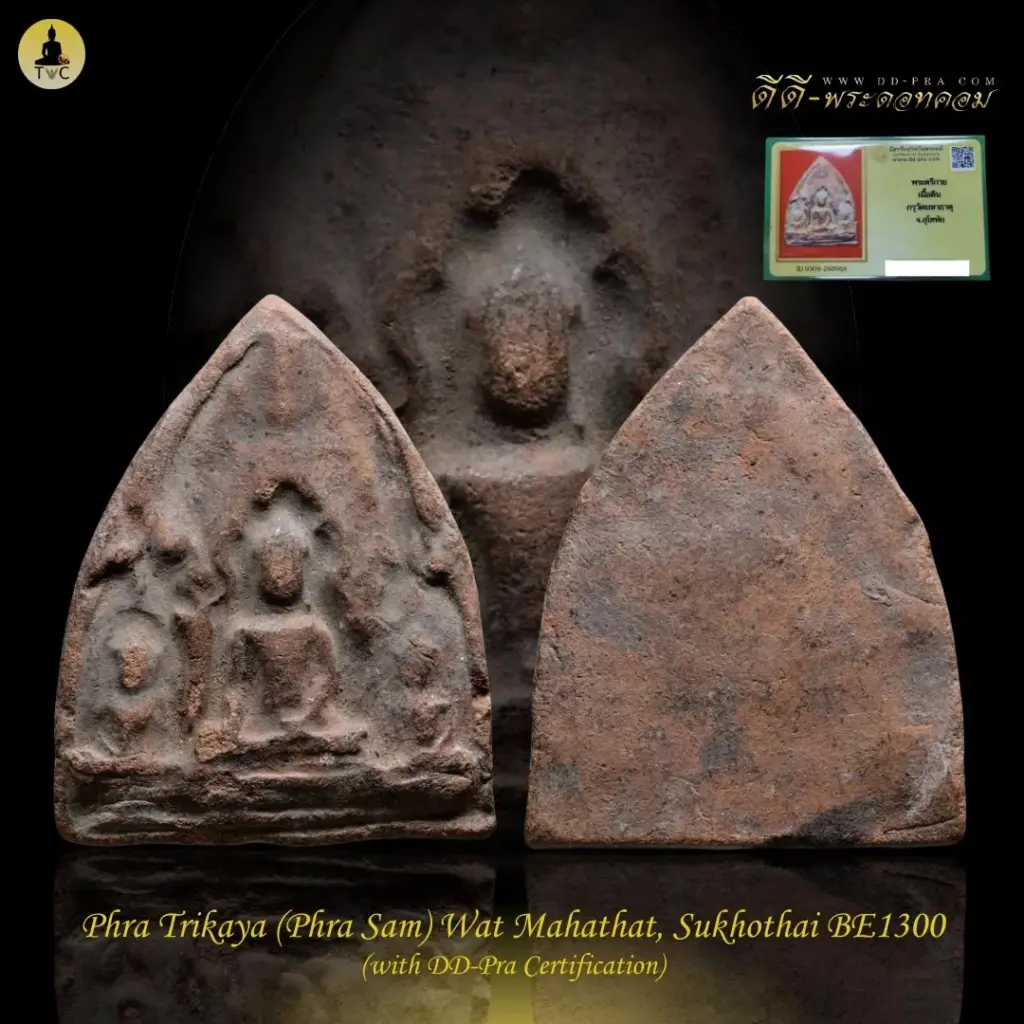
Phra Trikaya (Phra Sam) Nur DIn Wat Mahathat, Sukhothai BE1300
| Temple | Wat Mahathat |
| B.E. Year | 1300 |
| Material | DIn |
| SKU | TAC-0232 |
Authentic Phra Trikaya (Phra Sam) Nur Din Wat Mahathat, Sukhothai BE1300, an archaeological votive c. 757 CE. Museum-worthy, extremely rare. SGD 688.
What is the Phra Trikaya (Phra Sam) Nur Din Wat Mahathat, Sukhothai BE1300?
The Phra Trikaya (Phra Sam) Nur Din Wat Mahathat, Sukhothai BE1300 is an archaeological-period votive dated to approximately 757 CE, recovered from the sacred grounds of Wat Mahathat, Sukhothai. Pressed in nuea din (earthen clay material), it presents three seated Buddha figures expressing the Trikaya doctrine — among the earliest surviving examples of this iconography from the upper Chao Phraya basin.
A votive from the earliest layer of Wat Mahathat
Wat Mahathat, Sukhothai sits at the ritual centre of the old capital. Most collectors know it through the great royal monastery formalised in the 13th century, but the site carries evidence of devotional activity well before that. This piece dates to BE 1300 — roughly 757 CE — placing it in the formative Dvaravati-to-early-Sukhothai horizon, before standardised batch production or formal phutthaphisek (consecration ceremony) records existed.
Production at this period was small-scale by necessity. Local clay was hand-prepared, investment moulds were primitive, and output served merit-making within the temple precincts rather than organised distribution. That context is part of what makes intact examples so scarce. Comparable pieces from this horizon rarely appear on the open market — they sit in museum collections or long-term private holdings. The broader Thai Buddhist amulet tradition spans more than a millennium, but objects predating the Sukhothai royal era occupy a category of their own.
The pim, the nuea, and what the casting tells you
The pim (mould collectors authenticate against) shows three seated figures arranged beneath an arched field — the Phra Sam layout that gives the piece its common name. Relief is shallow, the rim is primitive, and the overall form has the quiet economy of line that early-period production carried. There is no later tooling, no recut detail. What you see is what came out of the original mould.
The nuea is din — earthen clay rather than bronze — and the surface now carries a stable green-brown patina with cuprite nodes, mineral accretions from long burial, and micro-pitting consistent with ancient casting gases. Investment-mould seam remnants are visible on the side profile. These physical markers are the primary authentication indicators for a piece of this age, since no formal certification body covers archaeological-period votives of this horizon.
- Intact contour lines with no evidence of modern tooling
- Stable, undisturbed patina — green-brown with cuprite nodes
- Mineral accretions and casting seam remnants consistent with long burial
- Micro-pitting on the reverse from ancient casting gases
- Shallow relief and primitive rim matching the known Phra Sam pim profile
Because no consecrating monk is recorded for a votive of this period, and formal phutthaphisek documentation post-dates the piece by centuries, assessment rests entirely on physical evidence. The original listing rates it as museum-worthy and extremely rare — a fair summary given how infrequently intact examples surface.
What serious collectors look for in this piece
Age alone does not make an early votive valuable to a collector. What matters is the combination: undisturbed patina, crisp enough ridge lines to read the pim clearly, a reverse field with no modern interference, and provenance that places the piece within a credible Thai temple context. This example, as documented, meets those conditions. [Curator: note observed condition and any provenance chain here before publishing.]
Assessed at SGD 688, this sits at an entry point that is unusually accessible for a piece rated museum-worthy. Early Dvaravati-horizon votives with intact nuea din and confirmed Wat Mahathat attribution do not appear at this price level regularly. Collectors who focus on pre-Ayutthaya material will recognise that immediately.
We at TAC consider this Phra Trikaya (Phra Sam) Nur Din Wat Mahathat, Sukhothai BE1300 one of the more unusual pieces we have handled — a pre-Sukhothai-royal votive with no named master and no certification body that covers it, which means the physical evidence has to do all the work, and from what we can see, it does. For a collector focused on early Thai Buddhist material rather than post-Ayutthaya niyom pieces, this is the kind of object that rarely comes available at this price point.
Attributes reflect Thai Buddhist devotional tradition and are not measurable claims.