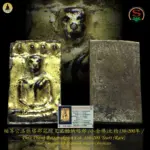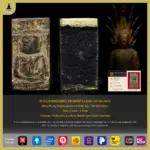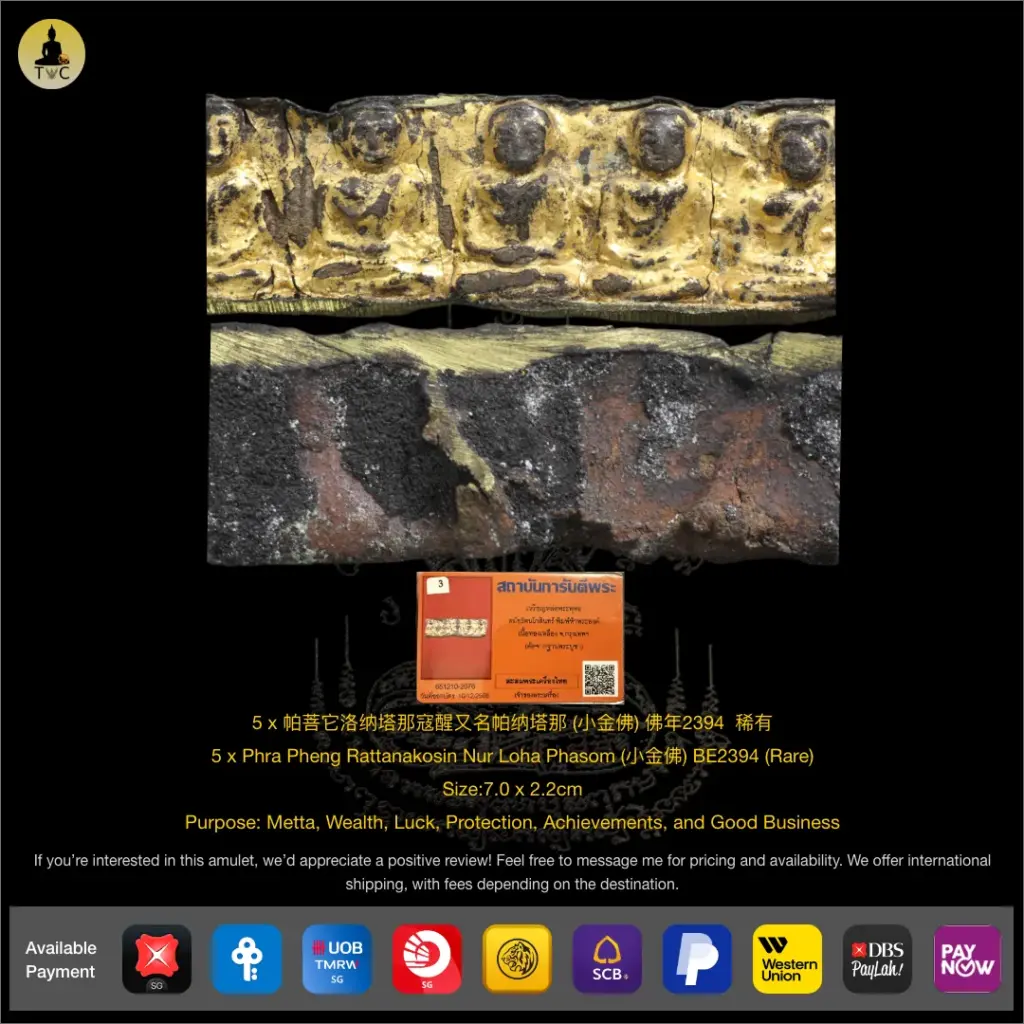
5 x Phra Pheng Rattanakosin Nur Loha Phasom (小金佛) BE2394 (Rare)
| B.E. Year | 2394 |
| Material | Nur Loha Phasom |
| SKU | TAC-0589 |
Authentic 5 x Phra Pheng Rattanakosin Nur Loha Phasom (小金佛) BE2394 (Rare), early Rattanakosin era. Five-piece mixed-metal alloy set. Certificate noted. SGD 338.
What is the 5 x Phra Pheng Rattanakosin Nur Loha Phasom (小金佛) BE2394 (Rare)?
The 5 x Phra Pheng Rattanakosin Nur Loha Phasom (小金佛) BE2394 (Rare) is a five-piece set of compact Buddha-form metal castings dated to BE 2394, pressed in nuea (material/substance) loha phasom — a mixed-metal alloy — and associated with the early Rattanakosin period. The temple and consecrating monk are not specified in the listing. The set carries a certificate and is priced at SGD 338.
Early Rattanakosin castings and why this set draws attention
BE 2394 sits deep in the early Rattanakosin era. Compact Buddha-form castings from that period are uncommon as intact sets — survivability over more than 130 years thins the field considerably. The collector nickname “小金佛” (Little Gold Buddha) refers to the warm, gold-like tone that loha phasom produces rather than any literal gold content.
What makes a five-piece set particularly interesting is consistency. All five pieces should show the same casting geometry, the same alloy behaviour, and the same aging character. If one piece in the set reads differently from the others — surface tone, edge sharpness, patina distribution — that inconsistency is worth investigating before you commit. For background on how collectors approach Thai Buddhist amulet tradition, the Wikipedia entry is a reasonable starting reference.
The listing labels these “Rare.” That is a reasonable collector-opinion claim given the stated age, but rarity should always sit alongside a caveat: issuer attribution (temple and monk) is not documented here, and era attribution alone is not the same as confirmed provenance. The “Rare” tag rewards verification, not assumption.
The nuea and what to look for when you examine these pieces
Nuea loha phasom — mixed metal alloy — was a common casting material for devotional Buddha images in the Rattanakosin period. The blend was chosen for casting stability and the warm, near-gold surface tone it produces. Exact alloy formula is not specified for this set, which is typical for pieces of this age.
Older loha phasom pieces age in a particular way: multi-tone oxidation rather than a single flat colour, micro-pitting on recessed surfaces, and a softness to high-relief detail that reflects period mold work rather than sharp modern tooling. These are the cues worth studying on this set. Avoid aggressive cleaning — honest patina is part of the documentation, and removing it reduces your ability to read the piece.
- Surface tonality: warm alloy should show layered oxidation, not a uniform machine-polished finish.
- Casting detail: period molds leave softness at fine points — face, robes, base edges — that differs from later reproduction work.
- Wear patterns: natural wear concentrates on high points and corners; artificial aging tends to distribute unevenly or too uniformly.
- Set consistency: all five pieces should match in proportion, face geometry, base shape, and alloy behaviour.
A certificate accompanies this set. Collectors treat certificates as supporting paperwork — useful for the record, but not a substitute for close visual study and, where possible, comparison against documented reference specimens from the same stated period.
What collectors associate this set with and how value is assessed
In Thai amulet tradition, Buddha-form castings are carried for metta (เมตตา — warm regard, likeability in dealings), maha larp (มหาลาภ — abundance and good fortune), and khumkhrong (คุ้มครอง — protective safeguarding). These are cultural attributions, framed by tradition and devotional practice rather than guaranteed outcomes. Traders and business owners in Singapore, Malaysia, and the broader Chinese-Thai collector community have long associated compact gold-tone Buddha pieces with smoother dealings and opportunity.
Value for a set like this depends on several factors: the credibility of the BE 2394 dating once verified through material study, the condition and completeness of all five pieces, and whether the certificate can be cross-referenced against a recognised authentication standard. If provenance can be supported — even partially — the age and format of a five-piece set from this era would place it above single-piece listings of comparable style. Condition variation within the set, or gaps in documentation, would pull in the other direction.
We at TAC are offering this five-piece Phra Pheng Rattanakosin Nur Loha Phasom (小金佛) set at SGD 338 — a mid-nineteenth century attribution in mixed-metal alloy that is uncommon to find as a complete matched lot rather than individual pieces. The age claim, if supported by close material study, is the main value argument here, and collectors who document this type carefully tend to hold it well.
Attributes reflect Thai Buddhist devotional tradition and are not measurable claims.