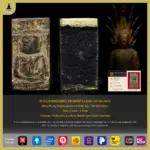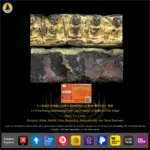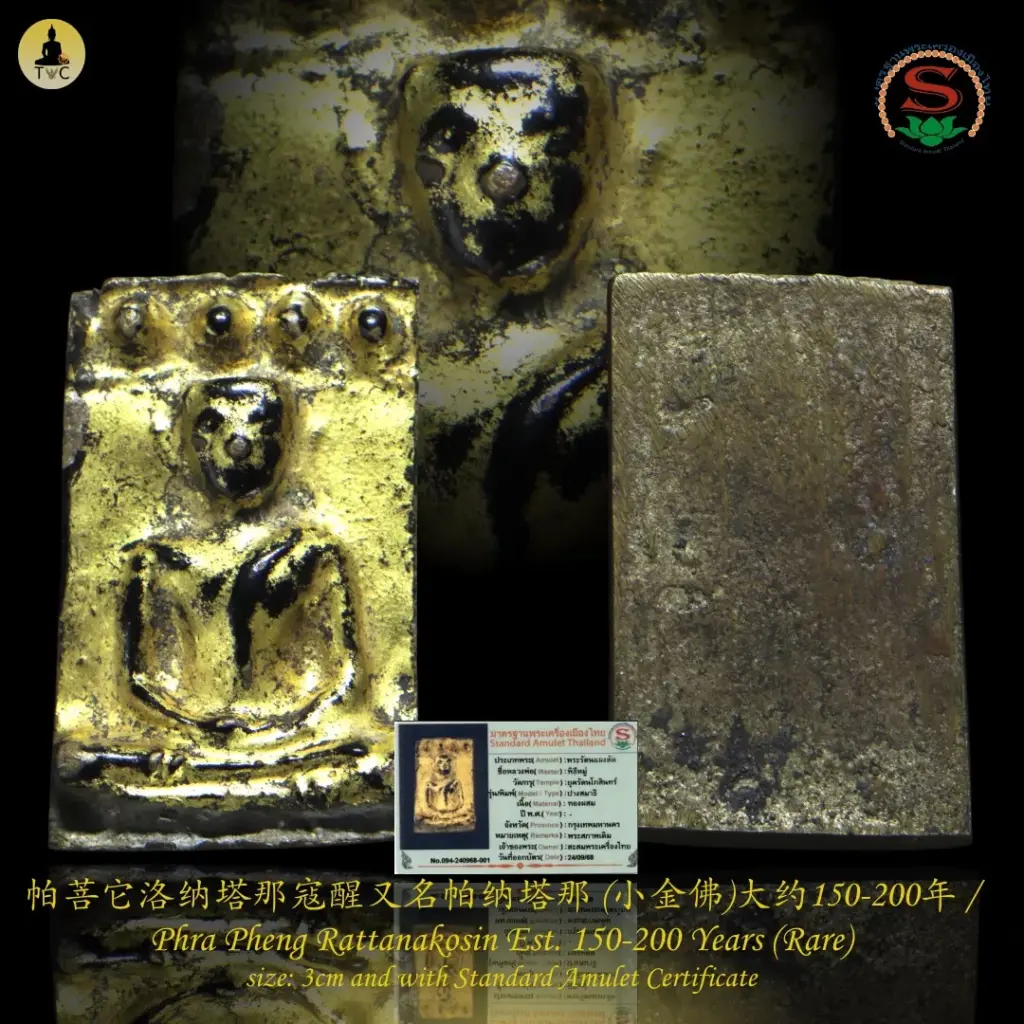
Phra Pheng Rattanakosin Est. 150-200 Years (Rare)
| SKU | TAC-0379 |
Authentic Phra Pheng Rattanakosin Est. 150-200 Years (Rare), the Little Gold Buddha, early Rattanakosin period circa 1825–1875.
What is the Phra Pheng Rattanakosin Est. 150-200 Years (Rare)?
The Phra Pheng Rattanakosin Est. 150-200 Years (Rare) — known in Chinese Buddhist circles as the Little Gold Buddha (小金佛) — is a sacred brass alloy metal amulet produced during the early Rattanakosin period, circa 1825–1875 CE. Cast from loha chanuan (sacred brass alloy) and finished with gold leaf and lacquer, it bridges Ayutthaya craft traditions with the emerging Bangkok aesthetic.
Early Rattanakosin metalwork and where this piece fits
When Rama I established Bangkok as the new capital in B.E. 2325 (1782 CE), royal temples and major provincial monasteries moved quickly to resume systematic amulet production. The early Chakri reigns — Rama II through Rama IV — saw temple workshops staffed by specialist bronze casters, known as chang thong, working under direct monastic supervision. What came out of those workshops was distinctive: compact metal Buddha images in the phra pheng (“small Buddha image”) format, portable enough for personal wear and protection.
This specimen sits squarely in that window, estimated at 150–200 years old. The metallurgical composition — a brass-copper alloy matrix incorporating consecrated powders, incense ash, and possible relic fragments — is consistent with documented temple productions from Bangkok and surrounding provinces during that period. Pieces from this era are getting genuinely hard to find intact. Two centuries of use, handling, and storage take a toll, and well-preserved examples with their surface treatments still legible are the minority.
The “Little Gold Buddha” designation is not purely poetic. Workshops applied thong kham (gold leaf) and a protective lacquer coating to enhance both durability and the characteristic golden luminosity. Over generations, the interaction between the brass alloy and its environment produces a natural patina — and that patina is one of the primary visual cues collectors rely on when assessing genuine antiquity. To understand the broader context of metal amulets within Thai Buddhist amulet tradition, the historical arc from Ayutthaya through Rattanakosin is worth knowing.
How the piece was made and consecrated
Production followed a two-stage process. First, the casting itself — using either lost-wax or sand-casting methods — conducted under monastic oversight, with mantras recited throughout to infuse the metal with spiritual intention. The alloy formulation was not purely functional; consecrated mineral compounds and blessed substances were integrated into the melt where ritual protocols allowed.
After casting came surface refinement: hand-finishing, gold leaf application, and the lacquer treatment that would eventually become the long rak pit thong (lacquer-and-gold-leaf finish) standard collectors recognise today. The reverse face carries yant (sacred inscriptions) — geometric configurations and mystical syllables applied during the phutthaphisek (consecration ceremony). These ceremonies could run across multiple days, with assemblies of senior monks chanting protective Pali suttas and senior meditation masters entering samadhi states specifically to channel accumulated merit into the amulets.
The seated-Buddha iconography — meditation posture, refined Rattanakosin aesthetic — reflects the deliberate break from late Ayutthaya conventions while retaining the underlying craft lineage. That continuity is part of what makes early Bangkok-period metalwork legible to trained eyes.
What collectors look for in this piece
Authenticated Rattanakosin-era metal amulets in good preservation are a specific sub-category that commands consistent attention from serious collectors across Thailand, Singapore, Malaysia, and Chinese Buddhist communities in Hong Kong and Taiwan. The draw is partly historical — these pieces predate the modern amulet market entirely — and partly material: loha chanuan from this period has a compositional character that later reproductions have not convincingly replicated.
When assessing a specimen like this, experienced collectors focus on:
- Natural patina depth and distribution consistent with 150–200 years of environmental exposure
- Metallurgical characteristics of the brass-copper alloy matrix matching documented early Rattanakosin compositions
- Casting quality and hand-finishing details under the surface treatment
- Yant configurations on the reverse consistent with early Bangkok temple workshop conventions
- Condition of any surviving gold leaf or lacquer treatment
Survival rate for intact examples from this era is low. Age, material degradation, and the simple attrition of two centuries account for significant losses. Specimens that have come through in excellent preservation — with authentication documentation supporting the provenance — represent the kind of opportunity that does not repeat regularly.
We at TAC source early Rattanakosin metalwork carefully, and this Phra Pheng Rattanakosin Est. 150-200 Years (Rare) — the Little Gold Buddha — is a genuinely uncommon find: a brass alloy amulet from the Rama II–IV era with authentication documentation supporting the 150–200 year age estimate. For collectors focused on early Bangkok-period sacred metalwork, intact specimens from this window are not easy to replace once they move.
Attributes reflect Thai Buddhist devotional tradition and are not measurable claims.