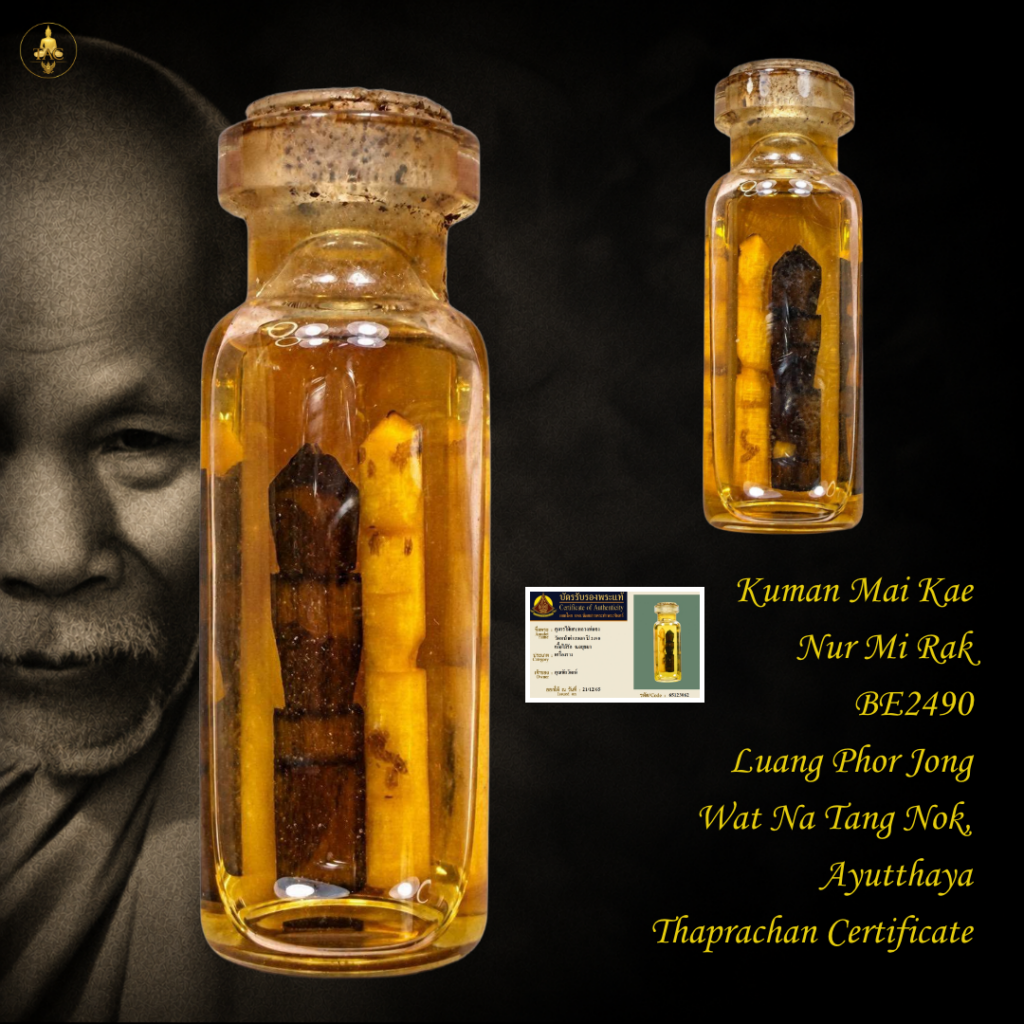
Kuman Mai Kae Rak Yom Nur Mi Rak E2490 Luang Phor Jong Wat Na Tang Nok, Ayutthaya
| Type | Kuman Mai Kae Rak Yom |
| Monk | Luang Phor Chong of Wat Natangnok, Ayutthaya |
| Temple | Wat Natangnok |
| B.E. Year | 2490 |
| Material | Nur Mi Rak |
| Condition | Good |
| Certificate | Thaprachan |
| SKU | TAC-KumanMaiKaeRakYom-LpJong-001 |
Authentic Kuman Mai Kae Rak Yom by Luang Phor Chong of Wat Natangnok, Ayutthaya. BE 2490, Nur Mi Rak wood, consecrated oil. Certified Thaprachan.
What is the Kuman Mai Kae Rak Yom by Luang Phor Chong of Wat Natangnok, Ayutthaya?
The Kuman Mai Kae Rak Yom Luang Phor Chong of Wat Natangnok, Ayutthaya is an authentic wood-carved Kuman-type amulet consecrated in BE 2490 at Wat Natangnok, Ayutthaya. Pressed from Nur Mi Rak — sacred wood from a naturally deceased tree, soaked in consecrated oil — and certified by Thaprachan, it is one of the more substantive pieces associated with Luang Phor Chong’s later abbacy.
Luang Phor Chong and what made his consecrations different
Luang Phor Chong of Wat Natangnok, Ayutthaya was regarded by his disciples as one of the most capable masters of amulet consecration in the Ayutthaya region. He accumulated deep knowledge of sacred magic throughout a long monastic life, and that expertise showed in both the range and the method of what he produced.
Beyond standard amulet batches, he was known for creating Kuman Thong child-spirit figures housed individually in bottles of consecrated oil — a rare practice that few masters attempted. The Kuman Mai Kae Rak Yom follows a related method: the oil immersion is central to preparing the Nur Mi Rak nuea (material/substance), concentrating its latent energy before carving and consecration. That shared logic between his bottled Kuman Thong and this wood-carved piece tells you something about how consistently he applied his ritual approach.
Collectors who have tracked his amulets note that merchants and traders were his most devoted followers, drawn by a tradition — passed down among keepers — that those who carried his pieces prospered in business and commerce.
Wat Natangnok, Ayutthaya and the Nur Mi Rak material
Wat Natangnok sits in Ayutthaya Province, a region whose position as an ancient royal capital gives its temples a depth of accumulated ritual knowledge that collectors across Southeast Asia and Greater China continue to value. The temple is directly associated with Luang Phor Chong’s legacy of Kuman and Rak Yom consecration, and the BE 2490 batch is considered one of the definitive outputs of his time there. For broader context on why provenance and temple lineage matter to authentication, the Thai Buddhist amulet tradition article on Wikipedia is a reasonable starting point.
Nur Mi Rak refers specifically to wood taken from a naturally deceased tree — not felled, but dead by natural process — which in Thai animist-Buddhist belief carries a particular spiritual receptivity. Luang Phor Chong’s method was to soak each carved piece individually in consecrated oil, a process that practitioners consider essential for activating the Kuman spirit within the wood. The result is an amulet that reads as genuinely antique in character: tactile, oil-darkened, and distinct from anything pressed or mass-produced.
Wood from this tradition is understood to be especially suitable for yant (sacred inscription) and oil consecration precisely because its cellular structure has already undergone natural transformation. Each piece from the BE 2490 batch reflects that belief in its preparation, not just its form.
What collectors look for and how this piece is certified
Thaprachan is one of Thailand’s most respected amulet authentication bodies, and its certification on the Kuman Mai Kae Rak Yom Luang Phor Chong of Wat Natangnok, Ayutthaya provides documented verification of provenance, material, and consecration origin. For buyers in Singapore, Malaysia, and across Greater China, that certificate is the first thing to confirm before any other assessment.
Beyond the certificate, there are specific physical markers collectors use to verify a piece from this batch:
- Oil-soaked Nur Mi Rak wood — the nuea should show consistent oil penetration, not surface coating; the wood grain and natural darkening are characteristic
- Carved form consistent with Luang Phor Chong’s Kuman style — the specific carved features associated with his hand are the primary pim (mould/form) reference for authentication
- Thaprachan certificate accompanying the piece — not a photocopy, and cross-referenced against the physical amulet
- Provenance documentation — ideally traceable to a known collector or dealer with a verifiable chain back to Wat Natangnok
Wood Kuman amulets of verified provenance from this period are increasingly scarce. Older batches from revered Ayutthayan masters have been absorbed into private collections over the decades, and the BE 2490 run from Wat Natangnok is no exception. Acquiring one now, with full certification intact, is considerably harder than it was even ten years ago.
We at TAC consider the Kuman Mai Kae Rak Yom Luang Phor Chong of Wat Natangnok, Ayutthaya to be a meaningful piece for any collector focused on Ayutthayan wood-carved amulets — the Nur Mi Rak nuea and the Thaprachan certification together make provenance verification straightforward, which matters at this age and scarcity level. The BE 2490 dating places this within Luang Phor Chong's later and most accomplished period, and surviving certified examples are genuinely harder to source than they were a decade ago.
Attributes reflect Thai Buddhist devotional tradition and are not measurable claims.