Takrut Tone Nur Thong Daeng BE2500-2517 Luang Phor Tob Wat Chon Daen, Phetchabun
| Monk | Luang Phor Tob |
| Temple | Wat Chon Daen |
| B.E. Year | 2500 |
| Material | Thong Daeng |
| SKU | TAC-0418 |
Authentic Takrut Tone Nur Thong Daeng BE2500-2517 Luang Phor Tob Wat Chon Daen, Phetchabun by Luang Phor Tob.
What is the Takrut Tone Nur Thong Daeng BE2500-2517 Luang Phor Tob Wat Chon Daen, Phetchabun by Luang Phor Tob?
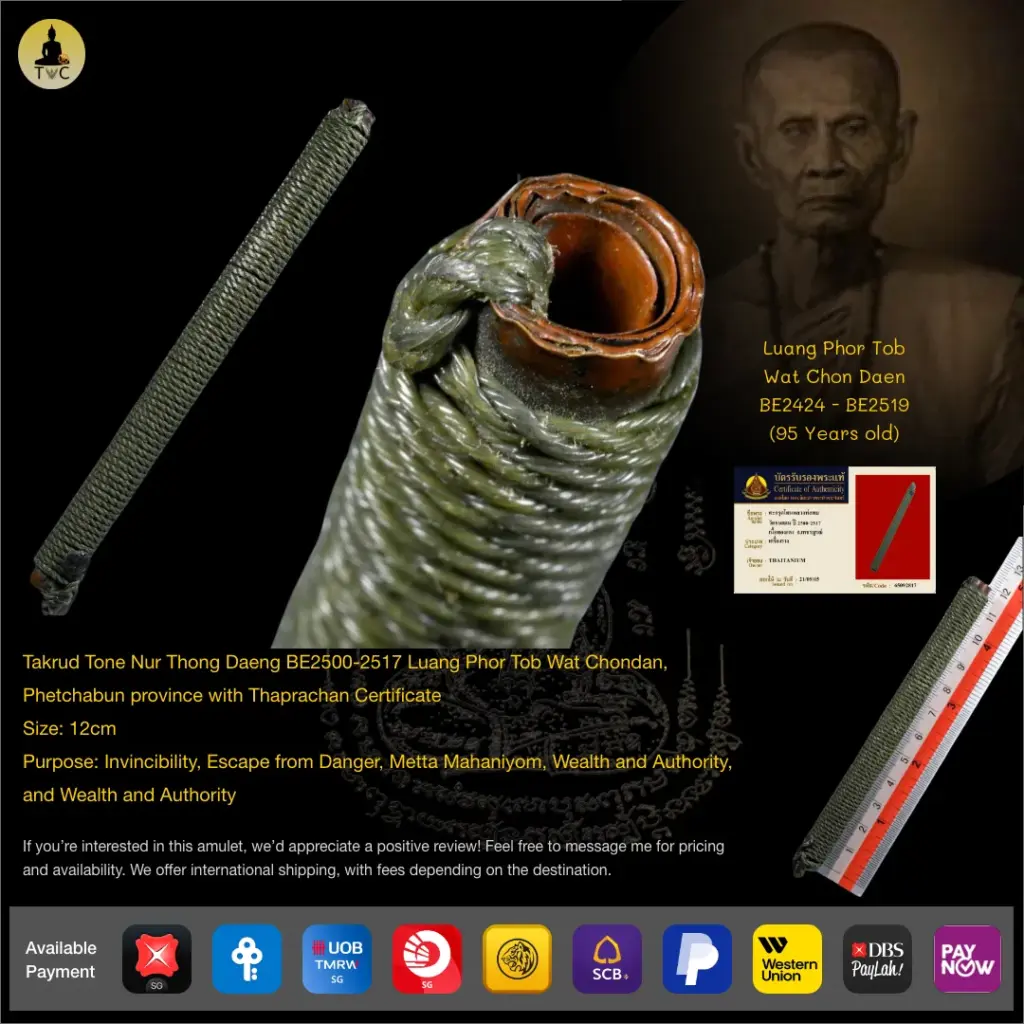
The Takrut Tone Nur Thong Daeng BE2500-2517 Luang Phor Tob Wat Chon Daen, Phetchabun is a single-scroll copper takrut (rolled metal scroll) attributed to Luang Phor Tob of Wat Chon Daen, Phetchabun, produced within the BE 2500–2517 period. Made from thong daeng (copper), it carries hand-etched yant (sacred inscriptions) and is accompanied by a Thaprachan certificate in this listing.
Luang Phor Tob and the Wat Chon Daen takrut tradition
Luang Phor Tob is consistently referenced by Thai collectors in connection with takrut and protective metalwork traditions. His name appears frequently in discussions of Phetchabun-province amulets, particularly for compact, purpose-driven formats rather than ornate pieces. The listing attributes this takrut to his tradition at Wat Chon Daen, a temple in Phetchabun that produced practical protective pieces during the mid-twentieth century.
The BE 2500–2517 window — roughly 1957 to 1974 — covers a period of active amulet production across many Thai temples. It was an era when takrut were commonly made for devotees engaged in travel, military service, and daily risk. The listing presents this year range as an attribution note. No specific named batch or dated consecration ceremony is specified, so collectors should treat the timeframe as a production period reference rather than a pinned event record.
Within the broader Thai Buddhist amulet tradition, the takrut format occupies a distinct place: it is compact, discreet, and built around the discipline of inscription rather than sculptural form. Monks known for their takrut work are judged by the precision and consistency of their yant, and by the care taken in the consecration of the metal itself.
Material and format — what the copper tells you
Thong daeng, or copper, is a preferred metal for takrut among serious collectors precisely because it is honest. It holds hand-engraved yant lines cleanly, and it ages in a way that is hard to convincingly fake at the micro level. Natural oxidation on a genuine piece tends to settle unevenly — deeper in the recesses of inscription lines, lighter on raised roll edges — in a pattern that develops over decades, not weeks.
The tone (โทน) format means this is a single principal scroll: one focused inscription set, rolled and sealed into a compact cylinder. Collectors generally read this format as directness of intention — no layering of multiple scrolls, no additional ornamentation. What you have is a clean object built around the yant itself.
When inspecting a piece like this, experienced collectors look at a specific set of cues:
- Patina coherence: natural darkening should appear uneven but consistent across edges, roll lines, and seal contact points — not uniformly brown or artificially polished.
- Engraving character: hand-etched yant lines show pressure variation — some strokes cut deeper, others lighter — which differs from mechanically stamped work.
- Seal age: the ends or seals of the scroll should match the age story of the body; older resin or wax typically shows hairline texture and a dull, matte sheen rather than a fresh shine.
- Roll tension: a naturally aged takrut has a roll profile that looks handled over time, not newly tightened or re-rolled.
This piece is accompanied by a Thaprachan certificate. A certificate strengthens confidence when the details align — photo match, serial reference, and issuer credibility — but it works alongside physical inspection, not as a substitute for it.
What collectors associate this piece with
In traditional Thai belief, takrut are carried for khum khrong (คุ้มครอง) — a protective presence, a sense of being covered in environments of risk or uncertainty. The tone format is particularly associated with focused, single-purpose intention rather than a general blessing object. Devotees approach the piece with respect and steady conduct; the object is never treated as a guarantee of outcome.
Collectors in the Singapore, Malaysia, and Hong Kong markets who focus on Phetchabun-province pieces often value this type for the combination of material integrity and documented attribution. The copper format, the single-scroll structure, and the Thaprachan certificate together make this a readable piece — one where the authentication story can be followed step by step.
We at TAC are offering this Takrut Tone Nur Thong Daeng BE2500-2517 Luang Phor Tob Wat Chon Daen, Phetchabun attributed to Luang Phor Tob of Wat Chon Daen — a copper single-scroll takrut from the BE 2500–2517 period, accompanied by a Thaprachan certificate. For collectors focused on Phetchabun-province material or Luang Phor Tob's takrut tradition, this is a readable, honestly documented piece where the authentication cues can be followed directly in hand.
Attributes reflect Thai Buddhist devotional tradition and are not measurable claims.