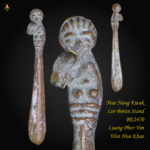
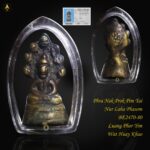
Phaya Tao Ruean Nur Loha Phasom BE2470 Luang Phor Im Wat Hua Khao
| Type | Phaya Tao Ruean |
| Monk | Luang Phor Yim (LP Im) Siriphunyo Wat Hua Khao |
| Temple | Wat Hua Khao |
| B.E. Year | 2470 |
| Material | Nur Loha Phasom |
| Condition | Fair |
| Certificate | Thaprachan |
| SKU | TAC-PhayaTaoRuean-LpIm-001 |
Authentic Phaya Tao Ruean by Luang Phor Yim (LP Im) Siriphunyo Wat Hua Khao, BE 2470. Nur Loha Phasom. Certified Thaprachan. Available from TAC, Singapore.
What is the Phaya Tao Ruean by Luang Phor Yim (LP Im) Siriphunyo Wat Hua Khao?
The Phaya Tao Ruean Luang Phor Yim (LP Im) Siriphunyo Wat Hua Khao is a sacred mixed-metal amulet cast in Nur Loha Phasom — a ritual alloy of multiple holy metals — and consecrated at Wat Hua Khao in BE 2470. Certified by Thaprachan, it is among the earlier documented examples of the Phaya Tao Ruean type and is now approaching a century in age.
Who was Luang Phor Yim (LP Im) Siriphunyo, and why does his name carry weight among collectors?
Luang Phor Yim (LP Im) Siriphunyo Wat Hua Khao was recognised during his lifetime for deep mastery of sacred metallurgy and Wicha — the esoteric knowledge tradition underpinning Thai amulet consecration. Devotees from across the region sought his blessings, and the reputation he built at Wat Hua Khao has held through multiple collector generations.
What matters to collectors today is not sentiment but traceable lineage. A piece tied to a monk with a documented temple base, a specific BE year, and third-party certification gives you something to authenticate against. The Thaprachan certificate attached to this piece does exactly that — it anchors provenance to a recognised grading body rather than a dealer’s word alone.
The nuea, the casting process, and what nearly a century does to Nur Loha Phasom
Nur Loha Phasom — the nuea (material/substance) of this piece — is a mixed-metal alloy assembled from several holy metals, each ritually purified before smelting. Monks recited sacred Kata (incantations) throughout the casting, binding the consecration into the physical structure rather than treating pluk sek (the consecration ceremony) as a separate step performed afterward.
By BE 2470, this approach to sacred metallurgy was already well established within the Thai Buddhist amulet tradition. The result is a casting with a distinctive density and surface character that experienced hands recognise quickly. Nearly a century of natural oxidation has produced a patina that cannot be convincingly replicated — it is one of the primary markers authentication specialists examine first.
The Phaya Tao Ruean form itself — the tortoise-house deity — carries specific iconographic details that collectors cross-reference against known reference pieces. Surface legibility matters: the sharper the remaining detail on an early-era Loha Phasom casting, the more precisely it can be compared against the pim (the mould collectors authenticate against).
What to examine and what the Thaprachan certificate tells you
Authenticating a BE 2470 piece requires looking at several things together rather than any single feature in isolation. The Thaprachan certificate — issued by one of Thailand’s most respected amulet grading committees — provides an independent assessment that serious collectors treat as a floor, not a ceiling, for their own examination.
- Patina consistency — natural oxidation on genuine Nur Loha Phasom develops unevenly across surfaces and recesses; artificial ageing tends to sit flat.
- Surface detail legibility — early-era castings show wear patterns consistent with age and handling, not mechanical abrasion.
- Metal weight and density — the alloy composition gives authentic pieces a specific heft that experienced collectors recognise by hand.
- Thaprachan documentation — confirm the certificate matches the piece physically; reference numbers and descriptions should align.
Pieces approaching 100 years old in verified condition are genuinely scarce. The surviving pool of authenticated BE 2470 examples from Wat Hua Khao is small, which is why provenance documentation carries as much weight as physical condition at this age.
A BE 2470 piece by Luang Phor Im of Wat Hua Khao represents genuinely early-era Thai amulet craftsmanship — at TAC, we consider this one of the more significant monk-and-temple combinations a serious collector can encounter, given how rarely authenticated examples from this period reach the market. The Nur Loha Phasom (mixed sacred metal) material places this squarely within a consecration tradition where the alloy itself was treated as part of the ritual, not merely the substrate. The accompanying Thaprachan certificate provides the authentication provenance that underpins confident acquisition for any collector building a historically grounded collection.
Attributes reflect Thai Buddhist devotional tradition and are not measurable claims.